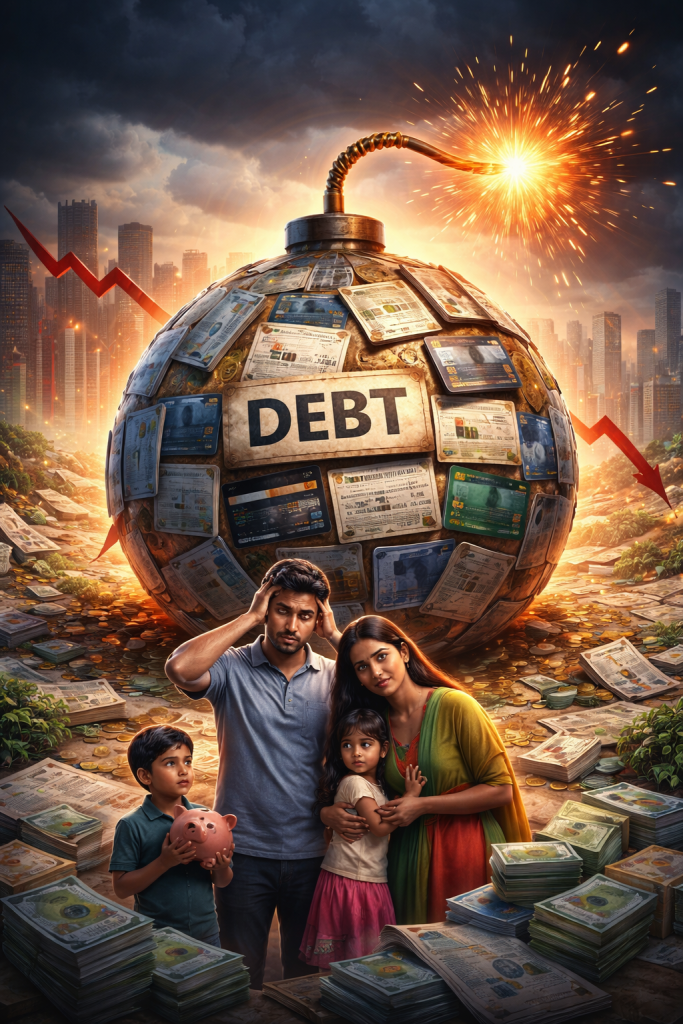
Household debt has always been the silent companion of economic growth—rarely celebrated, often ignored, and only fully understood when it becomes unmanageable. From the post-war consumption boom in the United States to the housing-led crises of the late 2000s, history shows that rising household leverage tends to follow optimism, liquidity, and easy credit. Today, as global debt levels remain elevated and household borrowing patterns evolve, the question is not whether debt is rising—but whether its composition, purpose, and sustainability are quietly shifting the foundations of economic stability.
From Productive Credit to Consumption Dependence
A structural shift is underway. Traditionally, household debt was linked to asset creation—homes, education, or small business investments. However, recent trends, particularly in emerging economies like India, indicate a growing tilt toward consumption-led borrowing. With nearly half of household loans now directed toward consumption rather than asset creation, the quality of debt is changing. This matters because consumption debt does not generate future income streams to service itself, making households more vulnerable to income shocks, inflation, or interest rate cycles. The expansion of digital lending, fintech-driven credit access, and unsecured personal loans has accelerated this transformation, creating a credit ecosystem that is fast, frictionless—and potentially fragile.
India’s Paradox: Low Aggregate Risk, High Micro Vulnerability
At a macro level, India appears relatively safe. Household debt at around 42–43% of GDP is significantly lower than advanced economies like the United States or even China. This provides a sense of comfort and policy space. However, this aggregate stability masks deeper micro-level vulnerabilities. The pace of debt accumulation has outstripped asset growth in recent years, and the burden is increasingly concentrated among lower- and middle-income households. These segments are more sensitive to employment volatility, medical shocks, and inflationary pressures. In effect, while the system may look stable from the top, stress is building at the bottom—where resilience is weakest.
Global Context: Stabilization or Illusion?
Globally, there are signs of stabilization in private debt ratios, especially after aggressive deleveraging in economies like the United States and China. But this stability may be deceptive. It is partly the result of tighter monetary conditions suppressing borrowing rather than a fundamental correction in balance sheets. High global debt—hovering above 235% of GDP—combined with elevated interest rates creates a precarious equilibrium. If rates remain high or growth slows, the cost of servicing even “stable” debt could rise sharply, turning a manageable situation into systemic stress. The lesson from past crises is clear: debt problems rarely emerge when ratios are rising—they surface when conditions tighten.
The Interest Rate Trap and Financial Fragility
One of the most critical risks lies in the interaction between household debt and interest rates. As central banks maintain tighter monetary policies to control inflation, borrowing costs remain elevated. For households already stretched by consumption loans, this translates into higher EMIs and reduced disposable income. The result is a compression of consumption demand—the very engine that debt was meant to support. This creates a feedback loop: weaker consumption slows economic growth, which in turn affects income stability, further increasing default risks. In economies with rising unsecured lending, this loop can amplify quickly, putting pressure on both financial institutions and broader economic sentiment.
Lessons from History: Crises Are About Structure, Not Size
The global financial crisis of 2008 was not triggered merely by high debt levels, but by where the debt was concentrated and how it was structured. Subprime mortgages, weak underwriting standards, and excessive financial engineering turned a localized problem into a global meltdown. The current situation is different—but not entirely disconnected. Today’s risks lie in unsecured retail lending, algorithm-driven credit scoring, and the rapid expansion of informal digital credit channels. These systems may lack the buffers and regulatory oversight needed to withstand shocks. The danger is not immediate collapse, but the gradual erosion of financial resilience.
From Time Bomb to Slow-Burning Risk
Are we heading toward a “time bomb”? Not in the traditional sense of an imminent explosion. Instead, the risk resembles a slow-burning structural imbalance. If economic growth remains strong, employment stable, and inflation controlled, rising household debt can be absorbed. But if multiple stress factors converge—geopolitical tensions, job market disruptions, or prolonged high interest rates—the vulnerabilities could surface rapidly. The real concern is not the level of debt, but the quality of financial intermediation and the resilience of households.
The Policy Imperative: Managing the Invisible Risk
The way forward lies in proactive calibration rather than reactive correction. Regulatory measures such as higher risk weights on unsecured loans, stricter lending norms, and enhanced credit monitoring are steps in the right direction. However, deeper structural interventions are needed—financial literacy, income stability through employment generation, and a shift toward productive credit. Policymakers must also recognize that digital finance, while expanding access, can accelerate risk transmission if not carefully governed.
Growth Engine or Hidden Constraint?
Household debt sits at the intersection of growth and vulnerability. It fuels consumption, drives demand, and supports economic expansion—but only up to a point. Beyond that, it becomes a constraint, limiting future spending and amplifying shocks. The current trajectory suggests that we are not yet at a breaking point, but we are certainly moving toward a more complex and fragile equilibrium. The challenge for economies like India is to ensure that credit remains a tool for empowerment, not a pathway to silent distress.
#HouseholdDebt #ConsumptionEconomy #FinancialStability #UnsecuredLoans #InterestRates #EconomicRisk #CreditExpansion #MSMEImpact #DebtTrap #FutureEconomy
 "Connecting communities, empowering nations: Unifying the Regional and Global Economy ."
Leave a comment