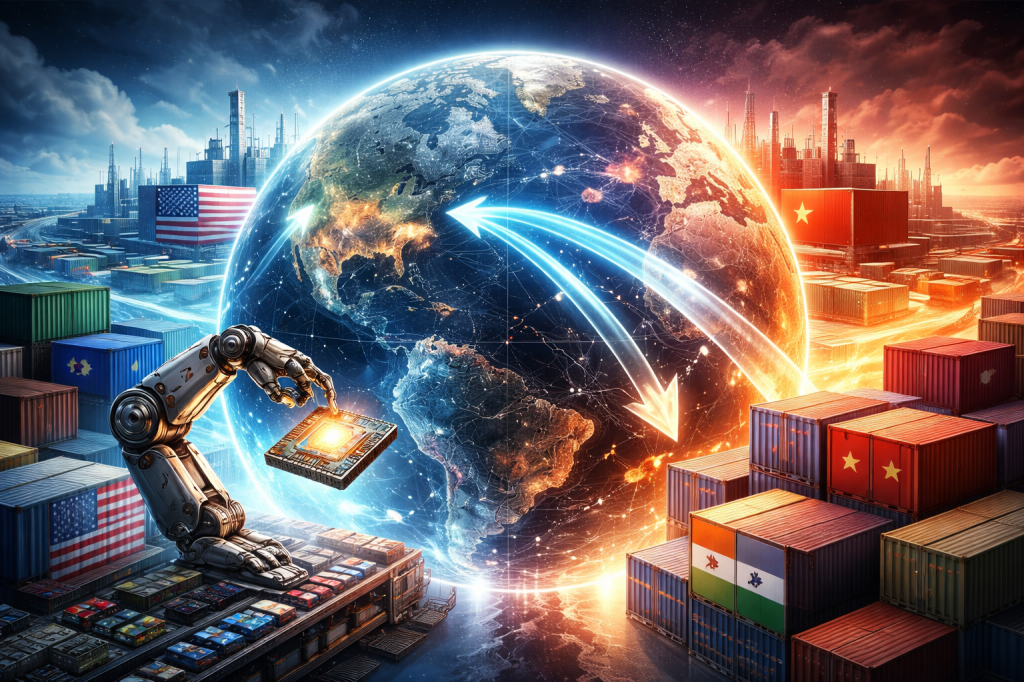
The global economy is quietly undergoing one of its most consequential transformations since the era of hyper-globalization began in the late 20th century. The very model that enabled emerging economies—particularly countries like China, Vietnam, Bangladesh, and India—to integrate into global value chains is now being re-evaluated by developed economies. The resurgence of reshoring, nearshoring, and friend-shoring strategies is not merely a cyclical adjustment; it is a structural shift driven by geopolitics, technology, and strategic autonomy. While this transition is often framed as a resilience-building exercise for developed nations, its deeper implication is the gradual contraction of export opportunities for developing economies that have historically depended on external demand as a growth engine.
From Efficiency to Resilience: The Collapse of the Old Trade Logic
For decades, global trade was governed by the principle of cost efficiency—production moved to wherever labor was cheapest and regulations were most flexible. This led to the rise of export-led growth models across Asia. However, disruptions such as the COVID-19 pandemic, supply chain bottlenecks, geopolitical tensions, and energy crises have exposed the vulnerabilities of over-extended supply chains. Developed economies, particularly the United States and European Union, are now prioritizing resilience over efficiency, incentivizing domestic production in sectors such as semiconductors, pharmaceuticals, critical minerals, and clean technologies.
Policies such as industrial subsidies, localization mandates, and strategic tariffs are redefining the rules of global trade. The shift is evident in large-scale investments under initiatives like domestic manufacturing incentives and supply chain security frameworks. This signals a departure from the WTO-era liberalization ethos toward a more state-driven industrial policy regime.
Technology as a Catalyst: Automation Redefining Comparative Advantage
One of the most underappreciated drivers of reshoring is the rapid advancement of automation and artificial intelligence. As robotics, additive manufacturing, and AI-driven production systems reduce dependence on low-cost labor, the traditional comparative advantage of developing economies is eroding. Developed economies can now produce domestically at competitive costs while maintaining higher standards of quality, traceability, and environmental compliance.
This technological shift fundamentally alters the global production equation. It reduces the incentive to offshore manufacturing and simultaneously raises the entry barriers for developing countries attempting to move up the value chain. The question is no longer about where labor is cheapest, but about where production is smartest, fastest, and most secure.
The New Geography of Trade: Fragmentation over Integration
Global trade is increasingly being reorganized along geopolitical lines. The emergence of “trusted networks” and regional trade blocs is creating a fragmented trade architecture. Instead of a single, integrated global market, we are witnessing the formation of parallel supply chains aligned with political alliances. This has significant implications for export-dependent economies that are not part of these strategic networks.
For instance, preferential trade agreements and regional partnerships are increasingly embedding rules of origin and compliance standards that favor domestic or allied production. Countries outside these frameworks risk being marginalized, not because of inefficiency, but due to geopolitical exclusion.
Implications for Developing Economies: The Export Model Under Stress
The reshoring trend directly challenges the sustainability of export-led growth strategies. Sectors such as textiles, electronics assembly, and low-end manufacturing—traditionally the backbone of employment generation—are particularly vulnerable. As developed economies internalize production, demand for imports in these categories may stagnate or decline.
For countries like India, this presents a dual challenge. On one hand, there is an opportunity to attract relocated supply chains through competitive policies and infrastructure development. On the other hand, the shrinking global demand space intensifies competition among developing economies themselves, leading to a race to the bottom in terms of incentives, labor costs, and regulatory concessions.
A Historical Parallel: Echoes of Protectionism with a Modern Twist
Historically, periods of economic uncertainty have often led to protectionist tendencies. However, the current phase differs in its sophistication. Unlike the overt tariff wars of the past, modern protectionism is embedded within regulatory frameworks, environmental standards, and digital compliance systems. Mechanisms such as carbon border adjustments and sustainability-linked trade policies act as non-tariff barriers, subtly restricting market access for developing economies.
This creates a paradox: while global discourse continues to emphasize free trade and cooperation, the operational reality is increasingly characterized by selective openness and strategic closure.
The Strategic Response: From Export Dependence to Domestic Value Creation
In this evolving landscape, developing economies must rethink their growth strategies. The focus needs to shift from pure export orientation to domestic value creation, regional integration, and technological upgrading. This involves strengthening internal demand, investing in skill development, and building resilient industrial ecosystems.
For India, the pathway lies in leveraging its large domestic market, fostering innovation-driven manufacturing, and integrating MSMEs into higher-value segments of global supply chains. Cluster-based development, digital transformation, and sustainability compliance will be critical in maintaining competitiveness.
The Future Outlook: A Narrower but More Complex Opportunity Space
The future of global trade will not be defined by volume expansion but by value concentration and strategic positioning. Export opportunities will not disappear entirely, but they will become more selective, compliance-intensive, and technology-driven. Countries that can align with emerging standards—whether in digital governance, environmental sustainability, or supply chain transparency—will continue to find space in the global market.
However, for those that remain locked in low-value, labor-intensive production models, the window of opportunity is rapidly closing. The reshoring trend is not just a shift in geography; it is a redefinition of the very logic of globalization.
A Transition Demanding Strategic Clarity
Reshoring is not a temporary disruption—it is a signal of a deeper transformation in the global economic order. For developing economies, the challenge is not merely to adapt but to anticipate and reposition themselves within this new paradigm. The era of passive integration into global value chains is over; what lies ahead is a phase of active strategic alignment, domestic capability building, and intelligent globalization.
#Reshoring
#GlobalTradeShift
#ExportChallenges
#IndustrialPolicy
#SupplyChainResilience
#AutomationEconomics
#Geoeconomics
#TradeFragmentation
#MSMECompetitiveness
#FutureOfGlobalization
 "Connecting communities, empowering nations: Unifying the Regional and Global Economy ."
Leave a comment