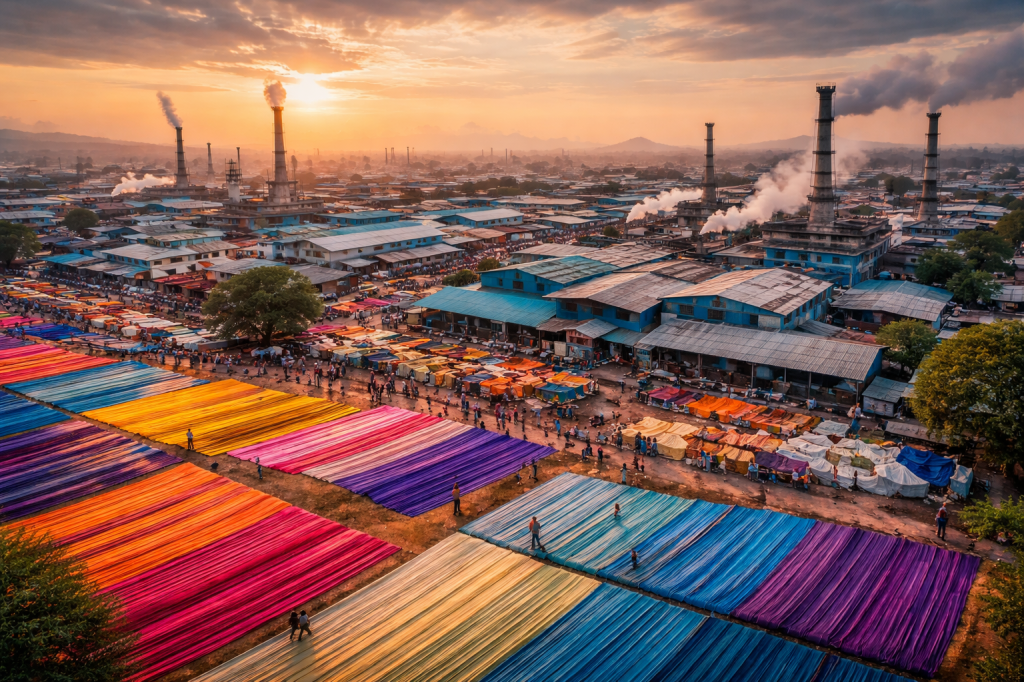
The Historical Strength: From Decentralized Excellence to Fragmented Survival
India’s textile clusters—from Tiruppur and Surat to Panipat and Bhilwara—were never built as isolated production hubs; they evolved as deeply interlinked socio-economic ecosystems. Historically, their strength lay in decentralized specialization: spinning in one pocket, weaving in another, dyeing elsewhere, and trading through dense networks of intermediaries. This fragmentation was not a weakness in the past—it was India’s version of flexible manufacturing long before the term became fashionable. Low capital intensity, abundant labor, and strong community-based trust systems allowed these clusters to outperform many centralized global factories for decades.
However, what was once an advantage is now turning into a structural liability. The same fragmentation that enabled flexibility has now resulted in inefficiency, lack of scale, inconsistent quality, and weak compliance systems. Global buyers today do not merely purchase textiles; they purchase traceability, reliability, and compliance. India’s historical model is struggling to adapt to this new definition of competitiveness.
Upstream Ecosystem: Cotton, Man-Made Fibres, and the Structural Imbalance
A critical fault line lies in the upstream ecosystem. India remains heavily cotton-centric, even as global demand shifts decisively toward man-made fibres (MMF), which now dominate over 65% of global textile consumption. Indian clusters are structurally misaligned with this demand pattern. While countries like China and Vietnam have aggressively invested in MMF-based integrated value chains, India continues to operate with a legacy bias toward cotton.
Further, raw material volatility—especially in cotton prices—creates instability in cost structures. Inconsistent quality, fragmented ginning processes, and limited technological modernization in upstream segments reduce India’s ability to deliver standardized inputs at scale. This is a serious disadvantage when competing with vertically integrated ecosystems in East Asia.
In addition, sustainability pressures are beginning at the farm level itself. Water-intensive cotton cultivation, excessive chemical usage, and lack of certified sustainable sourcing mechanisms are increasingly becoming red flags for global buyers. The upstream ecosystem is no longer just about cost—it is about credibility.
Midstream Bottlenecks: Processing, Dyeing, and the Compliance Crisis
The midstream—especially dyeing and processing—is perhaps the weakest link in India’s textile clusters. This segment is highly fragmented, often operating in informal or semi-regulated environments. Environmental compliance, effluent treatment, and chemical management remain inconsistent across clusters.
Global brands are now enforcing stringent environmental and social governance (ESG) norms. Zero Liquid Discharge (ZLD), chemical traceability, and carbon footprint disclosures are becoming non-negotiable. Many Indian clusters, particularly smaller units, simply do not have the financial or technological capacity to meet these requirements.
This creates a paradox: while India remains cost-competitive in theory, in practice it is being excluded from high-value global supply chains due to compliance risks. In contrast, countries like Vietnam and Bangladesh have strategically upgraded their processing infrastructure with centralized, compliant facilities, often supported by state-backed industrial parks.
Downstream Realities: Branding Deficit and Value Capture Failure
India’s greatest weakness lies downstream. Despite being one of the largest producers of textiles and garments, India captures disproportionately low value in the global supply chain. The reason is simple: India produces, but does not brand.
Most clusters operate as contract manufacturers, dependent on global buyers who dictate prices, standards, and timelines. There is minimal presence of Indian brands in premium global markets. Even in domestic markets, the shift toward organized retail and fast fashion is being captured by a mix of global players and a few large Indian firms, leaving cluster-based producers marginalized.
E-commerce and digital platforms were expected to democratize market access, but the reality is more complex. Without investments in design, branding, logistics, and customer engagement, cluster-based enterprises struggle to compete even in digital marketplaces.
Global Resistance: Trade Barriers, Geopolitics, and Supply Chain Reconfiguration
The global trade environment is becoming increasingly hostile and fragmented. Tariff barriers, non-tariff measures, and regulatory standards are being used strategically by developed economies. Mechanisms like carbon border taxes and sustainability-linked import restrictions are likely to disproportionately impact countries like India.
At the same time, global supply chains are being reconfigured under the “China+1” strategy. While this presents an opportunity, India has not fully capitalized on it. Countries like Vietnam and Bangladesh have moved faster in creating plug-and-play ecosystems, offering policy stability, faster clearances, and integrated infrastructure.
India’s textile clusters, by contrast, are still navigating issues like power costs, logistics inefficiencies, regulatory complexity, and policy unpredictability. The global market is not waiting—it is shifting toward ecosystems that offer speed, scale, and certainty.
Sustainability Shock: From Cost Advantage to Compliance Burden
Perhaps the most transformative shift is the rise of sustainability as a core competitive parameter. Textile production is among the most resource-intensive industries globally, and increasing scrutiny on water usage, emissions, and waste is reshaping the industry.
For Indian clusters, sustainability is not just a technological challenge—it is a structural one. Small-scale units lack access to finance for green upgrades. Collective infrastructure like common effluent treatment plants is often inadequate or poorly managed. Certification processes are expensive and complex.
What is emerging is a “compliance divide” within the industry. Larger, integrated players are moving toward sustainable practices and accessing premium markets, while smaller cluster-based units risk being pushed into low-value, low-margin segments or even informal markets.
The Brutal Reality: Competitiveness Is No Longer About Cost
For decades, India’s textile competitiveness was built on low costs—cheap labor, low capital intensity, and flexible production. That era is ending. Competitiveness today is defined by a combination of scale, speed, sustainability, and system integration.
Indian textile clusters are currently caught in a transition they are not fully prepared for. They are too large to be ignored, but too fragmented to be globally dominant. Without structural transformation, they risk becoming residual players in a rapidly evolving global industry.
The Future: Reinvention or Gradual Irrelevance
The future of India’s textile clusters will depend on their ability to reinvent themselves across the value chain. This includes shifting toward MMF-based production, investing in sustainable processing infrastructure, building collective compliance systems, and moving up the value chain through design and branding.
Equally important is the role of policy. Cluster-level interventions must move beyond traditional support mechanisms toward creating integrated, technology-enabled ecosystems. This requires coordinated action across ministries, industry bodies, and financial institutions.
However, the most critical change must come from within the clusters themselves. The era of operating in silos is over. Survival will depend on collaboration, formalization, and a willingness to adopt new business models.
A Future That Is Conditional, Not Guaranteed
Do India’s textile clusters have a competitive future? The honest answer is: only if they transform—rapidly and fundamentally.
The global textile industry is not declining; it is evolving. The question is whether India’s clusters can evolve with it. If they fail to address structural inefficiencies, sustainability challenges, and value capture gaps, they risk being left behind.
But if they can leverage their deep-rooted capabilities, adapt to new realities, and integrate into modern global value chains, they still have the potential to remain relevant—even competitive.
The window of opportunity, however, is narrowing. #TextileClusters #GlobalCompetitiveness #SupplyChainShift #SustainabilityCrisis #MMFTransition #ValueChainIntegration #ESGCompliance #ClusterTransformation #TradeBarriers #IndustrialPolicy
 "Connecting communities, empowering nations: Unifying the Regional and Global Economy ."
Leave a comment