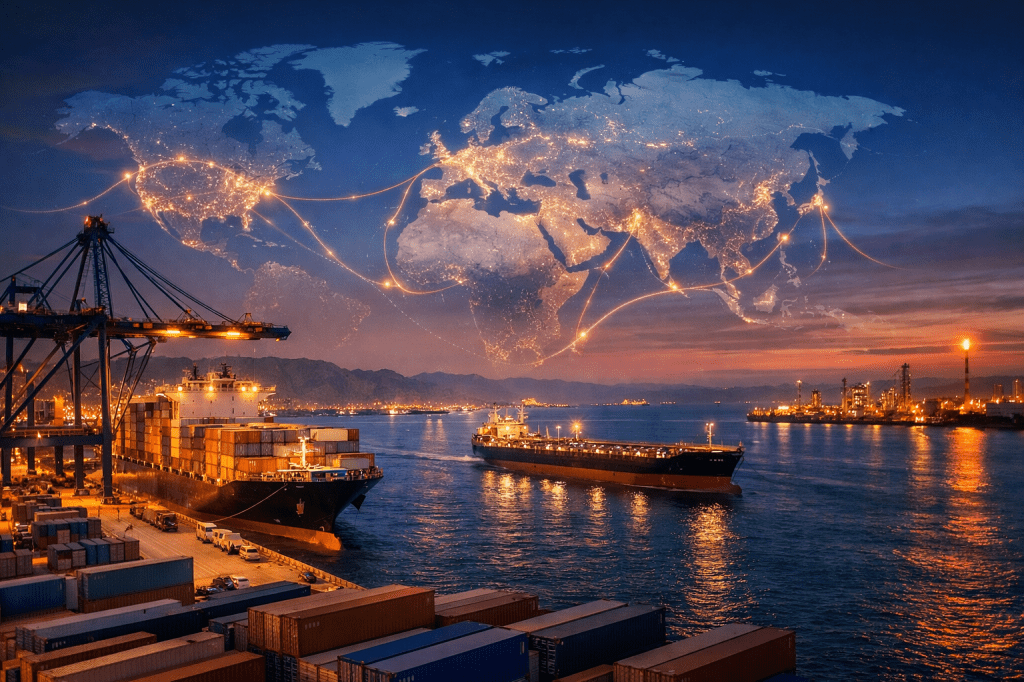
A Fragile Global Supply System
Modern global supply chains were built on the assumption of stability—predictable sea routes, reliable energy supplies, and relatively open trade systems. Over the last three decades, globalization allowed companies to fragment production across continents, sourcing raw materials in one country, processing them in another, and assembling final products elsewhere. However, geopolitical tensions and conflicts increasingly challenge this model. The recent crisis in the Middle East has once again exposed the vulnerability of the world’s logistical arteries. A significant portion of global oil shipments and container trade moves through critical chokepoints such as the Strait of Hormuz and the Red Sea corridor linking the Suez Canal with Asian and European markets. When these routes become unstable, shipping costs rise, delivery times increase, and supply chains across the world begin to strain.
Historical Perspective: From Oil Shocks to Logistics Wars
The current disruption echoes earlier crises in global economic history. The oil shocks of the 1970s demonstrated how political instability in the Middle East could ripple across global economies through energy markets. Later, globalization attempted to reduce such vulnerabilities by creating diversified supply chains. Yet the pandemic, the Russia–Ukraine war, and now Middle East tensions have revealed that the new vulnerability lies not only in oil but also in logistics networks themselves. Shipping lanes, ports, digital logistics systems, and supply chain financing mechanisms have become strategic assets. In this sense, the world is entering an era where supply chains are increasingly shaped by geopolitics rather than purely by efficiency.
Why the Middle East Matters to Global Trade
The Middle East sits at the crossroads of energy flows and maritime trade. Nearly one-third of the world’s seaborne oil passes through the Strait of Hormuz, while the Red Sea and the Suez Canal together carry a substantial share of container trade between Asia and Europe. Any disruption in this region forces shipping companies to take longer alternative routes around Africa, significantly increasing transport time and costs. Higher freight costs feed directly into inflation, affecting industries ranging from electronics and automobiles to food and fertilizers. For emerging economies like India, which depend heavily on imported energy and globally integrated supply chains, such disruptions create a complex economic challenge.
India’s Exposure to Supply Chain Disruptions
India’s economy is deeply connected to maritime trade. Over 90 percent of India’s trade by volume moves through sea routes. Energy imports—particularly crude oil and liquefied natural gas—are heavily sourced from the Gulf region. At the same time, many Indian manufacturing sectors rely on intermediate inputs imported from global supply chains. When shipping costs rise or logistics become uncertain, industries such as pharmaceuticals, chemicals, electronics, and automotive components face delays and higher production costs. Export competitiveness can also suffer as Indian products become relatively more expensive in global markets.
Supply Chain Diversification: The Strategic Imperative
One of the most important lessons from recent global crises is the need for diversified supply chains. For India, this means reducing excessive dependence on single sources of raw materials, components, or transport routes. Companies and policymakers are increasingly discussing the concept of “China plus one,” where production networks expand into multiple countries to reduce risk. India itself is attempting to position its manufacturing sector as an alternative node in global value chains. However, diversification must extend beyond manufacturing to logistics infrastructure, shipping partnerships, and energy sourcing.
Building Strategic Energy Security
Energy security remains central to India’s economic resilience. Middle East instability can lead to volatile oil prices and supply uncertainties. India has already begun expanding its strategic petroleum reserves to cushion temporary disruptions. In the long term, diversifying energy imports toward regions such as Africa, the United States, and Latin America can reduce dependency on any single region. Simultaneously, accelerating investments in renewable energy, green hydrogen, and electric mobility could gradually reduce exposure to global oil supply shocks. Energy transition therefore becomes not only an environmental priority but also a strategic economic necessity.
Strengthening Regional Trade Corridors
Another option for India lies in developing alternative trade corridors that bypass vulnerable maritime chokepoints. Infrastructure initiatives linking South Asia with Central Asia, Southeast Asia, and Europe through multimodal transport networks could provide additional resilience. Projects involving rail, ports, and digital logistics platforms can shorten supply chains and reduce reliance on traditional shipping routes. Such initiatives also align with broader geopolitical shifts where countries are investing in new connectivity corridors to secure trade flows.
Domestic Manufacturing as a Strategic Buffer
Supply chain resilience is closely tied to domestic industrial capacity. When key components are produced locally, economies become less vulnerable to external disruptions. India’s push for manufacturing through initiatives such as production-linked incentives and sectoral industrial policies reflects this logic. Strengthening domestic capabilities in electronics, semiconductors, pharmaceuticals, and advanced materials can reduce dependence on fragile global supply chains while simultaneously creating employment and export opportunities.
Digital Supply Chains and Predictive Logistics
Technology will play an increasingly important role in managing supply chain risks. Advanced data analytics, artificial intelligence, and real-time logistics monitoring systems can help businesses anticipate disruptions before they escalate into crises. Digital platforms that integrate shipping data, port operations, and supply chain financing can make logistics networks more transparent and efficient. For India, building such digital logistics ecosystems could become a competitive advantage in the emerging era of intelligent supply chains.
A Future Shaped by Strategic Trade Networks
The Middle East crisis highlights a broader transformation in the global economy. Supply chains are no longer merely operational systems for moving goods—they have become instruments of national strategy and economic security. Countries are now actively designing resilient trade networks that combine diversified production, secure logistics routes, and strategic energy partnerships. In this evolving landscape, India faces both risks and opportunities. If it successfully strengthens its manufacturing base, expands alternative trade corridors, and invests in digital logistics infrastructure, it could emerge as a critical stabilizing hub in the global supply chain system. The coming decade will determine whether India remains primarily a participant in global supply chains or becomes one of their architects.
#SupplyChains
#MiddleEastCrisis
#GlobalTrade
#EnergySecurity
#LogisticsDisruption
#IndiaManufacturing
#TradeCorridors
#EconomicResilience
#Geopolitics
#FutureOfGlobalization
 "Connecting communities, empowering nations: Unifying the Regional and Global Economy ."
Leave a comment