Historical Context and Strategic Positioning
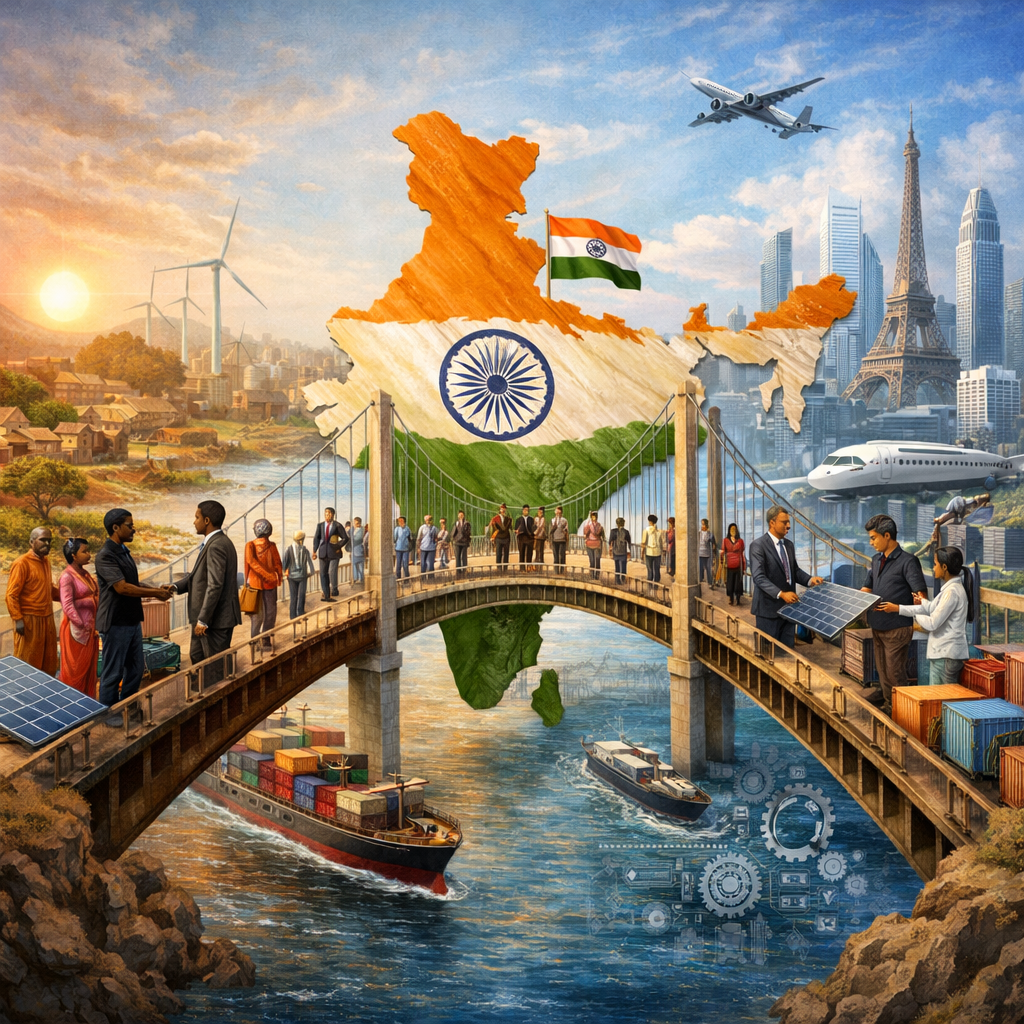
India’s role as a bridge between the Global South and developed economies is rooted in both its history and its evolving economic and geopolitical position. Since the era of the Non-Aligned Movement, India has attempted to maintain strategic autonomy while advocating for the interests of developing countries. At the same time, India has steadily integrated with advanced economies through trade, technology partnerships, and institutional cooperation.
In the 21st century, India’s unique position—being both a large developing economy and a rapidly growing global market—has enabled it to speak the language of both worlds. With a GDP exceeding $3.5 trillion and ambitions of becoming a $10 trillion economy in the coming decades, India increasingly operates as a mediator between emerging economies and industrialized nations.
Economic Bridge: Connecting Markets and Supply Chains
India’s economy embodies characteristics of both the Global South and developed markets. On one hand, it faces challenges common to developing nations—such as infrastructure gaps, rural poverty, and employment pressures. On the other hand, it has globally competitive sectors such as digital services, pharmaceuticals, and advanced manufacturing.
India is also positioning itself as a supply-chain alternative in the era of “China+1.” Countries in North America, Europe, and East Asia are increasingly diversifying their manufacturing bases toward India, Vietnam, and Mexico. Through initiatives such as the Make in India program and the Production Linked Incentive Scheme, India is building manufacturing ecosystems that link advanced markets with emerging production networks in Asia and Africa.
For developing economies, India provides a model of how digital infrastructure, industrial policy, and market reforms can coexist with social development programs.
Diplomatic Bridge: Voice of the Global South
India has actively positioned itself as a spokesperson for developing countries in global governance. During its presidency of the G20 in 2023, India pushed for stronger representation of developing economies and supported the inclusion of the African Union as a permanent G20 member.
India’s diplomacy often focuses on balancing interests:
advocating for climate justice for developing countries while engaging with advanced economies on clean energy transition;
supporting debt relief discussions for poorer nations while maintaining strong partnerships with institutions like the International Monetary Fund and the World Bank.
This dual engagement allows India to act as a mediator in negotiations related to trade, climate finance, digital governance, and development cooperation.
Technology and Digital Public Infrastructure
Another important area where India acts as a bridge is digital innovation. India’s digital public infrastructure—especially the Aadhaar, Unified Payments Interface, and broader India Stack ecosystem—has created scalable models that can be replicated across developing economies.
At the same time, India collaborates closely with advanced technology ecosystems in the United States, Europe, and Japan. This creates a technology corridor where innovations developed in advanced economies are adapted for large-scale deployment in developing markets.
For many countries in Africa, Southeast Asia, and Latin America, India represents a practical model of affordable digital transformation.
Climate and Energy Diplomacy
India’s role in global climate politics also illustrates its bridging capacity. As one of the world’s largest energy consumers but still a developing economy, India often advocates for a balanced approach to climate action.
Through platforms like the International Solar Alliance, India promotes renewable energy cooperation among developing countries while working with developed economies on green technology investments and financing mechanisms.
This positioning enables India to negotiate climate solutions that are both environmentally ambitious and development-oriented.
Strategic Challenges
Despite its bridging role, India faces several structural challenges. Infrastructure constraints, regulatory complexity, and uneven industrial competitiveness can limit its ability to fully integrate global supply chains. Additionally, geopolitical tensions between major powers—especially the United States and China—make balancing relations increasingly complex.
To sustain its bridging role, India must deepen institutional reforms, strengthen its manufacturing base, and expand its technological capabilities.
A Possible Future Role in the Global System
Looking ahead, India’s bridging role could become even more significant. As global trade becomes more fragmented and supply chains regionalize, countries that can connect different economic blocs will gain strategic importance.
India has the potential to serve as:
a production hub linking Western markets with Asian supply chains,
a policy voice representing developing nations in global institutions, and
a technology platform enabling digital transformation across the Global South.
In an increasingly polarized world economy, India’s greatest strategic asset may not simply be its market size or demographic advantage—but its ability to build trust and cooperation between vastly different economic systems.
#GlobalSouth
#EconomicBridge
#StrategicAutonomy
#SupplyChainDiversification
#DigitalPublicInfrastructure
#ClimateDiplomacy
#SouthSouthCooperation
#InclusiveGlobalisation
#EmergingEconomies
#IndiaGlobalLeadership
 "Connecting communities, empowering nations: Unifying the Regional and Global Economy ."
Leave a comment