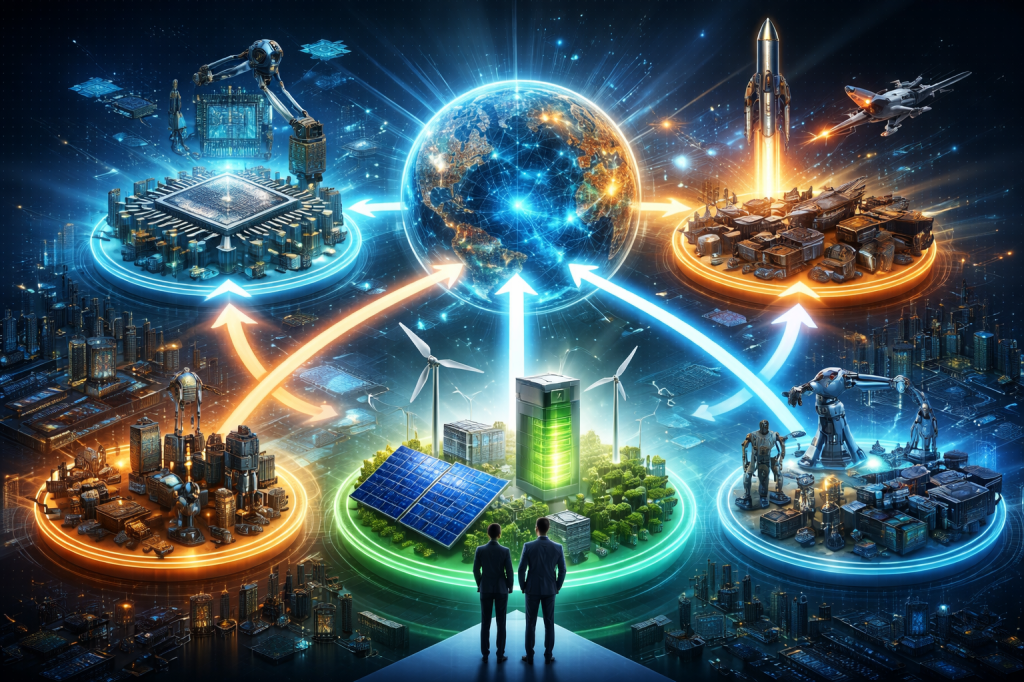
For nearly three decades after the Cold War, global capital flowed primarily toward efficiency. Investors rewarded cost arbitrage, scale, and global integration. Manufacturing expanded into lower-cost geographies, supply chains stretched across continents, and industrial policy appeared secondary to market logic. But the post-pandemic, geopolitically charged world has altered that pattern. Capital is no longer neutral; it is strategic.
Investment flows today are being directed less by pure return metrics and more by national security, technological sovereignty, and climate commitments. Semiconductors and AI hardware, defence and aerospace systems, renewable energy equipment, and advanced materials have become preferred destinations for both public and private capital. The logic is clear: these sectors are not only profitable but foundational to economic resilience and geopolitical leverage.
This shift marks a structural break from the era of global optimisation to an era of strategic concentration.
Strategic Sectors as Capital Magnets
Semiconductors illustrate the transformation most vividly. Governments across the United States, Europe, and East Asia have committed hundreds of billions of dollars to domestic fabrication capacity. The semiconductor industry, once driven primarily by commercial demand cycles, is now intertwined with national policy. AI hardware follows closely, with enormous venture capital inflows into chip design, data centres, and high-performance computing infrastructure. Artificial intelligence is no longer a peripheral digital trend—it is embedded in defence, finance, healthcare, and industrial automation.
Defence and aerospace spending is rising globally after decades of relative moderation. Heightened geopolitical tensions and regional conflicts have prompted renewed procurement cycles, strengthening capital flows into missile systems, advanced aircraft, cybersecurity, and space technologies. The defence sector, historically cyclical and government-dependent, has become structurally embedded in national growth strategies.
Simultaneously, renewable energy equipment and advanced materials are beneficiaries of decarbonisation mandates. Solar modules, battery storage, hydrogen systems, rare earth processing, and lightweight composites are receiving significant capital inflows. The green transition is not merely environmental—it is industrial. Countries view control over critical minerals and energy infrastructure as essential to future competitiveness.
The result is a concentrated flow of capital into sectors deemed strategic for technological dominance and security.
The Quiet Strain on Traditional Industry
While targeted sectors accelerate, traditional industrial segments—textiles, conventional machinery, low-tech manufacturing, mid-tier automotive components—face subdued capital inflows. Investors perceive these industries as mature, margin-compressed, and exposed to global volatility. Bank lending has become more selective, equity financing more cautious.
This does not imply decline; rather, it suggests consolidation and rationalisation. Firms in traditional industries are focusing on cost optimisation, automation, and incremental upgrades rather than expansion. Capital expenditures are cautious, often directed toward efficiency rather than capacity growth.
In many emerging economies, this dynamic is particularly visible. Manufacturing clusters that once thrived on low labour costs now compete against automated production in advanced economies. Without technological upgrading, they risk stagnation. Capital markets reward sectors aligned with digital and green transitions, leaving traditional segments navigating a tighter financial environment.
The Two-Speed Industrial Economy
The consequence is the emergence of a two-speed industrial structure. One corridor accelerates rapidly, fuelled by subsidies, venture capital, and policy alignment. The other advances cautiously, stabilising but not expanding.
This duality has macroeconomic implications. High-tech sectors generate significant valuations and productivity gains but often employ fewer workers relative to capital invested. Traditional sectors, though slower in growth, remain labour-intensive and socially stabilising. When capital disproportionately favours high-tech corridors, income distribution and employment patterns can become uneven.
Historically, industrial revolutions have always produced asymmetry. The shift from steam to electricity, from manufacturing to services, and from analog to digital each created winners and laggards. The current transition differs in one key respect: it is explicitly shaped by policy. Capital allocation is not simply a market phenomenon—it is a strategic instrument.
Geopolitics, Climate, and the New Investment Logic
Three forces drive this reallocation. First, geopolitics. Technology has become a strategic asset. Export controls, investment screening, and supply-chain reconfiguration channel capital into politically aligned ecosystems.
Second, climate commitments. Decarbonisation targets create predictable demand for renewable equipment and advanced materials. Investors interpret regulatory certainty as opportunity.
Third, digital transformation. AI and automation promise productivity gains across industries, but capital flows disproportionately toward infrastructure and hardware enabling these systems.
These forces intersect. Semiconductor fabs are justified on both economic and security grounds. Battery factories serve climate objectives and industrial policy. Aerospace innovation merges defence with commercial aviation and satellite communications.
Capital allocation today reflects this convergence of policy and market.
Risks of Over-Concentration
Yet strategic concentration carries risks. Excessive capital in favoured sectors can produce overcapacity, asset bubbles, and technological redundancy. Industrial policy, while supportive, can distort price signals if not carefully calibrated.
Moreover, neglecting traditional industries risks hollowing out the broader industrial base. Supply chains require mid-tier suppliers, logistics networks, and conventional manufacturing capabilities. If these segments are under-capitalised, resilience may weaken despite headline investment in strategic sectors.
There is also a fiscal dimension. Government-supported sectors rely heavily on public funds. Sustained subsidies raise questions about long-term efficiency and budget sustainability, particularly in economies already managing high debt levels.
A Futuristic Outlook: Integration or Polarisation?
Looking ahead, the critical question is whether the two-speed structure remains polarised or becomes integrated. In an optimistic scenario, technological spillovers from strategic sectors enhance productivity across traditional industries. AI improves supply-chain efficiency; advanced materials reduce costs in conventional manufacturing; renewable energy lowers operating expenses.
In a pessimistic scenario, capital segmentation deepens. High-tech clusters flourish within policy-protected ecosystems, while traditional sectors consolidate defensively. The industrial landscape becomes fragmented not only globally but domestically.
For emerging economies, the path is delicate. Competing directly in semiconductors or advanced aerospace requires enormous capital and institutional capacity. However, strategic integration—embedding into supply chains of renewable equipment, battery components, or advanced materials—may offer viable entry points.
Capital as Strategy, Not Just Finance
Capital allocation is no longer merely a financial decision. It is a strategic declaration about the future structure of the economy. Nations and corporations that align investment with long-term technological and environmental shifts may secure competitive advantages. Those that misjudge the trajectory risk stranded assets and declining relevance.
The industrial world is fragmenting—but fragmentation does not necessarily mean decline. It signifies reorganisation around priorities of resilience, sustainability, and sovereignty.
The defining challenge of the next decade will not be simply attracting capital. It will be ensuring that capital flows generate balanced productivity, inclusive employment, and durable competitiveness across both speeds of the industrial economy.
#StrategicCapital
#TwoSpeedEconomy
#IndustrialFragmentation
#Semiconductors
#AIHardware
#DefenceAerospace
#RenewableEquipment
#AdvancedMaterials
#CapitalConcentration
#IndustrialPolicy
 "Connecting communities, empowering nations: Unifying the Regional and Global Economy ."
Leave a comment