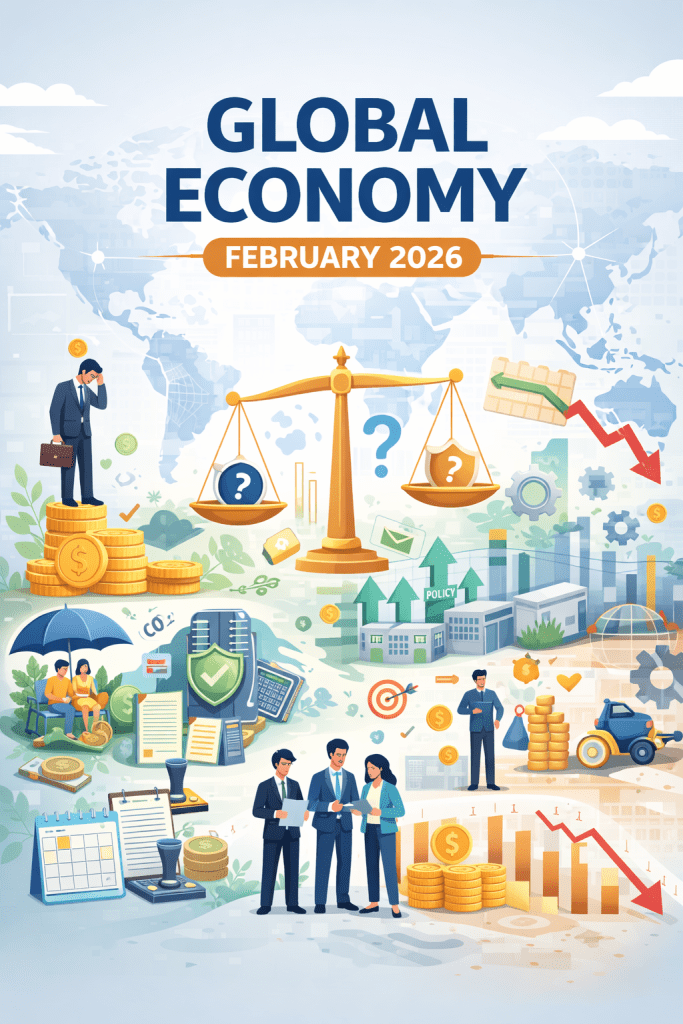
By early February 2026, the global economy finds itself in an unusual and uneasy position. The immediate fears of crisis—runaway inflation, financial instability, or synchronized recession—have receded. Yet confidence has not returned. What the world is experiencing instead is stability without conviction.
Growth persists, but it is narrow and uneven. Inflation is no longer accelerating, but neither is it fully tamed. Policymakers, markets, and households appear locked in a holding pattern—waiting for clarity that refuses to arrive.
The Inflation Fight Is Over—The Inflation Problem Is Not
Advanced economies have largely won the battle against headline inflation, but they are struggling with its more stubborn core. Housing, healthcare, education, and service-sector costs continue to rise faster than comfort levels, particularly in the US and Europe.
This matters because it exposes the limits of monetary policy. Interest-rate hikes were effective against goods inflation and excess demand, but they are poorly suited to resolve structural cost pressures. Central banks now face a dilemma: cut rates too quickly and risk re-igniting inflation, or hold tight and suppress already-weak growth.
The likely outcome is what markets are beginning to accept—a slow, uneven, and cautious easing cycle, rather than a decisive pivot.
A World Moving from Growth to Governance
One of the defining features of the current moment is the expanding role of the state in economic outcomes. Governments are no longer content to set rules and step aside; they are actively shaping markets through industrial policy, trade regulation, and strategic spending.
From energy transition and semiconductors to defence and critical minerals, economic activity is increasingly policy-anchored. This has reduced volatility and provided direction—but it has also blurred the line between economic efficiency and political priorities.
The risk is subtle but real: an economy that is managed too tightly can lose its capacity for innovation, competition, and self-correction.
Trade Without Trust
Global trade has not collapsed, but it has fundamentally changed. Efficiency and price are no longer sufficient conditions for market access. Carbon footprints, security considerations, origin rules, and geopolitical alignment now determine trade flows.
This shift toward conditional integration is creating friction beneath the surface. Supply chains are shorter and more resilient, but also more expensive and less flexible. Smaller economies and firms, in particular, struggle to meet the rising compliance threshold of global trade.
The promise of globalisation—growth through openness—has been replaced by a more cautious bargain: stability through control.
The Quiet Weakness at the Micro Level
Perhaps the most underappreciated feature of the global economy today lies below the headline indicators. At the micro level—among households and small firms—behaviour has changed decisively.
Savings are prioritised. Debt aversion is rising. Risk-taking is falling.
This is not irrational pessimism; it is adaptive behaviour shaped by repeated shocks. But it has macro consequences. When the micro economy focuses on resilience rather than expansion, demand weakens, entrepreneurship slows, and innovation becomes incremental rather than transformative.
The danger is not recession—it is economic stagnation driven by caution.
Emerging Markets: Opportunity with Constraints
Emerging economies enter 2026 with relative advantages—demographics, lower household leverage, and growing domestic markets. Yet they face a more complex global environment than their predecessors did.
The old path—export-led growth through unfettered global markets—is narrowing. New rules around carbon, technology, and security raise entry barriers. Success will depend less on cheap labour and more on institutional strength, skill formation, and strategic positioning.
The opportunity remains real, but it is no longer automatic.
Bottom Line
As of February 2026, the global economy is not in crisis—but it is not at ease either.
It is transitioning from a world driven by speed, leverage, and scale to one shaped by policy, constraint, and cautious optimisation. This transition may deliver stability, but it risks suppressing dynamism if not managed carefully.
The central question for the coming years is no longer how to restart growth, but how to restore confidence—among households, entrepreneurs, investors, and nations—without returning to the excesses of the past.
The answer will determine whether this decade is remembered as a period of managed stagnation—or the foundation of a more balanced and resilient global economy. #GlobalEconomy
#StickyInflation
#MonetaryPolicy
#ManagedInterdependence
#IndustrialPolicy
#TradeFragmentation
#MicroResilience
#EconomicStagnation
#EmergingMarkets
#PolicyDrivenGrowth
 "Connecting communities, empowering nations: Unifying the Regional and Global Economy ."
Leave a comment