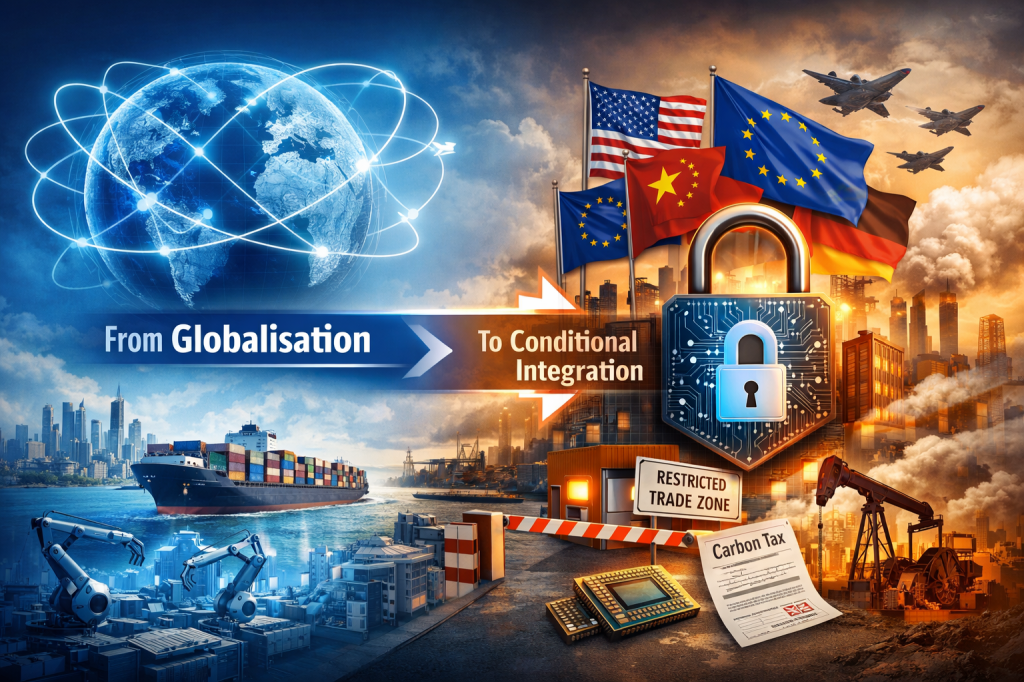
The Historical Arc of Globalisation
Globalisation once operated on a remarkably simple logic—price signals, comparative advantage, and supply-chain optimisation shaped the movement of goods, capital, and technology. From the early 1990s to around 2015, the world experienced a phase of hyper-globalisation, driven by China’s WTO entry, the rise of global value chains, and the digitalisation of services. Borders seemed to blur as trade rose from 39% of global GDP in 1990 to nearly 60% in 2012, reflecting unprecedented economic integration. The world believed efficiency and scale would remain the central pillars of global trade forever.
The Shift Toward Policy-Driven Flows
The last decade shattered that assumption. Trade flows today no longer move freely in response to market prices alone; instead, policy filters and political choices increasingly decide who can trade, what can be traded, and where investment can flow. Countries have introduced carbon rules like the EU’s CBAM, imposed technology-related export controls, tightened security screening for foreign investment, and revived industrial subsidies for semiconductors, green hydrogen, electric vehicles, and critical minerals. The result is that market efficiency now competes directly with national security, sustainability, and resilience goals.
Managed Interdependence, Not Deglobalisation
Contrary to popular narratives, this does not signal the end of globalisation, but rather its controlled evolution into “conditional integration”. Nations are not retreating into autarky; instead, they are redefining acceptable forms of interdependence. The emerging model is one where openness exists, but only within trusted networks, much like concentric circles: allies at the centre, strategic competitors at the margins, and neutral players navigating between spheres. Efficiency is slowly giving way to risk-adjusted efficiency, where firms diversify supply chains not for cheaper prices but for strategic stability.
Regulation as the New Competitiveness
In this transformed trade ecosystem, competitiveness alone is no longer enough; alignment with regulatory, environmental, and geopolitical frameworks has become equally critical. Companies must navigate export controls on chips, carbon compliance obligations, due-diligence laws on forced labour, and data-sovereignty rules that shape digital trade. For example, firms exporting to Europe must budget for carbon costs, while technology companies face multiple layers of semiconductor export restrictions. This means the global economy is now shaped by intersecting policy architectures rather than the free-flowing logic of markets. The winners are not merely efficient producers but those who can align operational models with shifting regulatory landscapes.
A Future Defined by Strategic Selectivity
Looking ahead, the next phase of globalisation will likely be defined by strategic selectivity rather than universal openness. Trade agreements will increasingly include climate clauses, digital standards, and supply-chain transparency rules. Capital flows will favour countries that provide geopolitical “trust value,” not just cost advantages. Developing nations must position themselves not as low-cost hubs alone, but as policy-aligned, risk-resilient, and tech-integrated partners. For India, ASEAN, and parts of Africa, this presents both opportunity and pressure—they can become the new nodes of diversified supply chains, but only if they build regulatory compatibility with major blocs while preserving strategic autonomy.
The Critical Question for Nations and Businesses
The true challenge lies in navigating this dual world—interdependent yet fragmented, open yet controlled. Nations must rethink industrial strategies, align trade policies with climate and security imperatives, and build institutional capacities to handle global regulatory regimes. Businesses must invest in geopolitical intelligence, carbon accounting, compliance systems, and diversified production networks. In the age of conditional integration, those who adapt early will shape the new rules of global trade, while those who resist will be pushed to the periphery.
#ConditionalIntegration
#ManagedInterdependence
#Geoeconomics
#TradeFragmentation
#CarbonRegulation
#ExportControls
#ResilientSupplyChains
#IndustrialSubsidies
#RegulatoryAlignment
#StrategicTradePolicy
 "Connecting communities, empowering nations: Unifying the Regional and Global Economy ."
Leave a comment