The Union Budget 2026–27 arrives at a moment when India stands at a crossroads—balancing ambition with inclusion, technology with tradition, and domestic priorities with global headwinds. Finance Minister Nirmala Sitharaman’s Budget Speech (February 1, 2026) sets out a bold restructuring of India’s growth journey with unprecedented clarityUnion Budget 2026–27: A Blueprint for India’s Next Economic Transformation
on manufacturing, infrastructure, fiscal discipline, technology leadership, and social empowerment.
At its heart, this Budget is framed around three kartavya—accelerating growth, fulfilling aspirations, and ensuring inclusive development. What makes this year’s Budget truly distinct is its Yuva Shakti-driven design, drawing ideas from the Viksit Bharat Young Leaders Dialogue 2026.
I. The Strategic Context: India in a Disrupted Global Economy
The speech acknowledges the hard reality: the world is entering a prolonged period of trade fragmentation, contested supply chains, and resource constraints. New technologies are reshaping competitive dynamics while intensifying demands on water, energy, digital infrastructure, and critical minerals.
Against this backdrop, India positions itself as a country that seeks higher growth with stability—a combination many economies today struggle to achieve.
“India’s economic trajectory has been marked by stability, fiscal discipline, sustained growth, and moderate inflation.”
A decade of reforms—GST, digitization, investment-led growth, Make in India, Atmanirbhar Bharat—provides the foundation for the next leap.
II. Scaling-Up Manufacturing: The Most Ambitious Push Since 1991
The Budget identifies 7 strategic and frontier sectors which will define India’s industrial future:
1. Biopharma SHAKTI — ₹10,000 crore
A five-year roadmap to build India into a global biopharma hub, including:
Domestic production of biologics and biosimilars
3 new NIPERs + 7 upgraded
1,000 new clinical trial sites
Stronger regulatory capacity
This is structurally important because India’s disease burden is shifting toward NCDs—cancers, autoimmune disorders, diabetes—requiring advanced biologics.
2. India Semiconductor Mission (ISM 2.0)
This upgrades ISM 1.0 and moves India from assembling chips to owning the full semiconductor stack:
Equipment & material manufacturing
Indian-designed IP
Supply chain risk reduction
Industry-led R&D centres
This is India’s strongest pitch yet to reduce semiconductor dependence on East Asia.
3. Electronics Components Scheme: Outlay increased to ₹40,000 crore
Boosting deeper value addition in India’s fast-growing electronics industry.
4. Rare Earth Permanent Magnet Corridors
In Odisha, Kerala, Tamil Nadu, Andhra Pradesh.
This is closely aligned with India’s ambition to build energy transition supply chains.
5. Capital Goods & CIE Push
Includes:
Hi-tech Tool Rooms
Construction & Infrastructure Equipment Scheme
Container Manufacturing with ₹10,000 crore support.
6. Integrated Textile Programme
A five-part programme combining fibre self-reliance, modernisation of clusters, handloom support, sustainability and skilling.
Plus new Mega Textile Parks.
7. Khadi, Handloom, Handicrafts Rejuvenation
The Mahatma Gandhi Gram Swaraj initiative aims at global branding + ODOP integration.
Why this matters:
India’s next growth curve will not come from only IT services but from advanced manufacturing—precisely where this Budget invests heavily.
III. MSMEs: From Survival to “Champion SMEs”
Recognising MSMEs as India’s growth engine, the Budget creates a three-pronged MSME strategy:
1. Equity Support
₹10,000 crore SME Growth Fund
₹2,000 crore top-up to the Self-Reliant India Fund
2. Liquidity Support
The most transformative piece:
Mandatory use of TReDS for CPSE purchases
Credit guarantee for TReDS discounting
Linking GeM with TReDS
TReDS receivables to become asset-backed securities
This will revolutionize MSME financing.
3. Professional Support
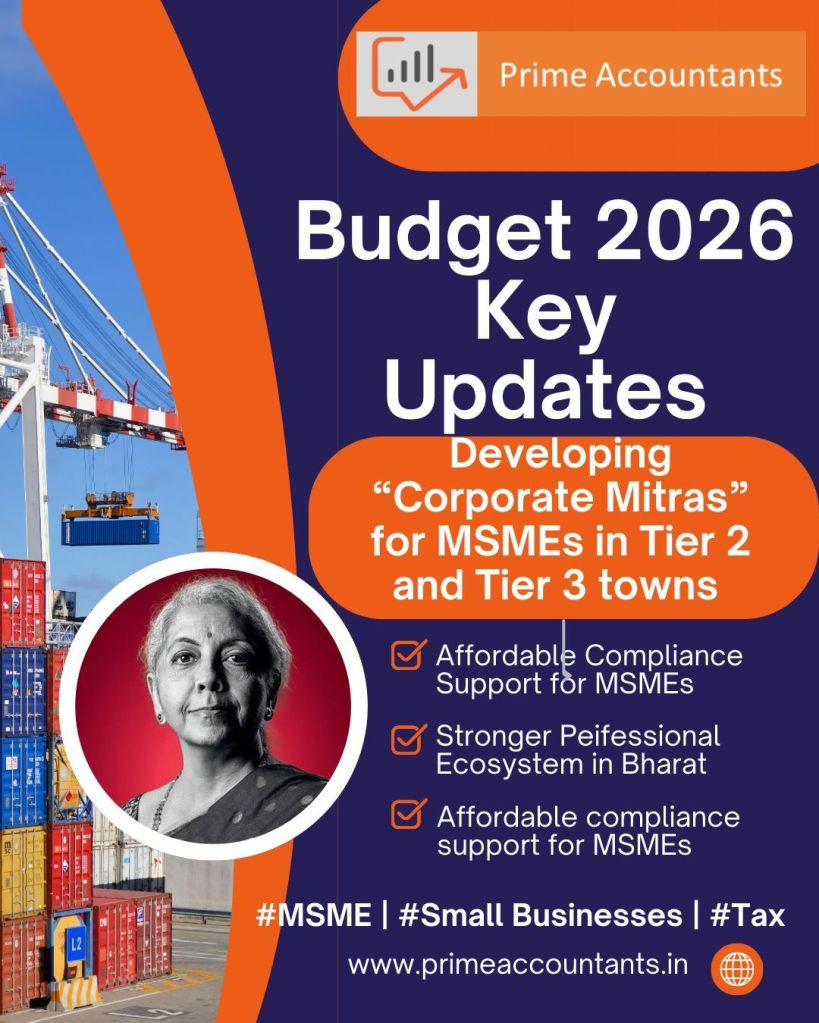
Creation of Corporate Mitras by ICAI/ICSI/ICMAI
To make compliance simple and affordable.
This is critical for small firms struggling with talent and regulatory load.
IV. Infrastructure: India’s Era of Mega-Investment Continues
Public Capex rises to ₹12.2 lakh crore—a historic high.
Key Announcements
Infrastructure Risk Guarantee Fund
Expanded REITs for CPSE assets
New Dedicated Freight Corridors (Dankuni–Surat)
20 new National Waterways
Coastal Cargo Promotion Scheme to double share of water transport
Seaplane VGF Scheme
High-Speed Rails: 7 New Growth Connectors
Mumbai–Pune
Pune–Hyderabad
Hyderabad–Bengaluru
Hyderabad–Chennai
Chennai–Bengaluru
Delhi–Varanasi
Varanasi–Siliguri
A decisive move toward India’s next-generation mobility network.
V. Energy Security & Climate Transition
CCUS Push — ₹20,000 crore
For cement, steel, power, chemicals and refineries.
Rare Earths, Lithium-Ion Cells, Solar Glass Support
Customs relief and industrial incentives.
India positions itself as a critical mineral and clean-tech manufacturing hub.
VI. Cities as Economic Machines: The CER Revolution
Each City Economic Region (CER) gets ₹5,000 crore over 5 years to build future-ready infrastructure for Tier-II/III cities.
This is one of the most forward-looking sections of the Budget—Indian urbanisation is now entering Phase 2.0.
VII. Financial Sector Reform
High-Level Committee on Banking
To redesign India’s banking architecture for the next 20 years.
NBFC restructuring
REC + PFC rationalisation.
Corporate Bond Market Deepening
Market-making
Derivatives on bond indices
Total return swaps
This will enable large-scale private capital formation.
VIII. Services as the New Driver: Education to Employment & Enterprise Committee
A transformational reform: India aims for 10% global share in services by 2047.
Key areas:
AI-led job mapping
Skill pipelines for health, AVGC, design, hospitality
University Townships
Medical Tourism Hubs
Telescope and astrophysics infrastructure
For your consultancy and policy work, this section aligns strongly with education-to-employment transitions.
IX. Agriculture, Livelihoods & Rural Enterprise
High Value Agriculture
Support for coconut, sandalwood, cashew, cocoa, almonds, walnuts, pine nuts.
A multilingual AI advisory system integrating AgriStack + ICAR for farm productivity.
SHE-Marts
Women-led community retail ecosystems replacing credit-based livelihood models.
This directly aligns with rural entrepreneurship work you do.
X. Taxation: Major Overhaul with the Income Tax Act 2025
Key Highlights
New Income Tax Act 2025 from 1 April 2026
Simplified rules & forms
TCS on overseas tour packages cut to 2%
TDS simplification for manpower services
Extended time for revised returns
Foreign Assets Disclosure Scheme
Lower penalties & reduced criminalisation
Corporate Tax Changes
MAT reduced from 15% to 14%
Buyback taxed as capital gains
STT hikes for F&O
Safe harbour for IT services expanded
These changes reduce friction, litigation and compliance costs.
XI. Customs & Indirect Taxes: New Push for Exports & Manufacturing
Export Promotion
Duty-free inputs for seafood processing raised to 3%
Footwear and shoe uppers support
Extended export timelines
Energy & Critical Minerals
Lithium-ion cell capital goods exemption
Solar glass chemicals exemption
Ease of Living
Duty on personal imports reduced from 20% → 10%
17 cancer drugs fully exempt
7 new rare diseases added
XII. Fiscal Outlook: Discipline with Growth
Fiscal Deficit
2025–26 (RE): 4.4% of GDP
2026–27 (BE): 4.3% of GDP
Debt-to-GDP
Expected to fall from 56.1% → 55.6%
A rare combination globally: high growth + falling debt ratio.
XIII. A Forward-Looking, Critical Perspective
This Budget signals India’s next economic transition—from a consumption-led model to an innovation-driven, technology-intensive, regionally diversified and globally confident economy.
Strengths
Deep push for industrial self-reliance
Future-ready investments in AI, semiconductors, biopharma
Enabling MSMEs with equity + liquidity
Strong social and rural empowerment
Urban expansion through City Economic Regions
Fiscal consolidation continues
Potential Challenges
Execution of mega investment schemes
State-level implementation capacity
Global supply chain risks for semiconductors & critical minerals
Labour market readiness for AI + services transformation
Financing for large urban and high-speed rail projects
Long-Term Outlook:
India is positioning itself for 7–7.5% sustainable growth, with the structural ability to become the world’s third-largest economy by 2028 and a $10 trillion economy before 2035.
#UnionBudget2026
#ViksitBharat
#ManufacturingPush
#CityEconomicRegions
#ChampionMSMEs
#BiopharmaShakti
#SemiconductorMission
#FiscalConsolidation
#InfrastructureBoost
#AspirationalEconomy
 "Connecting communities, empowering nations: Unifying the Regional and Global Economy ."
Leave a comment