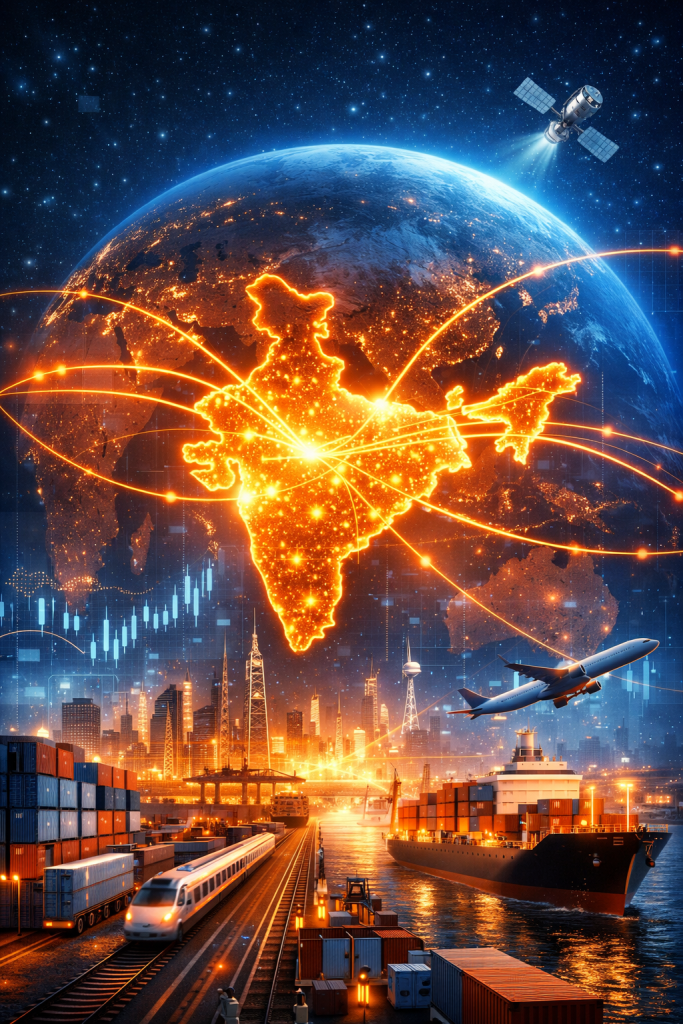
India’s external sector in 2025–26 stands at a moment where history, geopolitics, and technology intersect. The world economy is moving away from hyper-globalisation toward fragmented blocs, supply-chain realignments, industrial subsidies and weaponised trade policy. Chapter 4 of the Indian Economic Survey 2025-26, titled External Sector: Playing the Long Game, captures this transition with unusual clarity and sets the tone for how India must position itself over the next decade.
The Shift from Hyper-Globalisation to Strategic Trade
The Survey notes sharply:
“India’s external sector has evolved amidst a global environment characterised by heightened trade policy uncertainty, geopolitical realignments, and a structural shift away from a hyper-globalisation phase.”
This is not mere rhetoric. The Trade Policy Uncertainty (TPU) Index surged 1165.6% YoY in April 2025, driven by tariff cycles in the US, commodity disruptions linked to conflicts, and industrial policy battles between major blocs. WTO projects global trade growth to drop to 2.3% in 2026, signalling a more contested world.
Historically, India has been shaped by global trade waves—from colonial extraction, to post-1991 liberalisation, to the 2010s era of competitive FTAs. But the 2020s require a different playbook: strategic self-reliance without isolation, friend-shoring without dependence, and global competitiveness without sacrificing domestic stability.
A Record Export Performance Amid Global Flux
India registered USD 825.3 billion in total exports in FY25, a historic milestone. This performance reflects a deeper structural trend:
Services exports grew 13.6% YoY, cushioning merchandise weakness.
Merchandise exports held at USD 437.7 billion, but with crucial qualitative improvement.
Non-petroleum, non-gems & jewellery exports grew 7.5% YoY to USD 374.3 billion—an important sign of diversified value chains.
Yet imports grew too—6.3% YoY to USD 721.2 billion, driven by capital goods, signalling that India’s domestic investment cycle is accelerating. The trade deficit widened to USD 283.5 billion, a reminder that growth comes with higher energy and machinery demand.
In April–December 2025 alone, the deficit was USD 248.3 billion, reflecting rising consumption, investment, and high-value manufacturing expansion.
The PLI Effect: India’s Sunrise Sectors Mature
India’s Production-Linked Incentive (PLI) scheme emerges as a cornerstone of external sector resilience.
The Survey highlights:
10.6% average annual export growth across PLI sectors (FY21–25)
Electronics: 38.8% export growth
IT hardware: 77.2% export growth
Telecom: import contraction of –18.5% due to domestic capacity
This marks a dramatic shift from the pre-2014 scenario where electronics was India’s second-largest import item after oil. Today, India is not only assembling but increasingly designing, exporting and embedding itself into global value chains.
The 2030 horizon could see India becoming one of the world’s largest producers of semiconductors, telecom gear, and AI-enabled electronics, if policy consistency persists.
Agricultural Exports: A Sleeping Giant Held Back by Policy Cycles
Agriculture—another pillar of India’s external sector—shows mixed signals:
CAGR of 8.2% during FY20–25
Total exports: USD 51.1 billion
Stagnation in recent years due to episodic export bans, MSP-linked decisions, and climatic volatility
The Survey points to the potential to touch USD 100 billion, but only if India avoids ad hoc restrictions.
It cautions:
“Balancing domestic food security with agricultural export competitiveness requires predictable buffers and price stabilization rather than frequent bans that hurt credibility.”
The lesson is historical: India has repeatedly lost premium markets for onions, rice, wheat, and sugar whenever sudden restrictions were imposed. Playing the long game means becoming a reliable supplier, just as Vietnam, Thailand, and Brazil have done.
A World of Tariffs, Friend-Shoring and Industrial Policy: India’s Strategic Choices
The Survey clearly states that India must prepare for long-term shifts in global trade architecture:
US effective tariff rate now 50% for targeted sectors.
EU, Japan and ASEAN re-crafting supply chains through near-shoring and de-risking.
Manufacturing is becoming policy-led, not market-led.
For India, the response is not to fear protectionism but to use it as a window of opportunity. As global corporations seek alternatives to China, India must deepen:
logistics competitiveness,
standards & quality frameworks,
export financing efficiency,
FTA readiness, and
strategic sector prioritisation.
External Buffers: India’s Hidden Strength
Despite global volatility, India’s external stability is anchored by:
services trade surplus,
strong remittances,
rising FDI interest in high-tech and manufacturing,
robust forex reserves, now one of the highest globally.
Historically, India’s vulnerability during the 1991 crisis stemmed from low reserves and high oil dependence. Today, resilience is rooted in a diversified and digitalised services ecosystem, combined with manufacturing revival.
A Futuristic Outlook: The Next Decade of India’s External Sector
India’s external sector strategy must shift from reactive to anticipatory. The next decade will be shaped by:
AI-driven global trade models
digital services becoming the world’s fastest-growing export segment
cross-border data flows forming new “data trade routes”
green hydrogen, green steel and carbon-neutral products dominating market access
supply chains moving from cost-efficiency to risk-efficiency
India’s $1 trillion export dream by 2030 will depend not on volume but on value, not on low-cost labour but on high-value ecosystems, and not on sectoral incentives but on policy predictability.
Winning by Playing the Long Game
India’s external sector is no longer about chasing short-term export surges. The Survey’s core message is strategic:
“India must play the long game—diversify partners, build domestic capacity, sustain export credibility, and anticipate geopolitical shifts.”
In an uncertain world, India’s resilience, scale, digital strength and demographic momentum position it not as a follower of past globalisation cycles, but as a shaper of the next one.
#TradeResilience
#PLIManufacturing
#GeopoliticalRealignment
#ExportDiversification
#GreenValueChains
#DigitalTrade
#ServicesSurplus
#SupplyChainShift
#StrategicAutonomy
#FutureOfTrade
 "Connecting communities, empowering nations: Unifying the Regional and Global Economy ."
Leave a comment