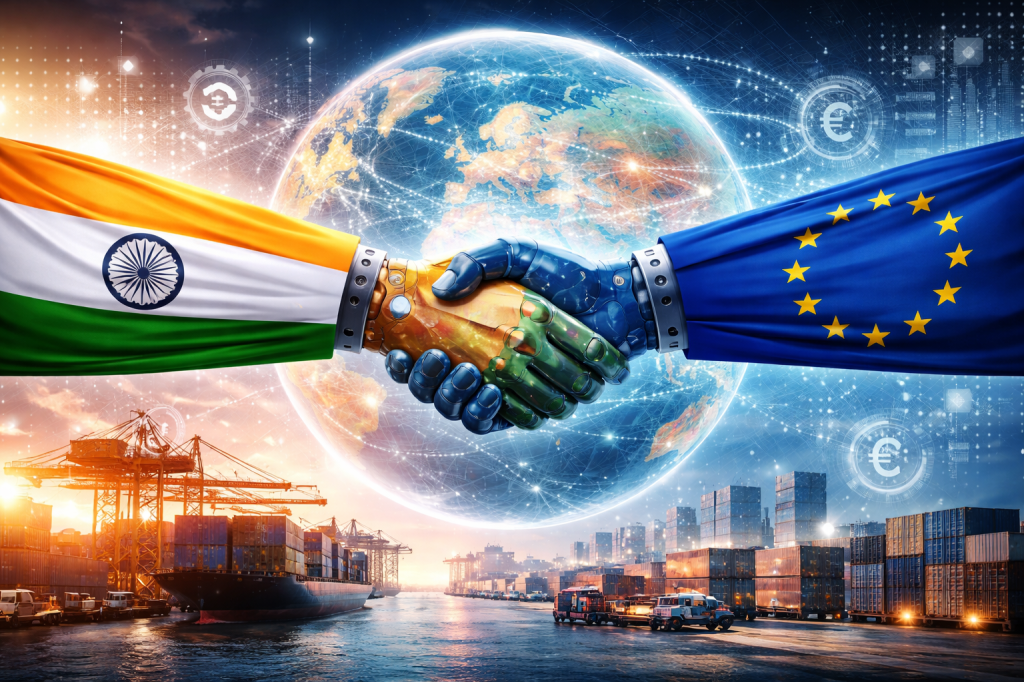
When India and the European Union formally announced the conclusion of their Free Trade Agreement at the 16th India-EU Summit in New Delhi, the moment marked the end of a negotiation marathon that began almost two decades ago. Now widely described as the “mother of all deals,” the pact connects a combined market of over two billion people and reshapes the future of trade across Eurasia. As the agreement enters its legal-scrubbing and ratification phase—with implementation likely by late-2026 or early-2027—the central question for India is simple: What does this mean for its 63 million MSMEs?
To answer that, one must look at historical patterns, current competitiveness, and the emerging architecture of global trade.
From Missed Chances to Strategic Alignment
Historically, India’s exports have suffered in Europe due to two major setbacks:
1. Graduation from GSP preferences, which eroded India’s tariff advantage over competitors from Bangladesh and Vietnam.
2. Fragmented export ecosystems where MSMEs lacked scale, technology, and compliance capacity.
The newly concluded FTA reverses much of this disadvantage. With the EU agreeing to zero tariffs on 90% of Indian goods immediately and 93% within seven years, India regains preferential access to the world’s largest consumption bloc. In many ways, the agreement mirrors the early 2000s moment when India’s IT sector took off after gaining access to EU markets—but this time, the beneficiaries are far more diverse: textiles, leather, footwear, engineering goods, chemicals, marine products, and low-carbon manufacturing.
This is not just another trade deal—it is a structural reset.
What Changes Immediately: The Tariff Revolution
The FTA does not simply reduce tariffs; it rewires the cost structure of Indian exports.
Textiles and garments regain the 12–16% duty advantage lost after GSP withdrawal.
Leather and footwear regain 10–14% competitiveness.
Marine products and processed foods become significantly more attractive for EU importers.
Specialty chemicals and engineering goods get deeper integration into EU supply chains as Europe diversifies away from China.
For MSMEs that operate on thin margins—often just 3–5%—these tariff cuts act as life-changing incentives, enabling them to enter new markets, revive dormant European demand, and scale up production with lower risk.
The FTA’s Hidden Power: A Dedicated SME Chapter
Unlike older FTAs, this agreement has a specific chapter dedicated to MSMEs. This is historically unprecedented in India’s trade diplomacy.
The SME chapter promises:
Dedicated contact points for MSMEs in both regions
Simplified portals for standards, documentation, and market-entry requirements
Lowered regulatory barriers
Better access to intellectual property protections
Quicker dispute redressal pathways
This means an MSME in Tiruppur, Surat, Moradabad, Rajkot or Coimbatore will be able to navigate EU regulations with far fewer intermediaries and lower costs. For a sector where compliance complexity is often a bigger barrier than tariffs, this is transformational.
New Pathways for MSMEs: From Low-Value Exports to High-Value Integration
The FTA gives Indian MSMEs a rare chance to climb global value chains. The EU is pushing for diversification away from China, especially in:
electronics sub-assemblies
battery and renewable energy components
specialty chemicals
pharmaceutical inputs
precision engineering
Indian firms can now position themselves as China+1 partners with tariff-backed cost advantages.
Simultaneously, India’s reduction of duties on EU machinery, robotics, advanced tools, and green technologies gives MSMEs access to equipment previously too expensive for small units. This can accelerate automation, improve quality, and shift exports from low-margin to high-value segments.
The FTA is therefore a productivity catalyst—not just a tariff bargain.
The Challenges: Where the FTA May Hurt MSMEs
The benefits are real but so are the risks. The biggest threat is not cheaper EU imports—it is non-tariff barriers.
Europe’s regulatory environment is tightening rapidly through:
CBAM (Carbon Border Adjustment Mechanism)
Green supply-chain disclosures
Traceability requirements
ESG reporting
Labour and human-rights compliance
Packaging & waste regulations
For a typical Indian MSME that runs on limited bandwidth, these compliance requirements may be costlier than the tariff benefits.
Three critical risks stand out:
1. Compliance Costs Could Neutralise Tariff Gains
CBAM alone could impose reporting frameworks most small firms are not ready for.
2. Competition from High-End EU Imports
Lower duties could lead to a surge in:
advanced machinery
medical devices
precision equipment
Indian units operating domestically may feel squeezed.
3. Pressure on India’s Subsidy Structures
EU competition rules may challenge MSME-support schemes like PLI or state incentives. Negotiations may have safeguarded many, but scrutiny will rise.
The Future Outlook: A Test for India’s Industrial Policy
If India treats this FTA as a simple tariff-cutting exercise, MSMEs could struggle.
But if it is used strategically—as a platform for upgrading firms, formalising supply chains, and adopting green production—the India-EU partnership could redefine the trajectory of India’s manufacturing sector.
Three major transitions will shape the future:
1. India’s Shift to Green Manufacturing
CBAM, ESG, and EU standards could become catalysts for India’s green industrialisation rather than burdens.
2. Deep Integration into Europe’s Supply Chains
Electronics, EV components, and chemicals offer long-term opportunities if MSMEs invest early.
3. India’s Positioning as a Value-Added Exporter
The FTA provides the final push for India to move from raw-material and low-value exports to design-rich, technology-driven manufacturing.
The FTA Is a Doorway—Not a Guarantee
The EU–India FTA is one of the most consequential trade deals in modern Indian history. The benefits for MSMEs are significant: improved market access, restored tariff advantage, technology inflows, and clearer regulatory pathways. But the risks—especially from compliance pressures and competitive imports—are equally serious.
The outcome will depend on India’s domestic readiness.
If MSMEs receive capacity-building, green-transition support, and compliance assistance, the FTA could mark the beginning of India’s export renaissance.
If not, the deal may widen the gap between India’s top exporters and small firms.
For now, the FTA stands as a powerful opportunity—one that requires strategy, adaptation, and foresight.
#FTAIndiaEU #MSMEExports #TradeCompetitiveness #CBAMImpact #EUStandards #GlobalValueChains #TariffCuts #GreenManufacturing #ChinaPlusOne #TradePolicyFuture
 "Connecting communities, empowering nations: Unifying the Regional and Global Economy ."
Leave a comment