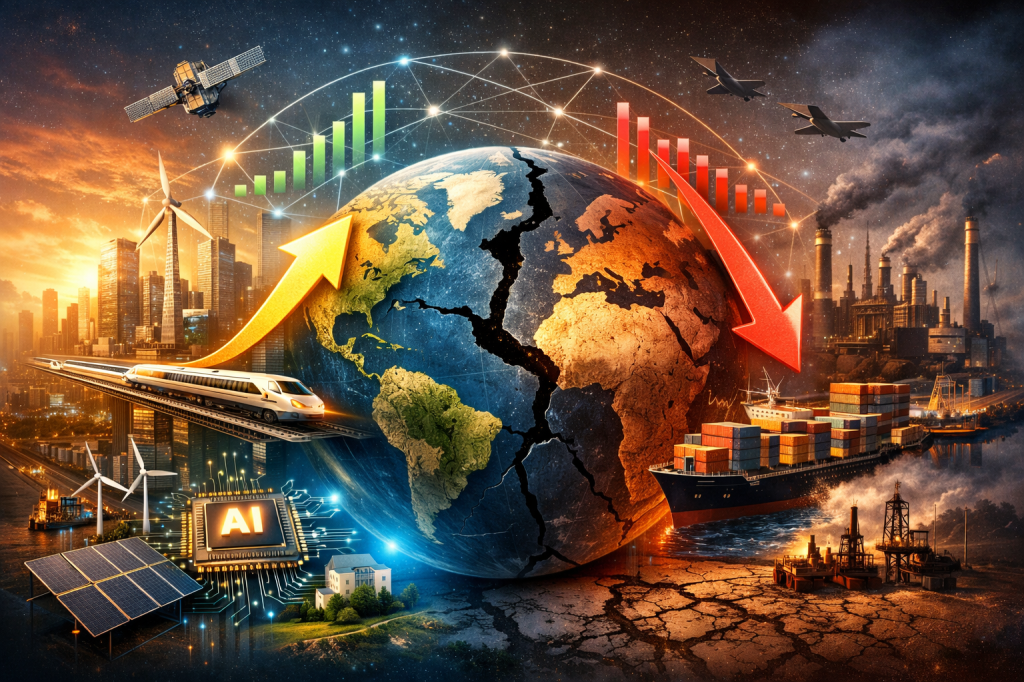
The world economy is entering a distinctly different phase—neither overheating with inflationary pressure nor collapsing into recession. Instead, global growth is settling into a low-gear, below-trend trajectory that reflects structural adjustments across major economies. This new normal challenges the assumptions that shaped global policy, trade flows, and investment strategies over the last three decades. The single most important shift is that the era of synchronized global growth is over. Divergence is now the defining feature of the global economy.
From Hyper-Globalisation to Fragmented Momentum
Historically, global growth cycles moved with a degree of synchronisation driven by globalisation, capital flows, and coordinated monetary policy. The early 2000s saw synchronized booms; the post-2008 period saw synchronized stimulus; the pandemic years saw synchronized collapse and recovery. But 2024–26 marks a break: geopolitical fragmentation, supply chain regionalisation, and differentiated monetary cycles have weakened the global connective tissue that once unified economic momentum.
The US continues growing on the strength of consumption and tech investment, while Europe faces structural stagnation and China grapples with its real estate overhang and demographic contraction. Emerging markets are not moving as one bloc either—India is accelerating, ASEAN is stabilising, and Latin America is diverging between commodity-rich and commodity-weak economies. The result is a multipolar growth map with multiple speeds.
Beyond the Headlines: Why Growth Has Slowed but Not Collapsed
The low-gear phase is not simply a slowdown—it is a recalibration. Inflation spikes have moderated but left behind higher living costs; interest rates have peaked but remain elevated by historical standards; and global supply chains have diversified but not fully stabilised. Investment is recovering selectively, driven more by government incentives—such as green industrial policy, chip subsidies, and infrastructure upgrades—than by private-sector confidence.
At the same time, demographics are tightening labour markets in advanced economies, technological transformation is reshaping productivity metrics, and climate-related disruptions are increasing unpredictability. These forces slow aggregate global growth but prevent an outright downturn, creating a zone of sub-par yet steady expansion.
The End of Global Averages
The world is no longer one economic story. This divergence is shaping everything from trade to foreign direct investment:
United States: moderate growth with strong AI-driven investment, but structurally high fiscal deficits.
European Union: low growth due to energy costs, demographics, and slow productivity gains.
China: stabilising but constrained by consumer sentiment and property sector pressures.
India: among the fastest-growing major economies, powered by domestic demand and formalisation.
ASEAN: mid-range growth benefiting from supply chain relocation.
Africa: potential for long-term expansion but short-term macro instability.
With no single engine of global expansion, regional strategies now matter more than global averages. Businesses, governments, and investors need to build region-specific plans rather than rely on global cycles to lift all boats.
Risks That Could Break the Stability
The low-gear equilibrium is fragile. Several risks could push the global economy into instability:
Fragmentation of trade and technology into competing blocs
High public debt limiting policy response space
Climate shocks affecting food, insurance, and migration patterns
Persistent geopolitical tensions disrupting energy and shipping routes
Slower productivity growth despite rapid technological diffusion
These headwinds could create a world of stable stagnation, where growth persists but opportunities become unevenly distributed.
Growth Will Shift, Not Disappear
Looking forward, global growth is not set to vanish—it is set to migrate. The next decade will likely be shaped by three new drivers:
1. AI-led productivity gains, especially in services and manufacturing automation
2. Green industrial transitions, including renewable energy, critical minerals, and decarbonised production
3. Regional supply-chain hubs, driven by China+1, friend-shoring, and geopolitical hedging
Countries that position themselves early—through skills, infrastructure, climate-resilient systems, and digital innovation—will capture disproportionate gains even in a low-gear world. The global economy is fragmenting, but opportunity is not disappearing; it is relocating.
#GlobalGrowth
#LowGearEconomy
#RegionalDivergence
#GeoeconomicFragmentation
#BelowTrendGrowth
#MultipolarWorld
#StructuralShifts
#EconomicStability
#FutureOutlook
#PolicyRealignments
 "Connecting communities, empowering nations: Unifying the Regional and Global Economy ."
Leave a comment