The European Union’s decision to extend the suspension of selected Generalized Scheme of Preferences (GSP) tariff benefits for Indian exports from January 1, 2026 to December 31, 2028 marks both a continuation of past regulatory trends and a signal of shifting global trade structures. While the move appears technical, it has deeper historical, economic, and strategic implications—especially as India and the EU edge closer to concluding a landmark free trade agreement.
GSP as a Development Tool and Its Limits
The EU’s GSP framework was originally designed as an engine of trade-led development, offering reduced or zero tariffs to developing economies. India long benefited under the standard GSP tier. However, the scheme also contains a “graduation mechanism” that removes benefits once a sector becomes globally competitive over a sustained period. The current suspension is therefore not punitive but a continuation of earlier withdrawals—including those witnessed in 2023—and reflects India’s rise in global value chains.
Over the years, India’s export basket to the EU has diversified into machinery, chemicals, engineering goods, and refined metal products. This structural transition means that many Indian sectors now cross EU competitiveness thresholds—triggering automatic GSP withdrawal.
What Exactly Has Been Suspended—and What Has Not
The updated rules suspend preferences across several non-agricultural categories such as textiles, plastics, metals, chemicals, and engineering items. Yet the government’s own calculations show a modest 2.66% impact on total Indian exports to the EU, equivalent to €1.66 billion out of €62.2 billion in 2023. Key agricultural items, leather categories, and some labour-intensive segments still retain eligibility.
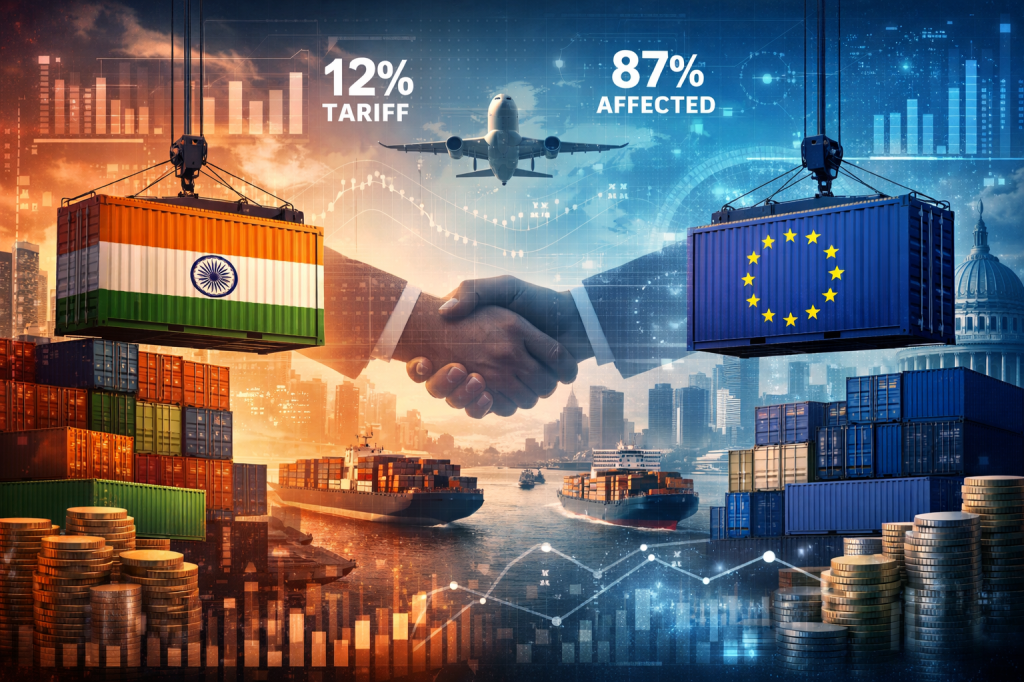
Export bodies highlight that several affected categories already enjoy zero Most Favoured Nation (MFN) duties, or maintain partial benefits if they meet strict rules of origin. However, critics like the Global Trade Research Initiative estimate a much broader impact—arguing that nearly 87% of India’s dutiable exports may now face MFN tariffs as high as 12%, particularly in textiles and apparel. The difference in estimates underscores a persistent challenge in Indian trade policy: the opacity of tariff-line-level data and the complexity of EU classification systems.
Economic Impact: Limited on Paper, But Uneven Across Sectors
The headline number—2.66%—may seem reassuring, yet the practical implications vary sharply across industries. Labour-intensive sectors like apparel and textiles face steeper competitive pressure as their margins thin under higher tariffs. Meanwhile, high-value sectors such as pharma and IT services remain unaffected, reflecting India’s long-term movement toward knowledge-driven exports.
The EU remains India’s ninth-largest export market, and tariff costs directly influence price competitiveness. Even a few percentage points of added duty can alter sourcing decisions by European buyers, pushing them toward Turkey, Vietnam, or North African suppliers integrated into the EU’s proximity-based value chains.
Strategic Context: Suspensions Aligning With FTA Timelines
The suspension is unfolding at a sensitive moment. India-EU FTA negotiations, which accelerated in late 2025 and early 2026, are reportedly nearing conclusion. Policymakers in Brussels may view the suspension as a bridge measure until the FTA—expected to take at least a year after signing to be ratified—creates more stable, long-term tariff frameworks.
In effect, the GSP withdrawal may be nudging India toward faster concessions in the FTA, particularly on regulatory alignment, sustainability commitments, and market access. It also reflects the EU’s transition from unilateral preference schemes to reciprocal trade partnerships with emerging economies.
A Forward-Looking Assessment: India’s Competitiveness Is Driving the Shift
Viewed through a futuristic lens, the GSP suspension reveals four structural realities:
1. India is no longer seen as a low-cost, preference-dependent exporter. Its sectors have reached maturity, triggering preference withdrawal mechanically.
2. Global trade is shifting from preferential access to regulated partnerships, with the EU increasingly embedding climate, labour, and sustainability norms into trade rules.
3. Indian MSMEs must accelerate compliance capacity. EU buyers increasingly demand traceability, carbon reporting, deforestation-free supply chains, and due-diligence frameworks. These requirements pose a greater challenge than tariffs.
4. The upcoming FTA is likely to reshape India-EU trade more than GSP ever did, especially in areas like customs cooperation, digital trade, services, and investment.
Short-Term Pain, Long-Term Realignment
In the short term, exporters—especially in apparel, plastics, and low-margin engineering products—will face higher landed costs. They may temporarily lose share to competitors integrated into EU free-trade networks. But in the long term, the shift may push Indian firms to upgrade technology, diversify markets, and prepare for deeper regulatory integration.
The GSP era for India is slowly closing; the FTA era is opening. The real competitive battle ahead will not be about tariffs but about standards, sustainability, and supply-chain resilience—domains where India must now invest strategically.
#GSPsuspension
#IndiaEUEconomy
#ExportCompetitiveness
#TariffImpact
#TradeNegotiations
#MarketAccess
#FTAOutlook
#NonTariffBarriers
#GlobalValueChains
#SustainabilityStandards
 "Connecting communities, empowering nations: Unifying the Regional and Global Economy ."
Leave a comment