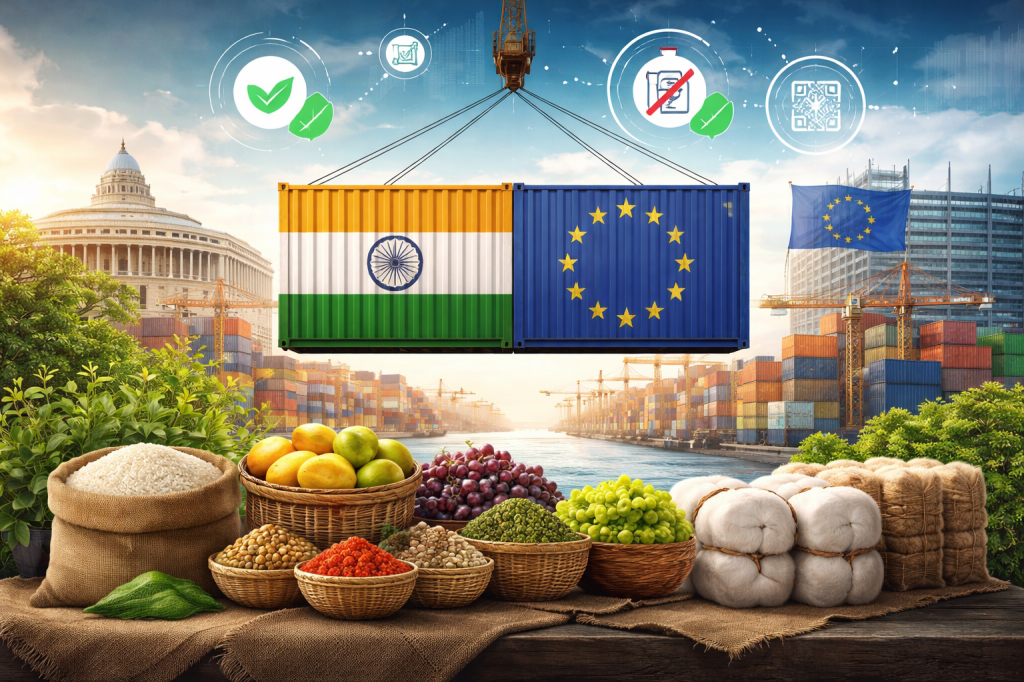
The India–EU Free Trade Agreement (FTA), now in its final stages as of January 2026, represents one of the most ambitious attempts to redefine India’s global trade footprint. Yet the deal’s biggest silence—the exclusion of agriculture—reveals more than it hides. It reflects a deeper historical tension between Europe’s highly protected farm sector and India’s politically sensitive rural economy. As negotiations accelerate toward a possible announcement around January 27, this FTA looks set to reshape India–EU trade—but not India–EU agriculture.
A Historic Negotiation Without Its Most Historic Sector
EU–India trade talks, relaunched in earnest in 2025 after a decade-long pause, made rapid progress on goods, services, investment, and rules of origin. Meetings in New Delhi in November 2025 narrowed gaps across most chapters. High-level visits in January 2026 signal that the agreement is essentially ready—except for agriculture and dairy, which have been kept outside the framework to avoid triggering EU farm lobbies and undermining India’s rural protections.
This exclusion follows a historical pattern: European agricultural exceptionalism has shaped every major EU FTA for decades, while India’s domestic politics continue to anchor food security and farmer incomes. An “early harvest” FTA—with agriculture set aside—became the only politically feasible route for both sides.
Agri-Exports Continue to Face the Same Old Barriers
While non-agri sectors stand to benefit, the agricultural trade story remains unchanged—and the challenges have only intensified. Indian exports such as basmati rice, spices, tea, mangoes, grapes, marine products, and cotton still face high EU tariffs, and the situation worsened after the EU suspended GSP tariff preferences for 87% of India’s exports from January 1, 2026.
For thousands of small exporters, this means a sudden return to tariff walls they had long navigated around.
Tariffs, however, are only half the battle. The larger challenge is non-tariff barriers, especially:
Sanitary and Phytosanitary (SPS) standards
Strict limits on pesticide residues
Food safety protocols
Traceability and sustainability certifications
Animal welfare and environmental standards
These norms frequently lead to rejections of Indian shipments of rice, fruits, vegetables, spices, cotton, and marine goods. In a market of 450 million European consumers with rising preferences for “clean” and “sustainable” products, compliance is not optional—but achieving it requires systemic changes India has been slow to institutionalize.
A Future Where Market Access Depends More on Data Than on Tariffs
The future of agri-trade with Europe will be decided less by tariffs and more by the credibility of India’s compliance ecosystems. Europe’s sustainability-linked regulations—covering carbon footprints, deforestation risks, animal welfare, and supply-chain traceability—are essentially turning market access into a technology and documentation exercise.
India’s agricultural exporters must increasingly demonstrate:
Real-time traceability from farm to port
Digital pesticide and input records
Integrated packhouse and lab testing ecosystems
Independent third-party verification
Sustainability and low-carbon production practices
Without these shifts, tariff reductions—even if negotiated later—would not translate into actual market entry.
Implications for India: Protection Today, Pressure Tomorrow
Excluding agriculture from the FTA protects Indian farmers from subsidized EU imports. Politically, it avoids the rural backlash that has historically stalled trade reforms. Economically, however, it locks Indian agri-exporters into the same barriers they have been navigating for years—now made tougher by the GSP withdrawal.
Indian exporters thus face a paradox:
They are shielded from competition at home but unshielded from restrictions abroad.
In the long run, competition will intensify as developing countries like Vietnam, Morocco, and Tunisia race ahead in SPS compliance. If India fails to upgrade its standards infrastructure, it risks losing a high-value market even without competing directly with European farmers.
Beyond the FTA, Toward a Standards Partnership
While agriculture is absent from the FTA, it does not need to be absent from the bilateral agenda. India and the EU can initiate technical cooperation tracks on:
SPS harmonization
Joint laboratory recognition
Mutual acceptance of certification
Shared sustainability benchmarks
Capacity-building for Indian testing facilities
Such targeted mechanisms—outside tariff negotiations—could achieve what tariff concessions alone cannot.
The Next Decade Will Rewrite Agri-Trade
The next ten years will be defined by a new global reality where market access is governed by science, data, and sustainability, not just diplomacy. For India, winning in Europe will require:
A national SPS compliance mission
Digital farm registries and input monitoring
Green-packaging and low-carbon agri-supply chains
Farmer collectives trained in traceability
Private-led certification ecosystems
State-led investment in labs and logistics
Commodity boards reoriented toward quality and sustainability
Historically, India’s export story was built on cost competitiveness and scale. But the EU market of 2026 and beyond demands credibility, compliance, and climate-conscious agriculture. The FTA, even without agriculture, is therefore a wake-up call. India’s agri-trade future will depend not on what is negotiated in Brussels, but on what is modernized in Indian farms, packhouses, and labs.
#AgriTrade
#EUIndiaFTA
#SPSStandards
#MarketAccess
#SustainabilityCompliance
#GSPWithdrawal
#Traceability
#NonTariffBarriers
#AgriExports
#GlobalValueChains
 "Connecting communities, empowering nations: Unifying the Regional and Global Economy ."
Leave a comment