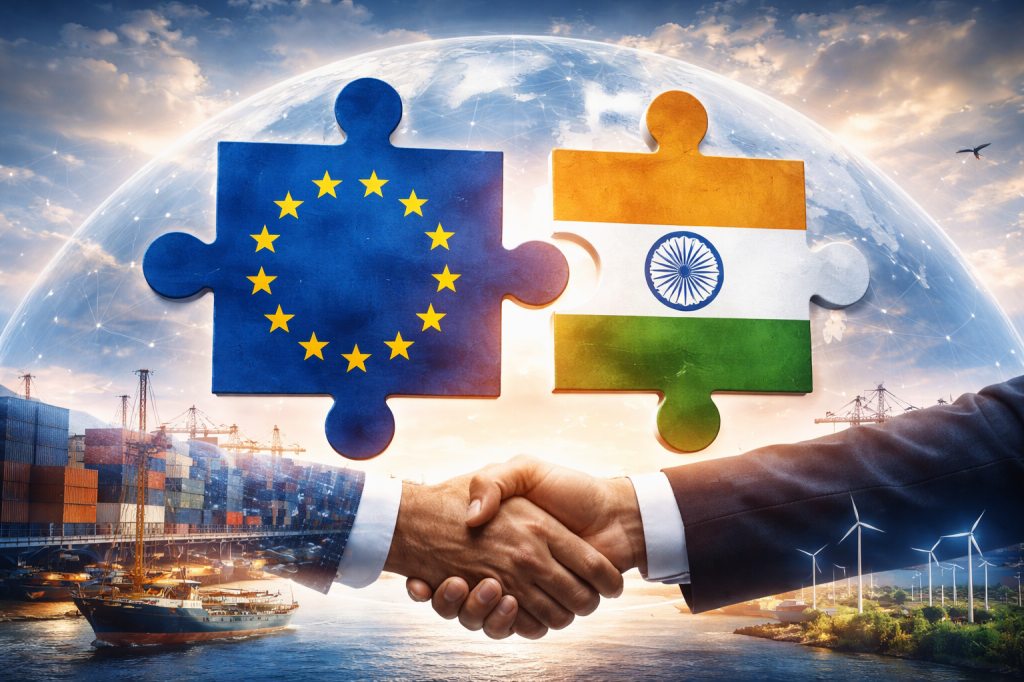
When Ursula von der Leyen called the upcoming EU–India Free Trade Agreement the “mother of all deals” at Davos, it was not diplomatic exaggeration. It was a recognition that this potential agreement—linking nearly two billion people and close to one-fourth of global GDP—could structurally shift the direction of global trade, investment and supply chains for the next three decades. For India, which is juggling export stagnation, tariff re-alignments by major partners, and the risk of missing the next manufacturing wave, the stakes are unusually high. For the European Union, facing strategic dependence on a few suppliers and an ageing industrial ecosystem, the search for a reliable, large-scale, rules-based partner has become a strategic imperative rather than an economic choice.
Historically, India and the EU have hovered around each other on trade ambitions. Negotiations launched in 2007 stalled repeatedly over tariffs on automobiles, wine, spirits, data adequacy, mobility of professionals, and labour-environment standards. The geopolitical landscape has transformed since then: supply-chain diversification, climate-linked industrial policies, the rise of digital regulation, and growing energy insecurity have made both sides revisit earlier red lines. What was once a tariff negotiation is now becoming a comprehensive strategic realignment.
Critically, the deal comes at a time when global trade itself is fragmenting. With high tariffs, techno-nationalism, and re-shoring gaining momentum, a large cross-continental agreement that is not driven by political blocs but by economic logic becomes unusually important. Europe needs a stable partner to rebalance its China exposure; India needs a high-value market that can anchor its next stage of industrial upgradation. The complementarities are striking: India’s demographic scale and growing manufacturing base match Europe’s technology depth, capital availability, and demand for diversified suppliers.
But the path ahead is not frictionless. Negotiations are now entangled with CBAM (Carbon Border Adjustment Mechanism), labour and sustainability benchmarks, digital-data rules, pharmaceutical IP, and market access for sensitive sectors such as dairy, automobiles, and processed foods. India’s traditional policy posture—protective on agriculture, cautious on standards, and defensive on IP—will be tested. Conversely, the EU will have to acknowledge that climate policy cannot become a disguised tariff, especially for countries like India where development pathways differ.
A futuristic reading suggests that the FTA may become more than a tariff-cutting exercise. It could evolve into a geo-economic partnership, shaping standards in green technologies, critical minerals, digital markets, supply-chain security, pharmaceuticals, and skilled mobility. If negotiated well, it could position India as Europe’s preferred alternative in global value chains—especially as both regions confront the volatility of energy markets and the tightening grip of climate regulations.
India’s broader ambition of becoming a $30 trillion economy by 2047 depends on securing long-term export anchors. Europe, with its purchasing power and regulatory heft, offers that anchor. Meanwhile, Europe’s search for a resilient, large-scale, democratic partner finds a natural match in India. The agreement therefore sits at the intersection of economics, strategy, and ideology.
Whether this truly becomes the “mother of all deals” will depend on how both sides balance ambition with pragmatism. Yet, for the first time in nearly two decades of negotiation, the incentives for convergence are stronger than the reasons for delay.#EUIndiaFTA
#GlobalTradeShift
#StrategicPartnership
#SupplyChainDiversification
#SustainableEconomy
#MarketAccessReforms
#GeoeconomicAlignment
#GreenTransitionTrade
#InvestmentFlows
#FutureReadyEconomies
 "Connecting communities, empowering nations: Unifying the Regional and Global Economy ."
Leave a comment