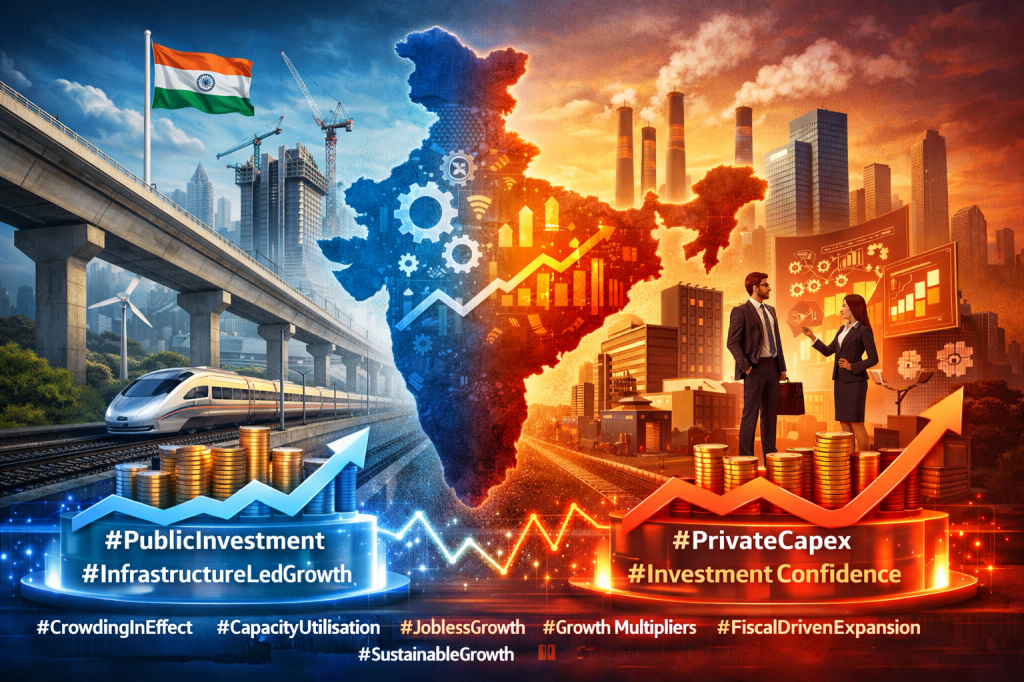
India’s current growth story sits at an unusual historical crossroads. At a time when headline GDP growth for FY26 is projected in the 6.5–7.4% range, the composition of that growth reveals a deeper structural imbalance. The economy is expanding, but it is being carried disproportionately by the state rather than by private enterprise. In macroeconomic terms, the Indian growth engine today is public-capex driven, with private investment still hesitant to take the baton—a pattern that carries important implications for sustainability, employment, and long-term productivity.
The State as the Growth Anchor
Historically, periods of high and durable growth—whether in post-war Europe, East Asia’s manufacturing boom, or India’s own early-2000s expansion—were marked by a strong and confident private investment cycle. In contrast, India’s post-pandemic recovery has leaned heavily on public capital expenditure. Large outlays on highways, railways, logistics corridors, ports, and urban infrastructure have acted as a macro stabiliser, preventing growth from slipping below potential amid global shocks, trade disruptions, and tightening financial conditions.
Government capital spending has risen steadily not merely in absolute terms, but as a strategic policy choice. This has supported gross fixed capital formation even as global demand weakened and export-oriented manufacturing faced tariff and dumping pressures. In the short run, this strategy has worked: public capex has provided demand, generated construction employment, and improved long-gestation infrastructure that private firms alone would not finance.
Yet history also teaches caution. When public investment becomes the dominant driver for too long, it risks diminishing returns. Infrastructure creates capacity, but capacity alone does not generate growth unless private firms see profitable opportunities to utilise it.
The Missing Private Investment Cycle
Private investment in India remains stuck at roughly 10–11% of GDP—well below the levels seen during high-growth phases and far short of what is needed to sustain 8–10% expansion. This hesitation is not due to a lack of liquidity alone, but to a deeper demand and confidence problem.
Capacity utilisation in manufacturing continues to hover below optimal levels, signalling that firms do not yet see sufficient demand pull to justify large new investments. Global uncertainty—ranging from US tariff escalation risks to geopolitical fragmentation—has further raised the hurdle rate for long-term private projects. Domestic factors compound this: policy unpredictability at the micro level, regulatory complexity, MSME credit gaps, and skills mismatches all weaken the investment climate.
From a historical lens, this resembles phases seen in Latin America during infrastructure-heavy but private-investment-light periods, where growth appeared robust in the short run but struggled to translate into productivity gains or employment intensity.
Crowding-In Has Limits
Economic theory often argues that public investment “crowds in” private investment by lowering costs and expanding markets. In India’s case, this effect is visible—but weakening. The multiplier impact of government spending has declined over time, suggesting that each additional rupee of public capex now generates less private response than it did a decade ago.
This matters because public investment cannot indefinitely substitute for entrepreneurial risk-taking. Roads and railways improve logistics, but factories, services, innovation, and exports ultimately depend on private balance sheets. Without a revival in private capex, growth risks becoming fiscally intensive and employment-light—an uncomfortable combination for a young, labour-abundant economy.
Growth Without Jobs: A Structural Warning
One of the most critical consequences of this imbalance is the persistence of jobless or low-quality-job growth. Public infrastructure generates employment, but largely during construction phases. Sustained job creation—especially for educated youth—requires private manufacturing, services, and technology investments at scale.
Historically, economies that failed to rebalance from state-led to private-led growth often faced rising inequality and social strain. The warning signs are subtle but present: educated unemployment, underutilised skills, and an expanding informal or gig economy absorbing workers who should have been employed in higher-productivity roles.
The 2026 Inflection Point
Looking ahead, the next phase of India’s growth will depend on whether private investment finally re-engages. Lower commodity prices, deeper trade agreements, improved GST efficiency, and more predictable policy frameworks could help reduce uncertainty. Equally important is risk-sharing—through well-designed public–private partnerships, credit guarantees for MSMEs, and stable long-term regulatory signals.
The lesson from history is clear: public investment can ignite growth, but private investment must sustain it. India has successfully built the runway. Whether it can now convince private capital to take off will determine not just the growth rate, but the quality and inclusiveness of growth in the decade ahead.
In that sense, India’s current growth is not fragile—but it is unfinished. The future lies not in choosing between public and private investment, but in restoring the balance that turns infrastructure into industry, capacity into confidence, and growth into shared prosperity.
#PublicInvestment
#PrivateCapex
#CrowdingInEffect
#InfrastructureLedGrowth
#CapacityUtilisation
#JoblessGrowth
#GrowthMultipliers
#InvestmentConfidence
#FiscalDrivenExpansion
#SustainableGrowth
 "Connecting communities, empowering nations: Unifying the Regional and Global Economy ."
Leave a comment