Asia’s post-pandemic recovery is entering a more fragile phase, shaped less by domestic cycles and more by the reordering of global technology, trade, and power. What appears today as a cyclical slowdown in exports and consumption is, in reality, a deeper structural transition—one where geopolitics, industrial policy, and technology controls are redefining the rules of growth.
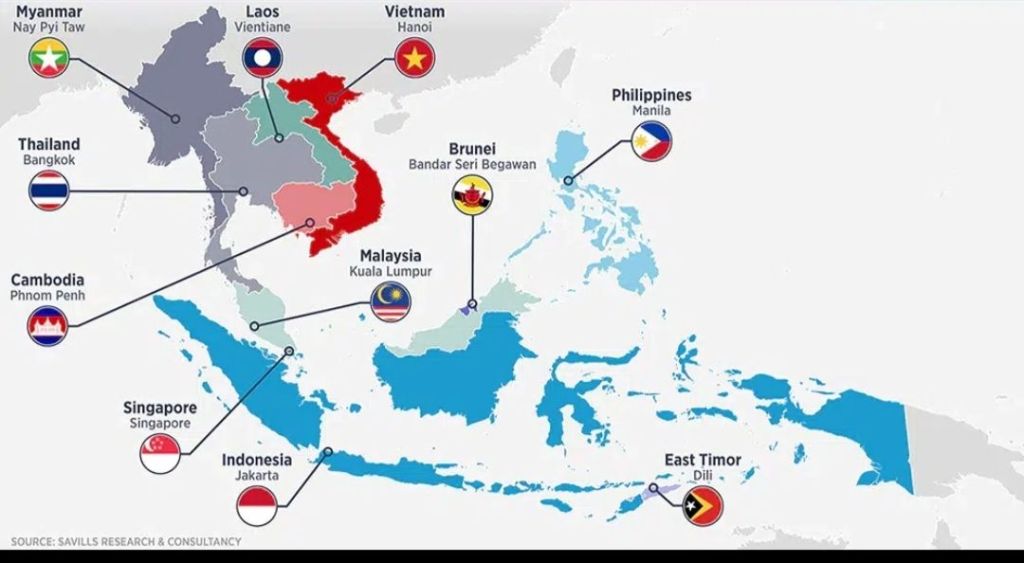
For export-dependent economies such as Vietnam, Malaysia, Thailand, and Taiwan, the tightening of US semiconductor controls and a broad-based slowdown in external demand have exposed a critical vulnerability: over-reliance on a narrow set of global value chains that are no longer governed purely by efficiency or price.
The Semiconductor Shock and Its Second-Order Effects
Semiconductors are no longer just intermediate goods; they are strategic assets. US restrictions on advanced chips, equipment, and design software—aimed at reshaping technological power balances—have had spillover effects well beyond their immediate targets. Taiwan, at the apex of global chip manufacturing, faces rising uncertainty over future market access, even as capital expenditure remains elevated. Southeast Asian economies that had positioned themselves as alternative manufacturing hubs for electronics assembly and testing are discovering that diversification without technology sovereignty has limits.
The immediate impact is visible in factory utilization rates and export orders. The deeper impact is unfolding in labour markets. Electronics and component manufacturing are among the highest formal employment generators in Vietnam, Malaysia, and Thailand. As orders soften, hiring freezes and job losses are beginning to dampen household consumption, creating a feedback loop where weaker domestic demand further suppresses growth.
Historically, Asia’s export-led model thrived on predictable globalization—stable trade rules, expanding consumer markets in the West, and rapid technology diffusion. That model is now being replaced by selective globalization, where access is conditional, and scale alone is insufficient.
External Demand Slowdown Meets Domestic Fragility
The current slowdown is not merely about semiconductors. Weak consumer demand in advanced economies, inventory corrections, and tighter financial conditions have collectively reduced appetite for Asian manufactured goods. What makes this phase more challenging is that many Asian economies are confronting it with less fiscal and monetary room than in previous downturns.
Unlike the early 2000s or the post–Global Financial Crisis period, governments today are constrained by higher debt levels, aging populations, and rising social spending commitments. This limits their ability to offset export weakness through aggressive domestic stimulus without long-term fiscal consequences.
India: Relative Resilience, Absolute Constraints
Against this backdrop, India stands out for its relative resilience—but not immunity. Growth hovering around 6% looks robust in a slowing global economy, yet it masks an important shift. India’s external sector is under pressure from tariffs, trade frictions, and subdued global demand, particularly in labour-intensive exports.
Historically, India relied more on domestic demand than exports, providing a buffer during global downturns. Today, however, ambitions to expand manufacturing, integrate into global value chains, and attract supply-chain relocation make external conditions far more consequential. Persistent tariff barriers and trade uncertainty risk slowing export momentum just as public investment and welfare spending are stretching fiscal balances.
The danger is not an immediate crisis, but gradual fiscal strain. Slower export growth limits revenue buoyancy, while political economy realities make expenditure compression difficult. Over time, this narrows India’s policy space precisely when structural investments—in infrastructure, skills, and industrial upgrading—are most needed.
A Historical Inflection Point for Asian Growth
From the Japanese manufacturing boom of the 1980s to China’s WTO-driven expansion in the 2000s, Asia’s growth story has been defined by its ability to plug into global demand. The current phase marks a turning point. Technology controls, tariff walls, and strategic decoupling signal that future growth will depend less on being the cheapest or fastest producer, and more on being strategically aligned, technologically relevant, and domestically resilient.
For Vietnam, Malaysia, Thailand, and Taiwan, the challenge is to move up the value chain while reducing exposure to single-country policy shocks. For India, the task is to balance openness with self-reliance without sliding into protectionism that undermines competitiveness.
The Futuristic Outlook: From Export Dependence to Strategic Growth
Looking ahead, Asia’s next growth cycle will be uneven and more contested. Economies that successfully combine industrial policy with workforce resilience, technology depth, and diversified trade partnerships will emerge stronger. Those that remain overly dependent on legacy export models may find that even modest external shocks translate quickly into domestic slowdowns.
The age of frictionless globalization is over. What replaces it is a world where growth is negotiated—through policy, alliances, and long-term strategy. Asia’s response to this transition will define not just its economic trajectory, but its place in the global order over the next decade.
#SemiconductorGeopolitics
#ExportLedGrowth
#TradeFragmentation
#AsianManufacturing
#GlobalValueChains
#TariffRisks
#EmploymentShock
#FiscalConstraints
#IndustrialPolicy
#StrategicDecoupling
 "Connecting communities, empowering nations: Unifying the Regional and Global Economy ."
Leave a comment