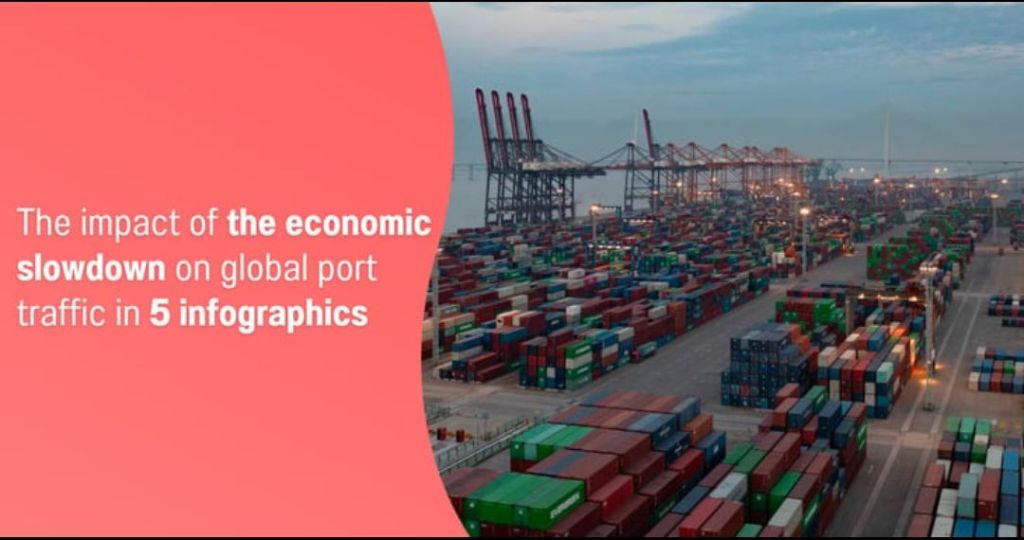
Global merchandise trade today sits at a decisive historical inflection point. After decades in which expanding volumes, falling tariffs, and efficiency-driven global value chains defined international commerce, the post-pandemic world has ushered in a more constrained, fragmented, and policy-heavy trade regime. While trade has not collapsed, it has unmistakably slowed—growing well below its long-term historical averages—even as global GDP continues to expand unevenly.
This divergence reflects deeper structural forces rather than a temporary cyclical downturn. Weak global demand, persistently high financing costs, and heightened policy uncertainty have combined to suppress trade elasticity. In earlier decades, modest global growth could still generate robust trade expansion. Today, that multiplier effect has weakened, signalling a structural decoupling between growth and trade intensity.
The Quiet End of the Tariff-Centric World
Historically, the architecture of global trade revolved around tariffs. From the post-war GATT framework through successive WTO rounds, liberalisation was measured in percentage-point reductions in customs duties. That era is now effectively over. Tariffs still exist, but they are no longer the primary instruments shaping market access.
Instead, non-tariff measures have become the dominant forces governing who trades, what trades, and under what conditions. Carbon regulations, export controls on strategic technologies, industrial subsidies tied to domestic production, and security-based investment screening now define the contours of trade flows. These measures operate quietly but powerfully, often outside traditional trade negotiations and dispute-settlement mechanisms.
The result is a trade system that appears open in form but restrictive in substance. Market access is increasingly conditional—dependent not only on price competitiveness but on compliance with regulatory, environmental, and geopolitical expectations set by importing countries.
Carbon, Security, and the Rewriting of Comparative Advantage
One of the most transformative shifts underway is the rise of carbon-linked trade governance. Embedded emissions are fast becoming as important as embedded value. Exporters now face the reality that access to major markets will increasingly depend on how goods are produced, not merely how cheaply. This marks a profound redefinition of comparative advantage—from labour and capital efficiency toward regulatory and environmental alignment.
Simultaneously, national security considerations have moved from the margins to the centre of trade policy. Export controls on semiconductors, critical minerals, advanced machinery, and dual-use technologies reflect a growing perception that economic interdependence carries strategic risks. Trade is no longer viewed as inherently stabilising; in many capitals, it is seen as a vulnerability to be managed.
These dynamics are reshaping global supply chains. Firms are redesigning networks not for lowest cost, but for policy resilience—prioritising jurisdictions that offer regulatory predictability, political alignment, and access to subsidies. The economic logic of trade is increasingly filtered through strategic and political lenses.
Industrial Policy as a Trade Determinant
Perhaps the most striking feature of the current phase is the return of industrial policy as a central trade variable. Subsidies, local-content requirements, and state-backed financing are no longer exceptions but core features of competitiveness in many sectors. Clean energy, electric vehicles, semiconductors, and advanced manufacturing now operate within heavily policy-mediated ecosystems.
This blurs the boundary between domestic economic strategy and international trade rules. Trade outcomes are no longer determined at the border alone; they are shaped deep inside national policy frameworks. For exporting firms, understanding foreign industrial policy has become as important as understanding consumer demand.
Over time, this risks creating a two-tier global trade system: one governed by dense regulatory and subsidy regimes among advanced economies, and another where market access remains volatile and contingent for late-industrialising countries.
A Futuristic Outlook: Trade as a Negotiated Privilege
Looking ahead, global trade is unlikely to return to the high-growth, low-friction trajectory of the pre-2008 era. The future points toward slower, more selective, and more politicised trade expansion. Growth will persist, but it will be conditional—rewarding countries and firms that can align with evolving policy frameworks on climate, security, and industrial transformation.
In this emerging order, trade increasingly resembles a negotiated privilege rather than an automatic outcome of competitiveness. Compliance capacity—legal, environmental, technological, and institutional—will matter as much as productivity. Firms and nations that fail to adapt risk exclusion not through explicit bans, but through rising compliance costs and regulatory complexity.
Historically, trade liberalisation was about dismantling barriers. The next phase is about navigating them. The defining challenge of the coming decades will not be whether global trade grows, but who is allowed to participate meaningfully in it—and on whose terms.
#GlobalTradeReset
#PolicyConditionedMarkets
#NonTariffBarriers
#CarbonLinkedTrade
#ExportControls
#IndustrialSubsidies
#SupplyChainRewiring
#GeoeconomicFragmentation
#MarketAccessRules
#PostTariffWorld
 "Connecting communities, empowering nations: Unifying the Regional and Global Economy ."
Leave a comment