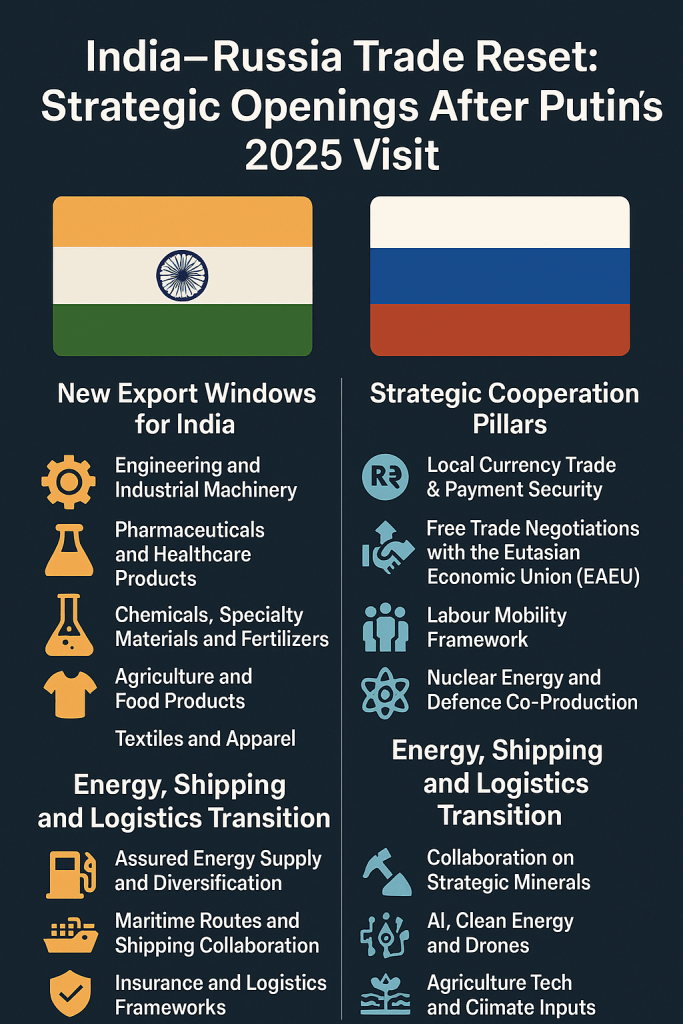
India’s renewed engagement with Russia following Vladimir Putin’s December 4–5, 2025 visit marks a decisive shift in New Delhi’s long-term foreign economic strategy. The new Economic Cooperation Programme till 2030 signals that the partnership is evolving beyond energy dependency into a structured, multi-sector commercial relationship with a clearly stated ambition: $100 billion in balanced bilateral trade within five years.
This is not an episodic diplomatic moment — it is a structural recalibration built around supply-chain realignment, currency de-risking, and long-term industrial collaboration amid a fragmenting global economic system.
Historic Context and Geopolitical Timing
India–Russia trade has long been characterized by asymmetry. Russia exported energy, defense equipment, and raw materials, while India exported restricted categories such as pharmaceuticals, tea, textiles, and some machinery. The trade deficit ballooned to nearly $59 billion in FY 2024–25, driven by discounted Russian crude imports.
Putin’s visit comes at a time when the global trade architecture is undergoing sharper geopolitical polarization, sanctions fragmentation, and technological blockage. Russia seeks alternative markets and supply chains amid Western restrictions, while India seeks diversification, strategic resources, and new export destinations. This is a rare alignment of opportunity and necessity — economically and geopolitically.
New Export Windows for India
The 2030 roadmap explicitly prioritizes increasing India’s non-energy exports, where Russia’s import capacity far exceeds India’s current penetration. The biggest opportunities include:
Engineering and Industrial Machinery: India currently exports $90 million worth to Russia against a potential demand of $2.8 billion. With Russia diversifying away from Chinese machinery under strategic autonomy pressures, Indian machine tools, automotive components, power equipment, and industrial systems could benefit.
Pharmaceuticals and Healthcare Products: Already a $520 million sector, Indian generics, biosimilars, immunologicals, and medical devices now stand to scale further as Russia seeks affordable alternatives to Western drugs.
Chemicals, Specialty Materials, and Fertilizers: The joint fertilizer plant announcement positions India for stable ammonia and potash supplies while enabling export of downstream chemical products.
Agriculture and Food Products: Processed foods, ready-to-eat meals, dairy, spices, and basmati rice remain high-margin opportunities due to consumer demand and competitive pricing.
Textiles and Apparel: With sanctions disrupting European fast-fashion supply chains, India can step in with cotton garments, technical textiles, and winter apparel.
Strategic Cooperation Pillars
The agreements signed indicate the relationship is moving toward structured economic integration:
Local Currency Trade & Payment Security: Rupee-ruble trade settlement mechanisms aim to bypass U.S. financial controls and reduce volatility risks.
Free Trade Negotiations with the Eurasian Economic Union (EAEU): If concluded, India could gain preferential access to a regional market of 180+ million consumers, expanding beyond Russia into Kazakhstan, Belarus, Armenia, and Kyrgyzstan.
Labour Mobility Framework: India is exploring a formal migration and employment corridor — especially for skilled technicians, healthcare workers, and shipbuilding labour — which could resemble existing Gulf-India labour pathways.
Nuclear Energy and Defence Co-Production: Shift from buyer-supplier to co-creation — including small modular nuclear reactors, repair ecosystems for military equipment, and local manufacturing of aviation components.
Energy, Shipping and Logistics Transition
While Russia assured “uninterrupted” energy supply despite U.S. pressure, India’s focus is clearly diversification — using discounted crude as a tactical input while expanding long-term cooperation in:
Arctic and Eastern maritime routes
The International North–South Transport Corridor (INSTC)
Shipbuilding and repair facilities
Insurance and logistics frameworks to bypass sanctions choke points
The vision is to make freight time between India and Russia competitive with China’s Belt and Road logistics network.
Critical Minerals, Technology and Future Trade Themes
Russia’s reserves in lithium, cobalt, palladium, nickel, and rare earths position it as a strategic partner as India accelerates EVs, defence tech, electronics manufacturing, and clean energy.
Future trade will likely extend into:
Hydrogen and ammonia fuel ecosystems
AI, cybersecurity, and semiconductor components
Dual-use drone systems and aviation ecosystems
Agriculture tech and climate-resilient farming inputs
These reflect a pivot from transactional trade to industrial and technological interdependence.
Futuristic Outlook
By 2030, the India–Russia commercial relationship may look fundamentally different from its Cold War-era defence-driven legacy. If executed strategically, India could emerge not just as a large buyer of Russian natural resources — but as a major supplier of industrial goods, pharmaceuticals, food systems, and technology solutions.
However, the partnership will evolve under the shadow of:
Secondary sanctions risk
U.S.–Europe pressure
Payment and insurance uncertainties
Logistics and tariff asymmetries
Domestic manufacturing capacity constraints
Success will depend on reforms in certification, standards, logistics financing, and trade infrastructure — particularly if India intends to shift from an import-driven equation to a balanced, manufacturing-led trade model.
Putin’s 2025 visit may be remembered as the moment India-Russia trade transitioned from hydrocarbon dependency to structured strategic economic cooperation. The opportunities are real — in machinery, pharmaceuticals, energy, nuclear co-development, workers’ mobility, agriculture, logistics, and critical minerals.
If India plays this phase strategically, leveraging geopolitical timing and industrial capacity expansion, the next five years could mark India’s emergence in Eurasia not just as a market — but as a systemic economic actor shaping supply chains, technology partnerships, and energy transitions in a multipolar world#IndiaRussiaTrade
#EconomicCooperation2030
#StrategicPartnership
#EngineeringExports
#PharmaLeadership
#EnergySecurity
#CriticalMinerals
#RupeeRubleTrade
#EAEUFTA
#GeopoliticalRealignment.
 "Connecting communities, empowering nations: Unifying the Regional and Global Economy ."
Leave a comment