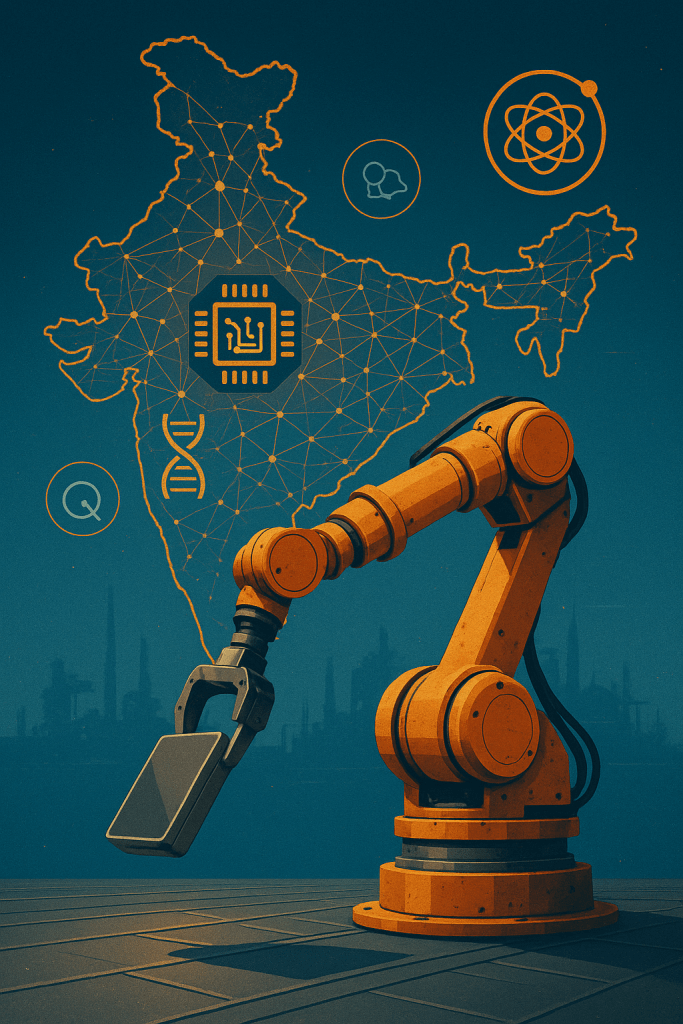
India stands at an inflection point. The next two decades will determine whether the nation becomes one of the world’s leading manufacturing and innovation hubs—or remains a peripheral contributor to global supply chains. The ambition is clear: by 2047, when India completes 100 years of independence, manufacturing must evolve from a supporting sector to a structural backbone of the economy.
Historically, manufacturing in India has hovered between 13–17% of GDP—far below the benchmarks seen in industrialised nations such as South Korea, China, Taiwan, Germany, and Japan. But the vision ahead is transformational: manufacturing should contribute approximately 25% of India’s GDP, and the sector’s output must expand nearly 15-fold from today’s levels. This is not merely a scaling exercise—it is a complete reimagination of how India produces, innovates, trades, and competes.
The Logistics Imperative: Silent, Decisive, Non-Negotiable
No manufacturing transformation is possible without logistics reform.
India’s logistics cost—long estimated at 13–14% of GDP—has been a drag on competitiveness. The new target is clear: shift towards 7–8%, aligning India with advanced manufacturing economies such as Germany, Japan, and South Korea. This shift is not cosmetic—it directly affects export pricing, supply chain reliability, and global investment attractiveness.
Key enablers already underway include:
Multi-Modal Logistics Parks
Modernised Ports under Sagarmala
Industrial Corridors like DMIC and CBIC
Digitised Supply Chains via ULIP, FASTag, ONDC-logistics frameworks
As these systems mature, India isn’t just improving logistics—it is building the infrastructure intelligence required for scale, speed, and resilience.
Opening India to the World: Strategic Markets, Strategic Diplomacy
India’s manufacturing ascent cannot occur in isolation. Global trade access, preferential agreements, and supply-chain diplomacy will shape sectoral competitiveness. India’s trade engagements—from CEPA with UAE to discussions with the EU, UK, Canada, and IPEF partners—signal a maturing strategic posture: India is negotiating not reactively, but assertively and selectively.
As value chains globally reorganise in response to geopolitical fractures, India’s positioning offers an alternative: scale, stability, cost advantage, and governance confidence. This is slowly changing India’s role—from being a procurement option to becoming a production and partnership hub for the world.
From Manufacturing to Research: Building the Innovation Engine
One of the most significant developments—though often understated—is the creation of the National Research Foundation (NRF). With its focus on:
Artificial Intelligence
Quantum Computing
Space Technology
Biotechnology
India is transitioning from being a technology adopter to a technology architect.
However, the next leap requires industry to lead—not follow. Corporate R&D labs, university collaboration models, and deep-tech ecosystem clusters must become core architecture—not optional enhancements. The goal must evolve from Make in India → Design in India → Invent in India.
Manufacturing without innovation leads to commodity traps. Innovation without production leads to dependency. The strength lies in fusion.
Demography, Skilling, and the Workforce Revolution
India’s demographic dividend is not automatic—it must be earned. The country needs a workforce equipped with advanced manufacturing, automation, AI-assisted productivity, robotics, and materials science capabilities.
A new skilling model is emerging—mass, agile, tech-enabled, and inclusive. Women’s participation—rising from 23% to much higher levels in recent years—marks a structural social shift. A future-ready manufacturing powerhouse cannot afford to leave 50% of its talent behind.
This is not just labour reform—it is human capital renaissance.
The Road Ahead: A Future Built, Not Inherited
If India succeeds, the next chapter will not be defined by low-cost labour or scale alone—it will be defined by:
Technological ambition
Domestic capability
Research leadership
Trusted supply chain identity
The world is watching a long cycle play out: China’s slowdown, supply chain diversification, reshoring in the West, and the rise of strategic manufacturing. India’s moment arrives not by coincidence—but by convergence.
The question now is not whether India can become a manufacturing and innovation powerhouse.
The real question is:
> Can India sustain the discipline, coordination, and long-term investment mindset required to lead—not just participate in—the next global manufacturing era?
If the answer is yes, then by 2047, India will not simply be making products—it will be shaping the technologies, materials, and systems that define the next age of industry.
#ManufacturingIndia
#InventInIndia
#LogisticsReform
#DeepTechEcosystem
#SkillRevolution
#NationalResearchFoundation
#DigitalSupplyChains
#WomenInWorkforce
#IndustrialCorridors
#India2047
 "Connecting communities, empowering nations: Unifying the Regional and Global Economy ."
Leave a comment