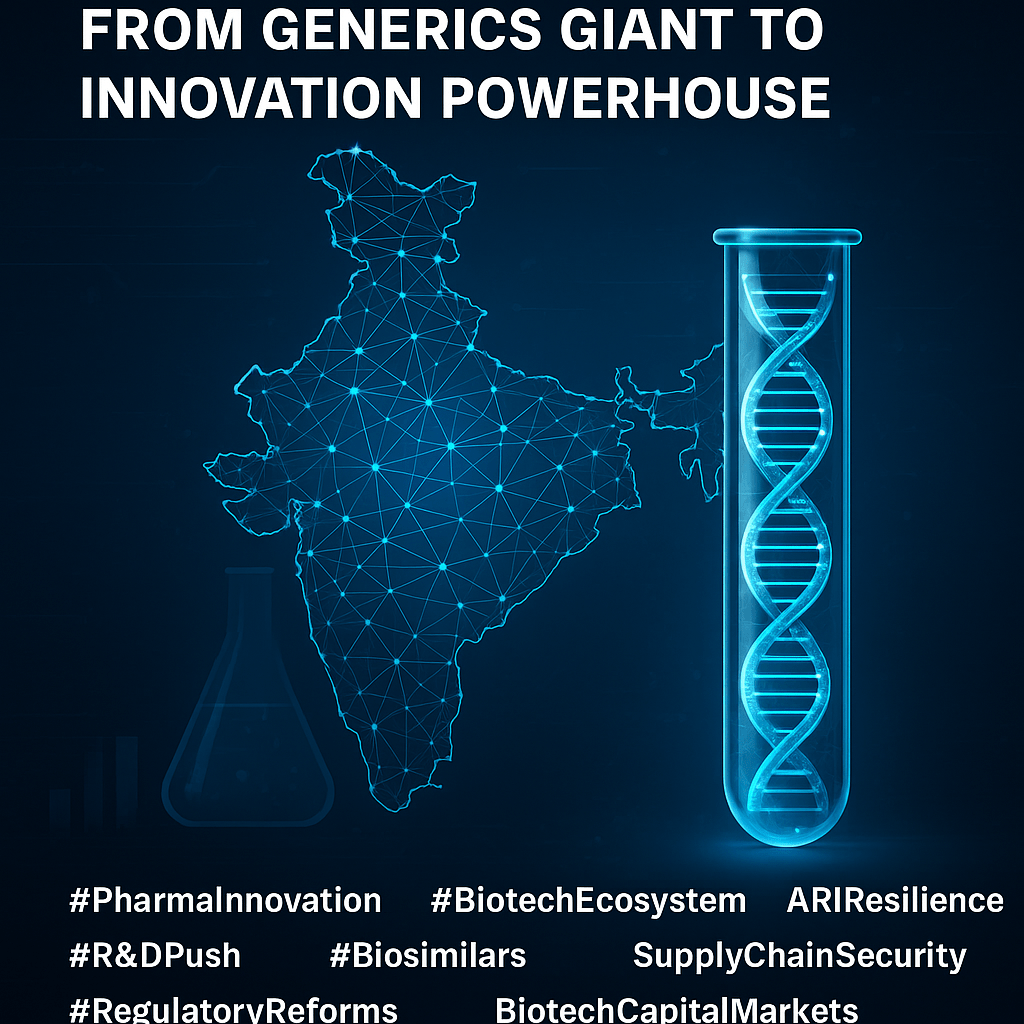
For decades, India’s pharmaceutical identity has been shaped by one defining phrase: “The pharmacy of the world.” With over 60% of global vaccine supply and nearly 20% of generic medicines consumed worldwide manufactured in India, the narrative has been firmly established. But history shows that industrial reputation is rarely static. Steel economies become chip economies, textile hubs evolve into automation hubs, and now — India’s pharmaceutical and biotech base is reaching an inflection point.
A quiet but powerful transition is underway: from low-cost volume manufacturing to innovation-driven value creation.
How We Got Here
India’s generics boom was built on three pillars:
A bold amendment to patent rules in the 1970s that prioritised process patents.
A large technical workforce and cost advantage.
Strong global demand for affordable medicines.
By the early 2000s, India had turned patent flexibility, chemistry expertise, and global market access into a strategic asset, especially after joining TRIPS under the WTO. The industry matured further with exports to regulated markets, WHO-approved facilities, and multinational partnerships.
But history also reveals a vulnerability: overdependence on imported Active Pharmaceutical Ingredients (APIs)—particularly from China.
The Strategic Shift: Innovation + De-Risking
The new editorial mood shaping the sector suggests that India is moving beyond the generics plateau. The direction is clear: discover, design, develop — not just duplicate.
Recent developments reinforce this pivot:
At the 18th CPHI & PMEC India Expo in New Delhi, more than 50,000 industry leaders discussed an innovation-led future.
Regulators signalled confidence that India could become an innovation-driven pharmaceutical power within the next five years.
CDSCO representatives highlighted a new ₹5,000-crore R&D push, flexible regulatory pathways, and support for biosimilars and complex biologics.
This marks a policy and regulatory evolution: from compliance policing to innovation enablement.
The Missing Link: Biotech Capital Markets
A key critique emerging from industry thinkers is financial infrastructure. While the US and Europe have biotech capital ecosystems — from NASDAQ’s biotech board to deep venture pipelines — India’s research-stage companies struggle to scale.
The call for a dedicated biotech listing board on NSE/BSE is not cosmetic — it is structural. Without risk capital, India risks repeating the electronics paradox: strong manufacturing, weak intellectual property ownership.
If India seeks to be a biotech innovation economy, biotech financing must shift from grant-dependence to capital-markets integration.
The China Factor: A Supply-Chain Reality Check
Despite progress, vulnerability remains.
China dominates critical raw materials — intermediates, fermentation-based products, key APIs — making India’s scale dependent on foreign reliability. Recent U.S. pressures for origin reporting in pharmaceutical supply chains underscore how geopolitics is becoming a compliance requirement.
India’s PLI schemes, API parks, and cluster-based backward integration initiatives are therefore not industrial incentives — they are strategic resilience architecture.
Global Collaboration: The Next Competitive Advantage
India is also signalling a willingness to globalise science. Biotech today thrives not on siloed research, but on cross-border collaboration — where academia, regulators, industry, and investors interact continuously.
Partnership-based innovation — from clinical research to biologics manufacturing — could accelerate India’s biotechnology maturity curve faster than any subsidy.
What Will Define the Next Decade?
India’s pharma and biotech future will depend on four intertwined shifts:
Strategic Vector Future Imperative
R&D to IP More patents, fewer reverse-engineering successes.
Volume to Value From low-margin generics to biologics, gene therapy, and precision medicine.
Dependence to Resilience From imported APIs to regional ingredient ecosystems.
Growth to Governance Regulatory agility without compromising quality or ethics.
A Decisive Moment
India’s pharmaceutical journey is entering its second act. The first was defined by affordability and accessibility — a global public good. The next may be shaped by innovation, resilience, and strategic autonomy.
The world doesn’t just need India’s medicines — it may soon need India’s medical breakthroughs.
The question is no longer whether India can innovate.
It is whether the ecosystem — capital, regulation, talent, and policy — can align fast enough to turn ambition into global leadership.
And right now, the momentum suggests the answer may soon be yes.#PharmaInnovation
#BiotechEcosystem
#APIResilience
#R&DPush
#Biosimilars
#SupplyChainSecurity
#RegulatoryReforms
#BiotechCapitalMarkets
#GlobalCollaboration
#InnovationEconomy
 "Connecting communities, empowering nations: Unifying the Regional and Global Economy ."
Leave a comment