1 From Engagement to Escalation
The economic relationship between the world’s two largest economies — the United States (US) and the People’s Republic of China (China) — has long oscillated between phases of integration and contestation. Beginning in the late 1970s, China’s opening up and its accession to the World Trade Organization (WTO) in 2001 underpinned three decades of deepening flows: of goods, capital, technology and supply-chains.
By the mid-2010s, China had become the manufacturing and export hub for many global value chains, and the US both outsourced production and imported cheap Chinese goods (which helped keep inflation low).
Simultaneously, China invested in advanced manufacturing and emerging tech, gradually narrowing the technological gap.
Frictions, however, had been building: trade imbalances, intellectual property (IP) concerns, forced technology transfer, state subsidies, and national-security anxieties.
In 2018-19, under the Trump administration’s “phase one” negotiations, the US ramped up tariffs and export controls on China; China responded with its own counter-measures and export restrictions (including in rare-earth elements) — effectively the start of a new trade war paradigm.
By early 2025 the conflict escalated further: China imposed tighter export controls on critical minerals; the US threatened 100 % tariffs; both sides were on brink of severe decoupling.
Thus, the recent agreement (announced October 30, 2025) emerges against a backdrop of structural contestation — not simply short-term trade squabbles.
2. The One-Year Agreement: What It Covers and Why It Matters
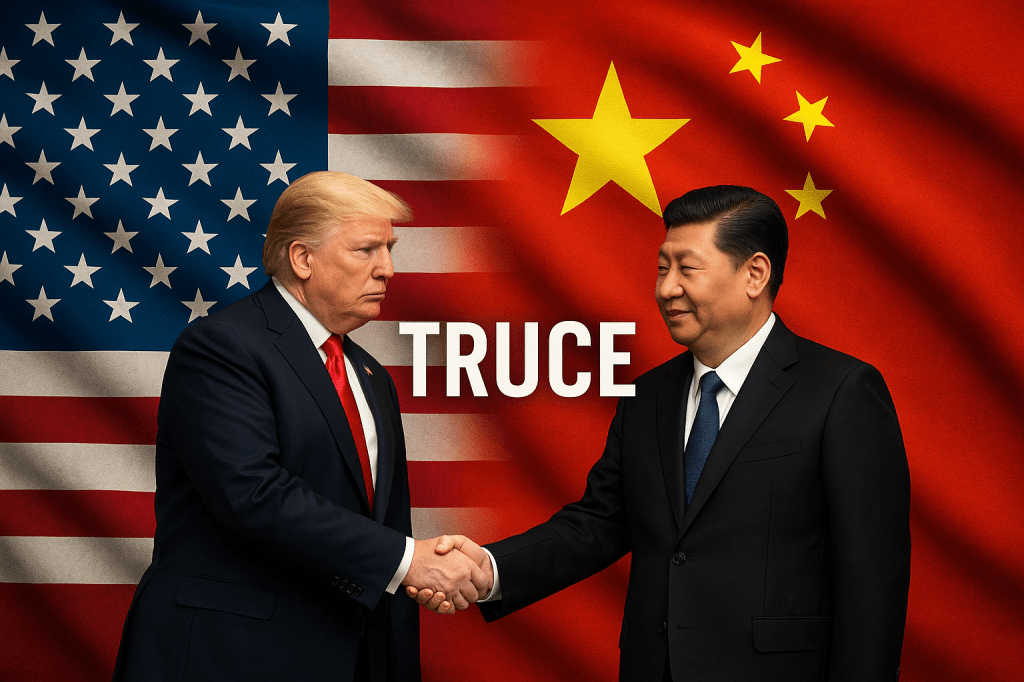
On October 30 2025, US President Donald Trump and Chinese President Xi Jinping met in Busan, South Korea, on the sidelines of the APEC summit and announced a “one-year” truce in their economic clash.
Key elements of the agreement:
China will suspend for one year its planned export restrictions on rare earths and critical minerals — a potent lever given China’s dominant global position in rare earth processing.
The US will lower its broader tariff burden on Chinese goods — from about 57% to 47% average — and cut the special “fentanyl-precursor” tariff rate from 20% to 10%.
A one-year cease-fire: no new tariffs or retaliatory trade barriers will be introduced during the period, giving space for negotiation of a deeper deal.
Other provisions: Suspension of reciprocal shipping/port-fees for one year; China’s commitment to increase purchases of US agricultural products (soybeans, energy) and to work closely with US on fentanyl precursor flows.
Why it matters:
For global supply-chains the rare-earth element is a major flash-point: many high-tech goods (EVs, wind turbines, defence electronics) depend on magnet and light/heavy-rare earth inputs. The one-year pause buys immediate breathing space.
For business and markets, the truce reduces uncertainty of “all-out” decoupling and wholesale tariff escalation, which had been raising costs, re-routing supply chains and elevating geopolitical risk premia.
For the US domestic political economy, it delivers headline relief (tariffs down, Chinese purchases up, Chinese action on fentanyl) — albeit this may be more symbolic than structural.
For China, the deal removes immediate uncertainty and gives time to calibrate its own strategy — but without relinquishing its longer-term strategic ambition of technological self-reliance and shifting global power balances.
3. Temporary Relief, Deep Structural Contestation
Although the truce offers positive signals, a critical assessment suggests caution.
Duration and renewal: The agreement is explicitly for one year, and both sides expect renewal or renegotiation. A one-year term suggests the deal is a cease-fire, not a resolution of underlying issues.
Unresolved core issues: Despite the deal, major structural conflicts remain: China’s ambitions in AI/semiconductors; the US concerns of technological leakage and national-security; supply chain vulnerabilities; intellectual-property and market-access grievances. The deal does not cover Taiwan, cybersecurity, full decoupling of defence-supply chains, or structural reform in China.
Asymmetries persist: China remains dominant in rare-earth processing; the US remains dependent. Indeed, China processes over 90% of rare-earths and magnets globally. This dependence gives Beijing latent leverage.
Symbolism over substance? Some critics argue the truce is more about optics and immediate risk-mitigation rather than a fully fleshed roadmap for de-escalation. As one analyst put it, “both sides have not given up their trade weapons but merely have agreed to stop firing.”
Market reaction cautious: Global markets reacted modestly, arguably reflecting scepticism that the deal changes fundamentals.
Thus, while the agreement is a meaningful stop-gap, it is far from a durable structural settlement.
4. The Future: Scenarios, Opportunities & Risks
Looking ahead, the agreement opens several possible trajectories — both positive and cautionary.
4.1 Scenario A: The “Managed Competition” Path
Under this scenario:
The one-year truce becomes an annual rollover mechanism; each year the US and China negotiate incremental adjustments rather than full structural resolution.
Supply-chains stabilize somewhat: companies accept a “some China exposure but diversified” model. Rare-earth sourcing diversifies (Australia, India, US), yet China remains central for many components.
India (and other middle economies) become supply-chain beneficiaries: lower immediate supply-shock risk, but also find themselves fitting into a multi-polar chain where China still anchors processing and the US anchors advanced-tech design.
Technological competition persists but becomes more institutionalised: e.g., separate rules-of-the-road for AI, semiconductors, export controls — a kind of regulated bifurcation rather than full decoupling.
4.2 Scenario B: Structural Breakthrough — or Breakaway
In this more optimistic yet disruptive scenario:
The one-year pause is used to negotiate a deeper treaty: covering technology transfer, mutual investments, export controls, and perhaps a partial “industrial peace” arrangement.
China gradually opens up market access in services and reduces forced-technology transfer; the US eases some tariffs and export controls.
Rare-earth supply-chains become more global and less China-centric; new players (Australia, India, Africa) ramp up. China transitions from choke-point to node.
Indo-Pacific economic architecture strengthens: the US, Japan, Australia, India cooperate more on supply chains, critical minerals, technology standards, offering an alternative to China-centric chains.
But this scenario carries high risk of destabilisation: if either side interprets the truce as merely tactical, they may restart escalation once the one-year term ends or if domestic politics demand it.
4.3 Scenario C: Re-escalation and Unintended Consequences
A less benign scenario:
The one-year agreement collapses (due to non-compliance, domestic political pressure, or unexpected shock) and both sides revert to full conflict: re-imposition of 100 % tariffs, expanded export controls on technology, China invoking rare-earth weaponisation.
Global supply-chains splinter: companies fully decouple from China (or allocate major capacity elsewhere); trade blocs solidify (US+allies vs China+“rest”).
India and other mid-sized economies become battlegrounds for supply-chain location, caught amid two blocs, each vying for preferential status and resilience.
Global growth suffers: elevated trade costs, supply-chain realignments, slower investment in risk-laden industries, tech fragmentation, higher inflation.
This scenario reminds us that the truce is not insurance against derailment — and we should treat it as fragile.
5. Implications for India and the Global South
For India (and other emerging economies), this US–China deal both alleviates immediate risks and raises strategic possibilities.
Immediate relief:
Reduced short-term risk of rare-earth export disruption — helping Indian firms that source magnets or specialised inputs for EVs or electronics.
Deceleration of freight/shipping volatility and tariff-shock anxiety — important given India’s integration into global supply-chains and dependencies on imported inputs.
Space for India to manoeuvre: the truce gives breathing room for India to deepen its supply-chain linkages (for example with the US, Asia, or China) without being forced into an immediate “choose-one” binary.
Strategic opportunity:
India can position itself as a diversification node: given rising interest in rare-earths, critical minerals, and supply-chain resilience, India’s reserves (e.g., in rare earths) and trusted geography (in the Indo-Pacific) could be leveraged.
India may participate in “tech-safe” chains: as the US seeks trusted supply-chain partners, India (with its democratic credentials) might attract investment in advanced manufacturing, semiconductors, and critical minerals processing.
India-China relations become more nuanced: China may look to India as a buffer or supplementary node in its supply-chain strategy; India must wield this carefully to avoid over-dependence.
But caveats:
The deal doesn’t guarantee supply-chain de-risking for India: China remains dominant in rare-earth processing, so India remains exposed.
India must balance maintaining strategic autonomy (with China) and aligning with the US and other democracies. The US–China truce may reduce urgency for India to pick sides — but over the medium term, alignment pressures will likely intensify.
India’s own policy and ecosystem must scale up: extracting rare earths is only part of the value-chain; processing, refining and manufacturing still need major investment and capability-building.
Long-Term Outlook and Critical Questions
As we project into the next decade, several key questions emerge — the answers to which will shape whether the truce becomes a stepping-stone or a waiting trap.
Will China genuinely reduce its dominance in rare-earth processing? Dominance in processing, refining and magnet fabrication gives China structural advantage. Unless this changes, the so-called “choke point” remains.
Will the US maintain consistent policy? Tariff and export-control policies depend on domestic politics. The durability of this deal depends on US administrations resisting retrenchment or relapse into “trade war mode.”
Can technology competition be compartmentalised? If the US and China manage to carve out trade/tech coexistence (e.g., separate “clusters” of supply-chains) that may be stable. But if tech becomes zero-sum (AI, semiconductors, quantum), then the risk of breakdown remains high.
Will the global system adapt? Many countries will no longer be passive “consumers” but active nodes in supply-chains and critical-minerals networks (India, Australia, Africa). The truce gives time, but the impetus to restructure is strong.
What role will India play? India has an opportunity to leap-frog from “supply-chain risk zone” to “supply-chain resilience partner”. But that depends on policies, investment climate, infrastructure and diplomatic agility.
A Truce, Not a Treaty
The US–China one-year trade agreement is significant, but it is by no means conclusive. It is a truce, not a final settlement. It delivers breathing space — but not a guarantee of long-term stability. In truth, the structural contest between the US and China over supply-chains, critical minerals, technology, and geopolitical influence remains very much alive.
For policy-makers, corporates and analysts the key challenge is this: how to use this window smartly. If actors treat the next 12 months as a reset moment — rebuilding resilient supply-chains, diversifying sources, investing in processing capacity, and engaging in next-generation technologies — then the deal may be a stepping-stone. If instead they relax and assume “normalcy” has returned, they risk being caught if the truce falters.
For India, the window is golden — but transient. The country must act now to position itself as a crucial node in the evolving global economic architecture.
In short: the handshake in Busan is promising — but whether it leads to a new era of cooperative competition, or simply postpones the next flare-up, will depend on actions taken today.
#uschinatradedeal
#rareearths
#tarifftruce
#globalsupplychains
#economicdiplomacy
#technologicalcompetition
#criticalminerals
#geopoliticalstrategy
#indiastrategicopportunity
#futureoftrade
 "Connecting communities, empowering nations: Unifying the Regional and Global Economy ."
Leave a comment