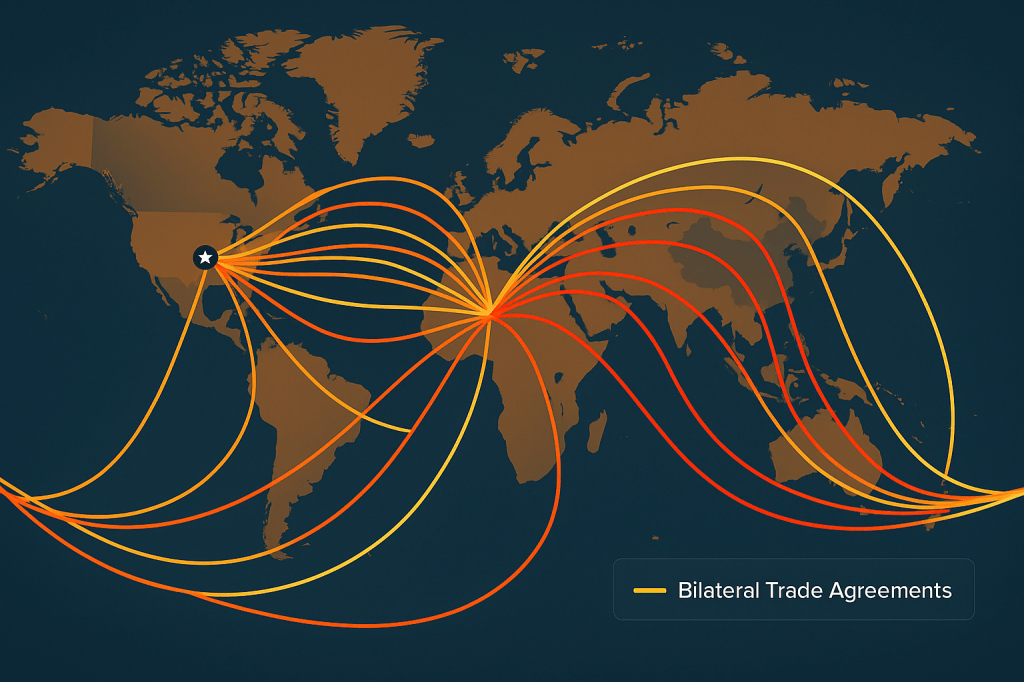
The November Anticipation: Fact or Political Optics?
As global markets await a series of trade announcements from Washington, a growing narrative suggests that the United States may finalize all its bilateral trade agreements before 5 November 2025. However, there is no public confirmation to substantiate this claim. The speculation, amplified by political timelines and trade calendar coincidences, appears to be driven as much by optics as by actual policy progress.
In truth, trade diplomacy rarely works on a synchronized calendar. Each agreement reflects a unique negotiation trajectory—shaped by strategic interests, domestic politics, and global economic currents. The idea that every bilateral deal could converge toward finalization before an early-November deadline sounds more symbolic than structural.
The U.S. and the Art of Incremental Trade Diplomacy
Historically, U.S. trade negotiations have evolved through incrementalism, not simultaneity.
From NAFTA in the 1990s (which later evolved into USMCA) to the Phase One China deal under the Trump administration, major trade pacts have followed years of iterative bargaining, internal reviews, and Congressional procedures.
The re-emergence of U.S. bilateral activism in 2025 recalls similar patterns—high-profile frameworks preceding concrete legal ratifications. Washington’s preference for “frameworks” rather than fully ratified treaties gives it flexibility to adjust commitments amid changing political winds, especially in a pre-election climate.
What We Do Know: Momentum, Not Finality
By late October 2025, the U.S. had announced trade frameworks with select Southeast Asian partners such as Malaysia and Cambodia, and a tentative understanding with China aimed at stabilizing the world’s two largest economies after years of tariff friction.
Simultaneously, India’s Commerce Minister publicly expressed optimism that a U.S.–India trade pact could be finalized “by November,” suggesting genuine progress but not a binding guarantee.
These developments indicate a political rhythm of acceleration—Washington signaling goodwill and forward motion ahead of key policy or judicial dates. Yet, most of these deals are frameworks—drafts of intent that must still navigate the machinery of ratification, compliance review, and, crucially, legislative scrutiny.
Why the “All Deals by November” Narrative is Weak
The claim that all bilateral trade agreements will be finalized before 5 November 2025 collapses under factual and procedural examination:
1. Multiplicity of Negotiations:
The U.S. is concurrently negotiating with multiple partners—India, the EU, Japan, ASEAN states, and Latin American economies—each requiring distinct legal language and tariff schedules. A single negotiation cycle can take months to years.
2. Frameworks vs. Final Agreements:
Many announced “agreements” are preliminary. A framework is a declaration of policy direction; it is not equivalent to a ratified treaty enforceable under domestic or WTO rules.
3. Domestic Ratification Bottlenecks:
Even after signing, agreements often require Congressional approval or implementing legislation. The history of trade pacts shows delays between signing and enforcement—sometimes stretching into multiple fiscal cycles.
4. November’s Real Significance:
The 5 November 2025 date aligns with trade-calendar events—notably, U.S. Supreme Court hearings related to tariff-authority cases—rather than with formal trade-agreement deadlines. It is therefore a policy coincidence, not a mandated milestone.
The 30–40% Probability Window
Given current progress, it is plausible that 30–40% of major U.S. trade negotiations could reach signing or near-finalization stages by early November 2025.
However, the likelihood that every bilateral agreement—across continents and industries—will be complete by that date is near zero.
Historical precedent supports this skepticism: even under strong executive momentum, comprehensive trade frameworks like the Trans-Pacific Partnership (TPP) took nearly a decade to structure and still failed to sustain bipartisan consensus.
The Deeper Dynamics: Strategic Layer Beneath the Deadlines
The rush toward early-November trade milestones reveals more about strategic signaling than trade finalization. The U.S. appears intent on projecting economic stability and diplomatic assertiveness ahead of critical domestic decisions—perhaps to reassure markets and allies that American trade leadership remains intact despite internal polarization.
This also reflects a broader post-globalization recalibration: the U.S. is restructuring trade not around free-trade ideals but around supply-chain control, strategic materials, and geo-economic resilience. The pace of these deals therefore mirrors the logic of security-linked trade—deliberate, fragmented, and heavily politicized.
The Next Trade Architecture
Looking beyond 2025, U.S. trade policy is likely to evolve toward “modular bilateralism”—a web of interconnected but flexible trade frameworks rather than mega-regional treaties.
This model allows the U.S. to pivot quickly between partners, manage tariff disputes through executive discretion, and adapt to the rapid shifts in technology, AI-driven trade logistics, and climate-linked supply-chain standards.
However, this agility comes with costs:
Uncertainty for exporters and investors,
Weaker long-term predictability for developing partners, and
Rising administrative complexity in maintaining multiple bilateral rules of origin.
The world may thus witness a fragmented but adaptive American trade order, balancing between speed and sustainability.
Between Diplomacy and Deadlines
The belief that all U.S. bilateral trade agreements will be finalized before 5 November 2025 is more aspirational than actual.
While progress is real—especially with India, China, and select ASEAN economies—the practical hurdles of lawmaking, ratification, and domestic politics make a complete wrap-up implausible.
The more profound takeaway is not about the date but about the direction:
Washington’s trade agenda is entering a new phase of selective globalization, strategic decoupling, and digital trade governance.
If managed well, this could redefine the architecture of 21st-century trade diplomacy—but only if the U.S. balances haste with coherence, and political signaling with genuine economic substance.
#TradeDiplomacy
#USBilateralAgreements
#GlobalTradePolicy
#EconomicStrategy
#FrameworkAgreements
#RatificationDelays
#GeoEconomicRealignment
#PostGlobalizationOrder
#TradeNegotiationDynamics
#ModularBilateralism
 "Connecting communities, empowering nations: Unifying the Regional and Global Economy ."
Leave a comment