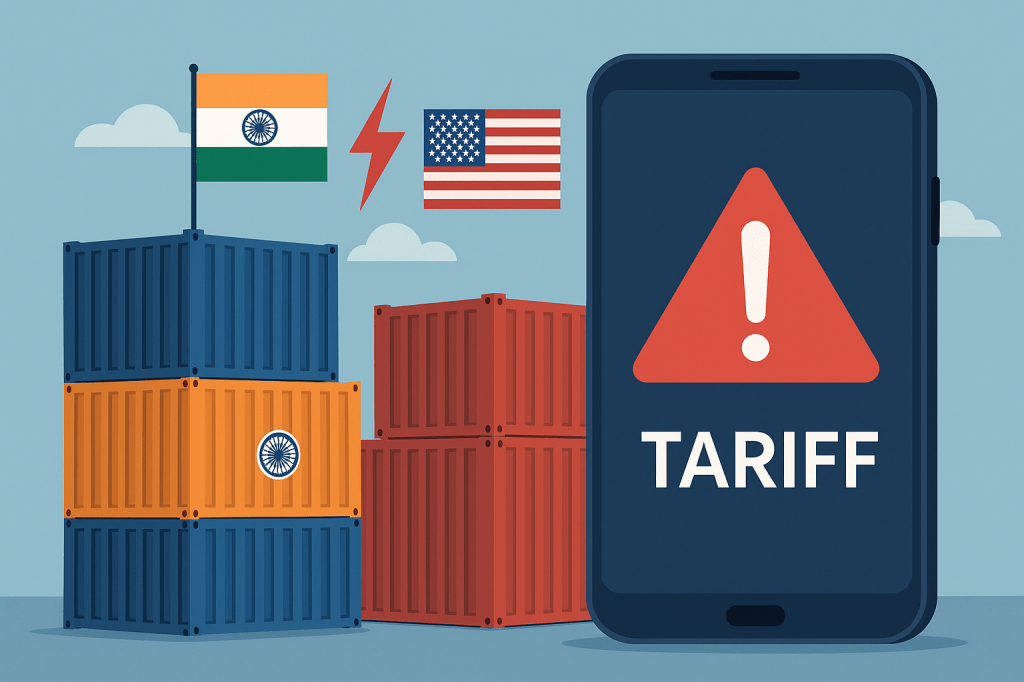
India’s trade relationship with the United States has entered one of its most challenging phases in recent years. What began as targeted tariffs has now snowballed into a broad-based crisis, with severe implications for multiple industries and long-term economic ties. The collapse of smartphone exports to America is only the most visible symptom of this wider malaise.
The Numbers Behind the Shock
Between May and August, Indian exports to the U.S. plunged by 22.2 percent, sliding from $8.8 billion to $6.9 billion. The timing is crucial: tariffs imposed by the Trump administration jumped from 10 percent in early August to 25 percent mid-month, and finally doubled to 50 percent by the end of August. The staged escalation created uncertainty for exporters, discouraging orders and disrupting supply chains before the higher rates were even fully in force.
Paradoxically, the steepest declines were not in tariff-hit categories but in tariff-exempt products. These zero-duty goods, which represent nearly 30 percent of India’s August shipments to the U.S., contracted by 41.9 percent. Their value fell sharply from $3.37 billion in May to just $1.96 billion by August. Such a trend suggests that the shock was not limited to tariff math alone but tied to larger issues of confidence, demand, and policy unpredictability.
Pharmaceuticals, long considered a stable pillar of Indian exports, also faltered. Outbound shipments in this category fell 13.3 percent in the same period, from $745 million to $646.6 million. Given the sector’s reputation for resilience, this decline underscores how broad and systemic the strain has become.
Beyond Tariffs: The Confidence Crisis
Why did tariff-exempt items perform worse than tariff-hit categories? The answer may lie in the psychology of markets. Importers in the U.S. are increasingly cautious, anticipating further policy shifts and preferring to reduce dependence on Indian suppliers. Buyers may also be diversifying sourcing to hedge against future uncertainty, even in sectors not directly touched by tariff hikes.
This creates a damaging feedback loop: exporters lose business not only because of higher duties but also because of eroded trust in the stability of bilateral trade. Once such confidence is shaken, rebuilding it takes much longer than undoing a tariff schedule.
Implications for India’s Export Strategy
The broader lesson for India is clear: over-reliance on a single market—however lucrative—exposes the economy to disproportionate risks. The U.S. absorbs a significant share of India’s high-value exports, from electronics to pharmaceuticals, and any disruption there has cascading effects on production, jobs, and foreign exchange inflows.
India’s policymakers face two urgent tasks:
1. Diversify Markets: Greater emphasis on Latin America, Africa, and ASEAN partners could reduce dependence on the U.S. and spread risk more evenly.
2. Strengthen Domestic Competitiveness: Tariffs hurt less when exporters can withstand price competition through efficiency, innovation, and scale. Reform in logistics, taxation, and regulatory practices can make Indian goods more resilient in hostile trade environments.
A Wider Geopolitical Underpinning
This trade dispute cannot be separated from geopolitics. The tariff escalation followed closely on high-profile diplomatic events, including Prime Minister Modi’s outreach to China. Trade, therefore, has become a tool of political signaling as much as economic protection. For India, the challenge lies in maintaining strategic autonomy while preserving stable access to key markets.
Crisis as a Wake-Up Call
The current deterioration in India–U.S. trade ties is not merely about tariffs; it signals deeper cracks in confidence, predictability, and mutual trust. With exports shrinking across both duty-hit and duty-free categories, India must rethink its trade architecture. The crisis is severe, but it also offers an opportunity: to pivot toward broader diversification, structural reforms, and a more resilient export ecosystem.#IndiaUSEnigma
#TradeCrisis
#TariffShock
#ExportDecline
#SmartphoneExports
#PharmaPressure
#ZeroDutyCollapse
#MarketDiversification
#GeopoliticalTrade
#EconomicResilience
 "Connecting communities, empowering nations: Unifying the Regional and Global Economy ."
Leave a comment