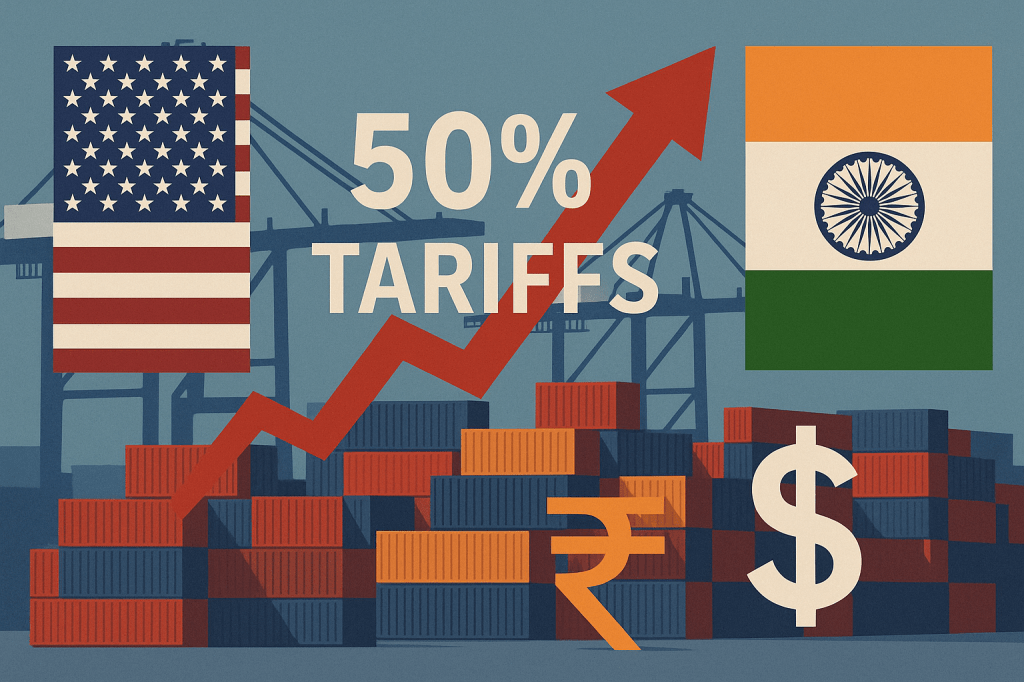
The recent imposition of 50% tariffs on Indian exports by the United States, linked to India’s discounted oil purchases from Russia, has once again highlighted how geopolitics and trade policy intersect. According to estimates, India’s economic growth could take a hit of nearly 0.8 percentage points, a non-trivial impact for an economy that has been positioning itself as the fastest-growing among large nations. Yet, rather than viewing this as merely a temporary setback, the episode forces India to re-examine the vulnerabilities in its economic architecture and global positioning.
The External Shock: More Than a Tariff Story
At first glance, tariffs are a trade issue. But the underlying message is strategic: India’s energy security choices are being penalized within a broader geopolitical rivalry. Unlike smaller economies, India has the scale and demand to resist unilateral pressures. But in the near term, cost competitiveness in sectors like textiles, leather, and engineering goods will erode. This is not just about lost market share in the U.S.—it could cascade into global value chains, with buyers shifting to competitors like Vietnam, Mexico, or Bangladesh.
Fast Growth, But Fragile Foundations
India’s resilience is undeniable. Domestic demand remains strong, digital adoption continues to deepen, and infrastructure spending is rising. Yet external shocks such as this tariff reveal that India’s growth rests on fragile linkages. Export diversification has been slow, with the U.S. and EU still accounting for a disproportionate share of India’s outbound trade. Equally important, high logistics costs, regulatory unpredictability, and factor market rigidities make Indian exporters more vulnerable to sudden external headwinds than they should be.
The Reform Imperative
The Financial Times is right in calling for reforms. India must:
Reduce regulatory friction: Excessive compliance continues to trap firms, especially MSMEs, in low productivity.
Reform land and labour laws: Factor market reforms are long overdue to unlock efficiency and scale.
Boost domestic competitiveness: The focus cannot be only on PLI-driven high-tech sectors; traditional industries also need productivity-enhancing support.
But here lies the deeper challenge: reforms in India often proceed in fits and starts, driven by political cycles rather than a long-term competitiveness agenda. The tariff shock may serve as the pressure point needed to accelerate reforms beyond rhetoric.
A More Challenging Perspective: Diversification Is Not Enough
While diversifying trade partnerships—toward ASEAN, Africa, and Latin America—is critical, it would be simplistic to think this alone solves the problem. Global protectionism is rising, and new trade blocs are becoming more exclusionary rather than inclusive. For India, the real task is not just to diversify markets but to embed itself deeply into alternative value chains—for example, by investing in Mexico as a North America gateway, or co-developing industrial corridors with Africa. This requires a mix of statecraft and industrial diplomacy.
India’s Strategic Dilemma
A difficult but necessary question arises: Can India continue to hedge between strategic autonomy (such as Russian oil purchases) and integration into Western-led trade networks? Or will it need to make sharper choices as trade and geopolitics align more tightly? This is not just an economic dilemma—it is a strategic positioning issue for India as it aspires to great-power status.
Turning Shock Into Strategy
The 50% tariff is a setback, but also a wake-up call. India cannot remain reactive to external shocks. It must build:
1. Resilient trade linkages that are politically diversified.
2. Domestic reforms that lower costs and raise competitiveness.
3. Strategic clarity on balancing energy security with trade openness.
If addressed boldly, today’s tariff challenge could be remembered not as a growth drag, but as the moment India recalibrated its trajectory toward sustainable and shock-proof growth.#USTariffs
#IndianExports
#Geopolitics
#TradeDiversification
#RegulatoryReforms
#EconomicGrowth
#Competitiveness
#EnergySecurity
#GlobalValueChains
#IndiaStrategy
 "Connecting communities, empowering nations: Unifying the Regional and Global Economy ."
Leave a comment