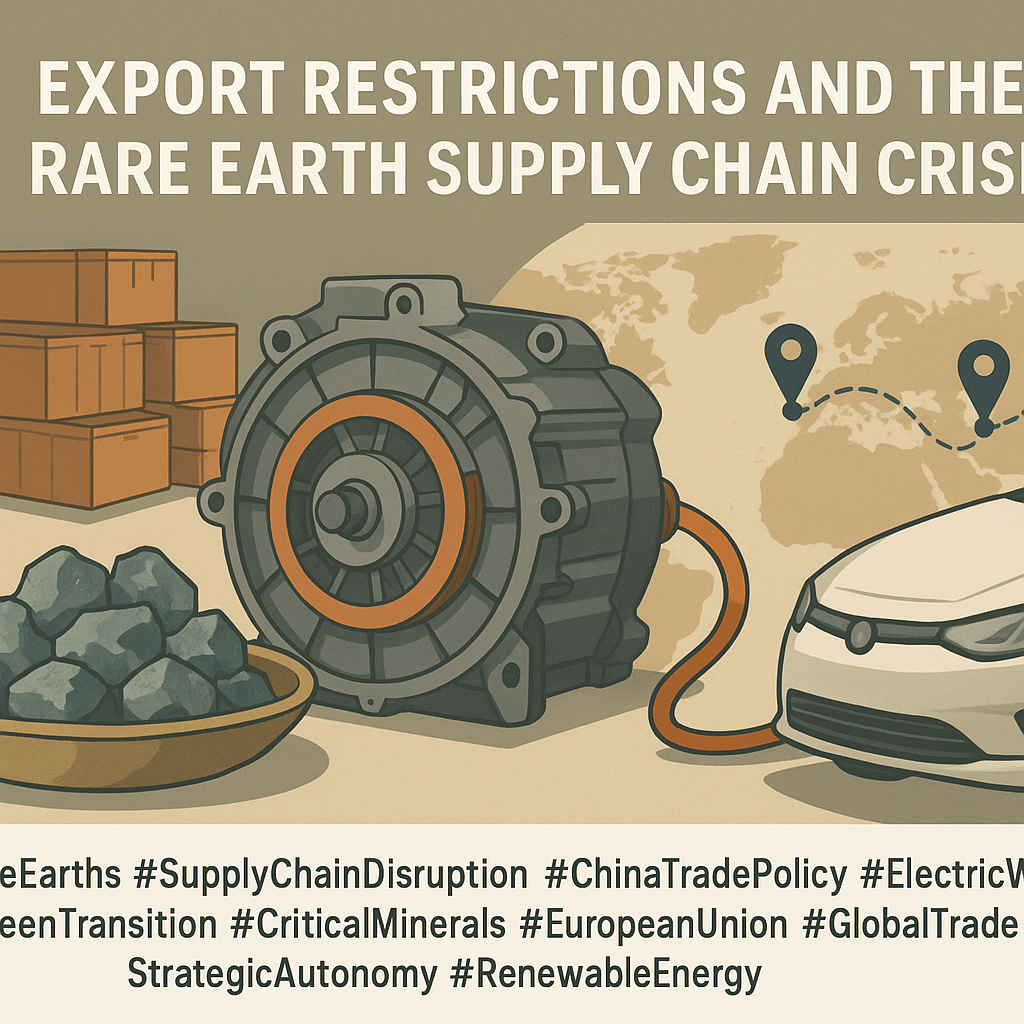
Global supply chains are once again under stress, this time due to China’s tightening grip on rare earth exports. Since April 2025, Beijing has imposed licensing requirements on seven key rare earth elements, including dysprosium and terbium—minerals indispensable for the production of electric vehicle motors, advanced defense equipment, and renewable energy technologies. These controls come at a time when demand for green transition materials is surging worldwide, making the disruption particularly acute.
China currently refines about 90% of global rare earths, giving it unrivaled leverage in global trade. While other countries, from the U.S. to Australia, have invested in exploration and mining, the processing bottleneck remains concentrated in China. This imbalance is what makes even limited export curbs reverberate across continents.
European Firms Caught in the Crossfire
European companies have been among the hardest hit. According to the European Chamber of Commerce in China, more than 140 export license applications have been filed by EU firms since the controls took effect. Yet only a handful have been approved. Jens Eskelund, the Chamber’s president, underscored the gravity of the situation, warning that several member firms are already suffering significant losses because of these delays. In fact, one company has reportedly lost “millions of euros” due to supply stoppages, though the Chamber declined to disclose its name.
For small and medium-sized enterprises (SMEs), the problem is magnified. Larger corporations often have diversified sourcing strategies or can stockpile critical inputs, but SMEs rely on timely, uninterrupted supplies. The current export bottlenecks not only threaten production schedules but could also jeopardize their survival in highly competitive markets.
Strategic Leverage or Global Risk?
From Beijing’s perspective, licensing requirements are being framed as a way to better regulate exports and ensure “responsible” global supply. Yet, to many trade partners, the policy looks like a tool of strategic leverage—one that can be deployed during trade disputes or geopolitical disagreements. China has used similar tactics before, most notably in 2010 when rare earth shipments to Japan were disrupted over territorial tensions. The new measures echo those earlier strategies but in a more formalized and bureaucratic manner.
Critically, these restrictions come at a time when global efforts to decarbonize are accelerating. Electric vehicles, wind turbines, and advanced batteries all require rare earths. Any extended disruption risks slowing the green transition, raising costs, and forcing manufacturers to reassess their timelines.
Policy Gaps and the Search for Alternatives
The EU has long recognized its over-dependence on Chinese rare earths. Initiatives like the Critical Raw Materials Act aim to diversify sourcing by developing domestic refining capacity and forging partnerships with resource-rich countries such as Canada, Australia, and several African states. Yet building up refining capacity is capital-intensive and time-consuming, meaning relief cannot be immediate.
Meanwhile, recycling and circular economy solutions—such as extracting rare earths from end-of-life electronics and magnets—remain underdeveloped. Without rapid scaling of these alternatives, dependence on China is unlikely to ease in the short term.
A Defining Moment for Global Supply Chains
The rare earth restrictions highlight a broader systemic risk: over-concentration of critical inputs in one geography. While globalization has delivered efficiency and cost savings, it has also produced fragility. The present crisis underscores the need for supply chain resilience, not just for rare earths but across all strategic commodities.
For European firms, the lesson is stark. Strategic autonomy in critical resources is no longer a policy ambition but a survival necessity. For China, the controls demonstrate its economic clout but also risk accelerating global efforts to diversify away from its dominance. In the long run, Beijing may find that the very leverage it wields today erodes its centrality tomorrow.#RareEarths
#SupplyChainDisruption
#ChinaTradePolicy
#ElectricVehicles
#GreenTransition
#CriticalMinerals
#EuropeanUnion
#GlobalTrade
#StrategicAutonomy
#RenewableEnergy
 "Connecting communities, empowering nations: Unifying the Regional and Global Economy ."
Leave a comment