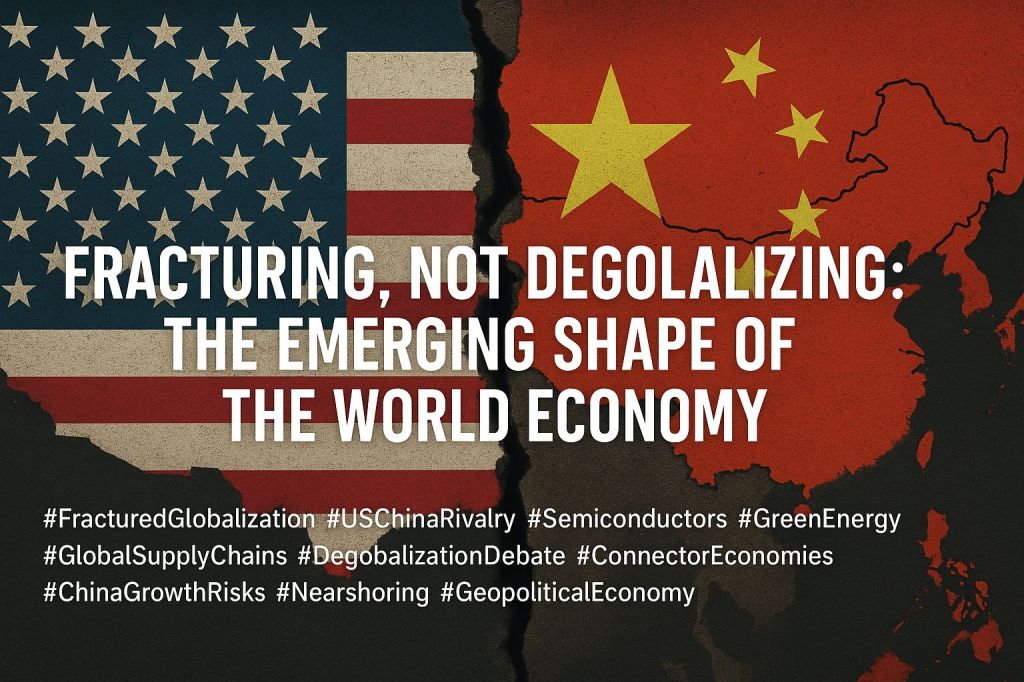
The global economy today is often described through the lens of deglobalization, but that framing risks oversimplifying what is truly happening. Rather than a retreat from global integration, what we are witnessing is a strategic fracturing of certain sectors. While trade, capital, and investment still flow across borders at scale, geopolitical rivalry—especially between the United States and China—is creating new divides in areas deemed vital for national security and technological leadership.
Endurance of Global Integration
Despite the rhetoric of deglobalization, evidence shows that global integration remains intact outside a few sensitive sectors. Cross-border trade and investments continue to expand, but their patterns are shifting. The bifurcation is primarily visible in strategic domains such as semiconductors and green energy, where governments view technological dominance as directly tied to long-term economic security. In these areas, integration gives way to fragmentation, driven by policy choices, industrial subsidies, and the need to build resilient supply chains.
U.S.–China Rivalry and Sectoral Fragmentation
At the heart of this shift lies the intensifying technological rivalry between the U.S. and China. Washington, backed by allies such as the EU, Japan, and South Korea, has moved to restrict China’s access to advanced semiconductor technologies. In response, Beijing has doubled down on self-sufficiency, investing heavily in domestic chipmaking capacity and renewable energy leadership. This has led to the rise of two parallel technology ecosystems—one U.S.-anchored and one China-centric. The costs of duplication are significant, from higher R&D expenditures to fragmented supply chains, but for policymakers these are justified by the strategic imperative of resilience.
The Rise of a Bifurcated Global Economy
The contours of a bifurcated economy are becoming clearer. On one side, a U.S.-led bloc—including the European Union, Mexico, Vietnam, and others—seeks alignment based on democratic institutions and security cooperation. On the other, a China-centered bloc of largely authoritarian states prioritizes strategic autonomy and south-south linkages. For many middle powers, this split forces difficult trade-offs: economic benefits from China’s vast market must be balanced against the security and supply chain reliability offered by alignment with the U.S. and its partners.
Emerging Winners: The Connectors
Not all countries are passive observers of this great realignment. Some—often referred to as “connectors”—are turning fragmentation into opportunity.
Vietnam has become a global hub for electronics, benefiting both from China’s supply chains and Western market demand.
Mexico, riding the wave of nearshoring, is attracting U.S. investments in automotive and electronics as firms seek alternatives closer to home.
Poland is carving out a niche in Europe’s green energy and auto supply chains, importing inputs from Asia while supplying the EU market with finished goods.
Other economies such as India, Indonesia, Turkey, and Thailand are also repositioning themselves to capture manufacturing investment as multinational corporations diversify beyond China.
China’s Growth Risks
China, once seen as the unchallenged driver of globalization, now faces mounting headwinds. Restrictions on technology access, shrinking productivity gains, and growing trade barriers are weakening its growth outlook. Its “dual circulation” strategy, designed to balance domestic demand with selective export opportunities, remains hampered by regulatory crackdowns on private enterprise and a less favorable external environment. The combination of slowed innovation and declining foreign investment makes sustaining its previous growth model increasingly difficult.
A Fractured but Connected World
The world economy is not unraveling into isolationism. Instead, it is reorganizing along strategic and geopolitical lines. Integration continues, but it is increasingly filtered through the lens of security, resilience, and political alignment. For “connector” economies like Vietnam, Mexico, and Poland, the current restructuring offers unprecedented opportunities. For China, however, the risks are rising as its access to foreign technology and markets becomes more constrained.
The global order ahead will not be defined by deglobalization, but by fractured globalization—a system that remains deeply connected yet segmented along strategic and political divides. The challenge for policymakers and businesses alike will be to navigate this complexity, balancing risks with opportunities in a world economy that is both enduringly integrated and structurally fragmented.
 "Connecting communities, empowering nations: Unifying the Regional and Global Economy ."
Leave a comment