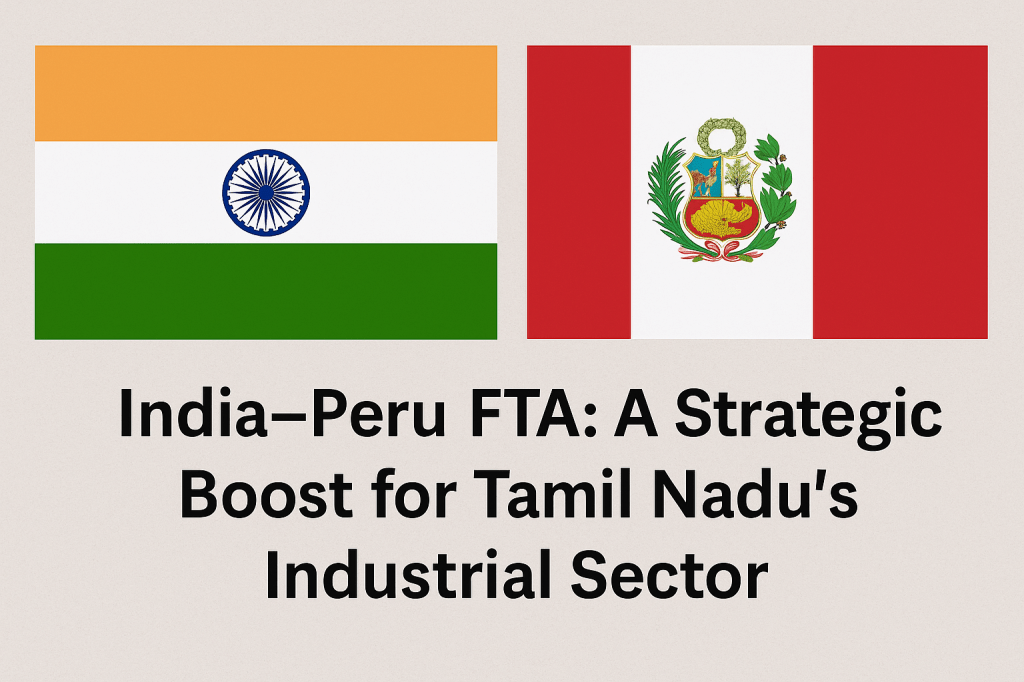
As India and Peru move closer to finalizing a Free Trade Agreement (FTA), attention is turning to how this partnership could reshape opportunities for Indian industry. The FTA, expected to cut tariffs and open markets in mining, agriculture, pharmaceuticals, and technology, holds particular promise for Tamil Nadu, one of India’s most dynamic industrial hubs.
Tamil Nadu has long established itself as a leader in automobile manufacturing, pharmaceuticals, textiles, and IT services. The state accounts for nearly one-third of India’s automobile production and contributes significantly to the country’s pharma exports, with its cluster of manufacturing units in Chennai and nearby districts. At the same time, its strong IT and software services base provides a natural link to Peru’s rising demand for digital infrastructure and technology solutions. Reduced tariffs under the FTA could help Tamil Nadu’s exporters expand into a relatively untapped Latin American market, lowering entry barriers and improving competitiveness.
From Peru’s side, the agreement is not just about market access but also about leveraging its abundant natural resources. Peru is one of the world’s top producers of copper, silver, zinc, and increasingly rare earth minerals, all of which are critical inputs for advanced technologies. These resources align closely with Tamil Nadu’s growth trajectory in electronics, renewable energy, and EV manufacturing. Access to Peruvian rare earths could strengthen Tamil Nadu’s supply chains, reduce dependence on China, and enable its tech-driven industries to scale faster.
Pharmaceuticals present another area of synergy. India already exports affordable generic medicines to Latin America, but tariff reductions could accelerate Tamil Nadu’s pharma exports and attract joint ventures with Peruvian distributors. Similarly, in agriculture and food processing, the FTA could allow Tamil Nadu’s exporters of processed foods, dairy, and spices to enter new value chains, while Peruvian imports of Indian machinery could modernize its own agro-industries.
However, critical challenges remain. Latin America is geographically distant, and logistics costs will be a concern unless India enhances its shipping connectivity with Pacific ports. Moreover, Tamil Nadu’s exporters will need to adapt to Peruvian standards, regulatory frameworks, and cultural preferences to make sustained inroads. Without institutional support in areas like quality certification, trade facilitation, and localized branding, the benefits of tariff reductions may not fully materialize.
Yet, strategically, this FTA offers Tamil Nadu an opportunity to extend its global footprint beyond traditional partners in the U.S. and Europe. By diversifying toward Latin America, Tamil Nadu’s industries could hedge against tariff volatility in Western markets and deepen resilience in global supply chains. The India–Peru agreement thus reflects more than a bilateral trade pact—it symbolizes a pathway for Tamil Nadu to leverage its industrial strength in an increasingly multipolar global economy.
 "Connecting communities, empowering nations: Unifying the Regional and Global Economy ."
Leave a comment