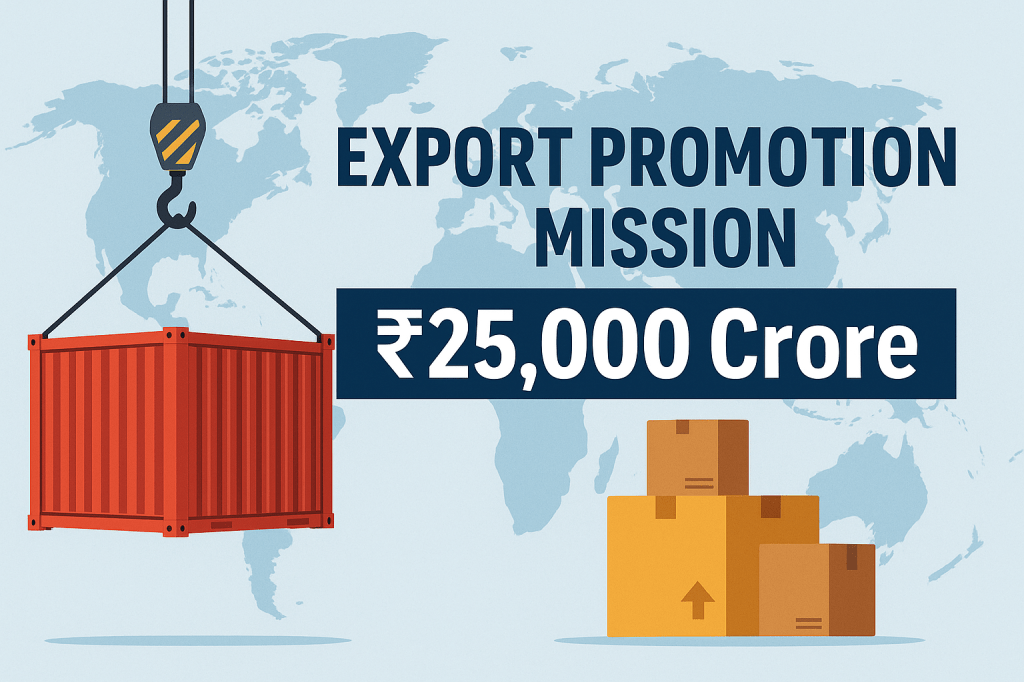
India’s export sector is entering a critical phase as global markets are reshaped by protectionist measures, rising tariffs, and tightening supply chain dependencies. Recognising these headwinds, the Government of India has rolled out the Export Promotion Mission (EPM), a ₹25,000 crore package spanning 2025–31. This mission aims not only to cushion exporters from tariff shocks but also to build long-term competitiveness through two flagship schemes: Niryat Protsahan and Niryat Disha.
Why the EPM Matters Now
The timing of this intervention is strategic. In 2025, Indian exporters faced significant setbacks after the U.S. imposed 50% tariffs on key categories such as textiles, chemicals, leather, and footwear. These sectors employ millions and are highly dependent on international demand. Without state-backed support, India risked losing hard-won global market share to competitors from Southeast Asia, Latin America, and Africa.
The EPM reflects a policy shift: rather than only reacting to global trade turbulence, India is building structural resilience into its export ecosystem.
Niryat Protsahan: Cushioning Exporters
With an allocation of ₹10,000 crore, Niryat Protsahan is designed to address exporters’ financial vulnerabilities. Its key features include:
Interest equalisation worth ₹5,000 crore: making export credit cheaper at a time when rising global interest rates are squeezing margins.
Alternative trade finance instruments: ensuring exporters are not overly dependent on traditional banking channels.
Dedicated export credit card for e-commerce players: recognising the role of small e-commerce exporters who operate outside traditional trade finance structures.
Liquidity bridging mechanisms: critical for MSMEs that often face working capital bottlenecks.
The scheme is effectively a risk buffer, ensuring Indian exporters can continue operations even in volatile trade conditions.
Niryat Disha: Building Competitiveness
The larger allocation—₹14,500 crore—is directed toward structural reforms under Niryat Disha. The focus here is not just survival but global competitiveness. The scheme covers:
Export quality compliance support (~₹4,000 crore): helping exporters meet the increasingly complex quality and sustainability standards of developed markets.
Overseas market development (~₹4,000 crore): funding market-entry strategies and trade fair participation.
Branding and logistics improvements: positioning Indian products higher up the global value chain.
Capacity building initiatives: enabling MSMEs to integrate with global value chains.
This reflects a strategic recognition that Indian exports cannot compete on cost alone; they must compete on quality, trust, and integration into global systems.
Collaborative Implementation
The mission is not a standalone government program. Instead, it adopts a multi-agency model, bringing together:
Department of Commerce, Ministry of MSME, Ministry of Finance
Exim Bank, ECGC, CGTMSE, NCGTC
Export promotion councils, industry bodies, and state governments
Such a collaborative architecture is critical because export challenges are multi-dimensional—ranging from financing gaps to compliance hurdles to market development.
Broader Implications
1. For MSMEs: Since MSMEs form the backbone of Indian exports, the EPM can be a lifeline. Access to credit and compliance support could enable thousands of small firms to stay competitive.
2. For Global Trade Strategy: India is signalling that it will not retreat from globalization but will instead adapt by enhancing resilience.
3. For Economic Growth: Exports account for nearly 20% of India’s GDP. Sustained export momentum is essential to achieving India’s long-term target of becoming a $5 trillion economy.
4. For Employment: Export-linked industries, particularly textiles and leather, are labour-intensive. Protecting them from tariff shocks indirectly safeguards millions of jobs.
Perspective
While the EPM is ambitious, its success hinges on execution and coordination. Past export schemes often faltered due to bureaucratic delays, uneven state-level implementation, and low awareness among MSMEs. Moreover:
The credit card and liquidity measures must be easy to access; otherwise, small exporters will remain excluded.
Market development funds should not be captured by larger corporations at the expense of smaller players.
Monitoring and audit mechanisms will be needed to ensure funds are effectively channelled to exporters in need.
If these challenges are addressed, the EPM can transform India’s export ecosystem into one that is resilient, inclusive, and globally competitive.
The Export Promotion Mission is more than just a relief package—it is a strategic push to redefine India’s place in global trade. By combining financial cushioning with long-term competitiveness measures, the initiative has the potential to turn current tariff shocks into a springboard for export growth.
As global trade becomes more fragmented and competitive, such interventions will determine whether Indian exporters merely survive—or lead—in the next decade of global commerce.
#ExportPromotionMission
#NiryatProtsahan
#NiryatDisha
#IndianExports
#GlobalTrade
#MSMEs
#TariffShocks
#ExportFinance
#MarketAccess
#GlobalCompetitiveness
 "Connecting communities, empowering nations: Unifying the Regional and Global Economy ."
Leave a comment