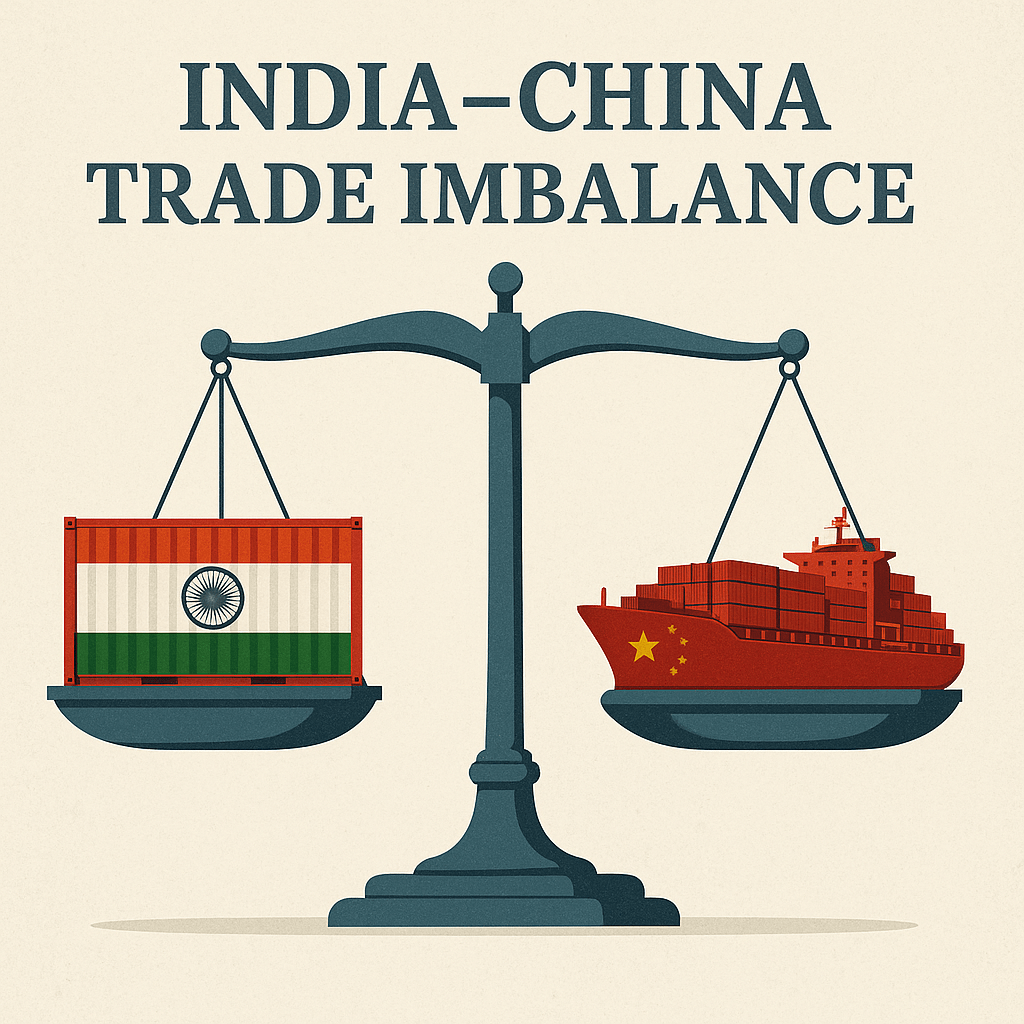
India’s economic engagement with China has long been defined by asymmetry, but the latest numbers show just how stark that imbalance has become. A recent study by the Indian Council for Research on International Economic Relations (ICRIER) highlights that India’s trade deficit with China has soared to $99.2 billion in 2024–25, a figure that overshadows trade gaps India holds with any other country. This imbalance raises fundamental questions about India’s economic strategy, its manufacturing ecosystem, and its ability to translate geopolitical caution into economic resilience.
The Nature of the Deficit
China remains India’s single-largest source of imports, dominated by electronics, active pharmaceutical ingredients (APIs), telecom equipment, and renewable energy components. While these imports fill gaps in India’s industrial ecosystem, they also expose a structural dependence that is difficult to unwind in the short term. On the export side, India’s shipments to China remain modest, largely concentrated in raw materials like iron ore, cotton, and certain chemicals. This lack of diversification underscores the weak competitiveness of India’s manufacturing exports in high-value categories where Chinese demand is strongest.
FDI: The Missing Link
Adding to this imbalance is the absence of significant Chinese foreign direct investment (FDI) into India. Despite China’s global presence as a major investor in Asia, Africa, and even developed economies, its footprint in India remains minimal. Political sensitivities after the 2020 border standoff, tighter FDI screening, and heightened scrutiny of Chinese tech firms have all restricted investment flows. While these measures serve strategic and security concerns, they also limit India’s ability to tap into potential capital and technology transfer that could otherwise strengthen domestic industry.
Untapped Export Potential
What makes the imbalance even more striking is ICRIER’s estimate of $161 billion in untapped export potential from India to China. This figure is not abstract—it represents real opportunities in sectors like pharmaceuticals, automotive components, agricultural produce, textiles, and IT-enabled services. For example, India has the capacity to scale up exports of generic medicines to China’s growing healthcare market, or to position itself as a reliable supplier of processed agricultural goods. Yet non-tariff barriers, weak market access agreements, and India’s own supply-side bottlenecks have kept this potential largely theoretical.
Strategic Recalibration: The Way Forward
The report calls for a strategic recalibration of India’s engagement with China, and the reasoning is sound. Instead of relying only on defensive measures—tariff hikes, import restrictions, or diversification away from China—India must adopt a more balanced mix of market access negotiations, domestic competitiveness reforms, and export promotion strategies.
1. Market Access Diplomacy: India should push for reciprocal trade concessions with China, especially in pharmaceuticals, IT services, and agriculture, where Indian firms are globally competitive.
2. Strengthening Domestic Ecosystems: Import dependence in critical areas like electronics and solar modules will persist unless India scales up production capacity through the PLI (Production-Linked Incentive) scheme and supply-chain integration.
3. Regional and Multilateral Platforms: India’s ability to leverage groupings like BRICS, RCEP (where it opted out but still engages), and WTO mechanisms could help in creating a more level playing field.
4. Private-Sector Partnerships: Export potential cannot be realized without scaling up industry capacity. India needs joint ventures, technology tie-ups, and global supply chain integration to boost both volume and value-added exports.
The challenge lies in balancing geopolitics with economics. While the deficit is unsustainable, outright disengagement with China is neither realistic nor economically wise. The $161 billion untapped potential demonstrates that India is not merely a victim of Chinese dominance—it has agency, provided it can act strategically. Ignoring this space means missing a chance to close the gap through trade recalibration rather than protectionism alone.
In the long run, India’s ability to manage this imbalance will define its journey toward economic self-reliance and global competitiveness. The ICRIER study is more than a report—it is a warning bell that the cost of inaction is too high.
#IndiaChinaTrade
#TradeDeficit
#ICRIERStudy
#ExportPotential
#ForeignDirectInvestment
#EconomicRecalibration
#ManufacturingCompetitiveness
#MarketAccess
#SupplyChainDependence
#GeopoliticsAndEconomics
 "Connecting communities, empowering nations: Unifying the Regional and Global Economy ."
Leave a comment