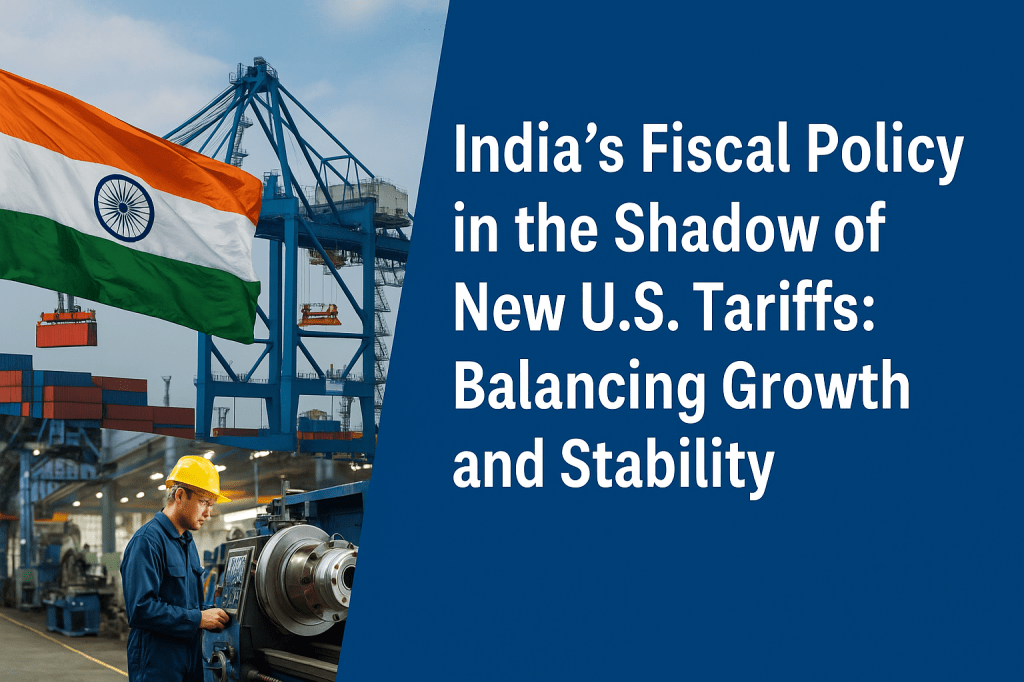
The sharp escalation of U.S. tariffs—now set at 50% on a substantial portion of Indian goods—marks a pivotal moment for India’s fiscal strategy. With USD 30–35 billion worth of exports directly affected and potential spillovers across the broader USD 87 billion trade relationship, policymakers face an immediate test in safeguarding economic momentum while protecting fiscal health.
Economic projections underline the seriousness of the challenge. Analysts at Morgan Stanley and Jefferies warn of a 0.8 percentage point dent in GDP growth if these tariffs persist, while Moody’s places the slowdown risk at around 0.3% for FY2025–26. Even in a resilient, consumption-driven economy, such export shocks can erode sectoral revenues, weaken employment prospects in manufacturing hubs, and strain the balance of payments.
Capital Expenditure as a Counterweight
India’s initial fiscal instinct is to lean into growth-oriented spending. The government’s infrastructure-heavy 2025–26 budget laid the groundwork, and the tariff disruption only strengthens the case for sustained capital expenditure. Investments in transport corridors, logistics upgrades, and industrial parks serve a dual purpose: they create immediate domestic demand and strengthen the competitiveness of Indian products in alternative global markets.
At the same time, structural reforms—especially deregulation and ease-of-doing-business measures—are being pushed forward at a faster clip. These reforms aim to lower input costs, speed up project clearances, and attract private investment to compensate for the export drag.
Fiscal Balance under Pressure
With revenue from export-linked sectors like textiles, chemicals, and auto parts likely to soften, the fiscal balance will come under strain. However, instead of relying on tax hikes that could dampen consumption, the government is expected to reprioritize spending. This means diverting resources toward infrastructure and credit support while containing non-essential expenditures, thereby preserving both growth momentum and fiscal prudence.
Self-Reliance as a Strategic Anchor
The Atmanirbhar Bharat framework will be reinforced as a long-term policy pillar. This involves channeling fiscal incentives toward domestic manufacturing, technology development, and supply chain resilience to reduce dependency on volatile export markets. While selective retaliatory tariffs—such as on steel and aluminum—may be considered to signal resolve, these will likely be measured to avoid further escalation that could damage investor confidence.
Coordination with Monetary Policy
Markets have already reacted to the tariff news, with the rupee weakening and bond yields inching upward. In this climate, fiscal measures will be designed to complement the Reserve Bank of India’s monetary stance. This could include targeted credit schemes for export-oriented industries, liquidity support for MSMEs, and calibrated borrowing to avoid stoking inflationary pressures.
Outlook
India’s fiscal response to the tariff challenge will not be a simple defensive maneuver. Instead, it is likely to blend pro-growth spending, accelerated reforms, and a push for domestic self-reliance, all while maintaining macroeconomic stability. If executed with discipline, this strategy could turn a short-term shock into a catalyst for deeper structural resilience—positioning India to emerge from the tariff storm with a stronger, more competitive economy.#FiscalPolicy
#USTariffs
#IndianEconomy
#GDPGrowth
#CapitalExpenditure
#AtmanirbharBharat
#ExportImpact
#InfrastructureSpending
#TradePolicy
#EconomicResilience
 "Connecting communities, empowering nations: Unifying the Regional and Global Economy ."
Leave a comment