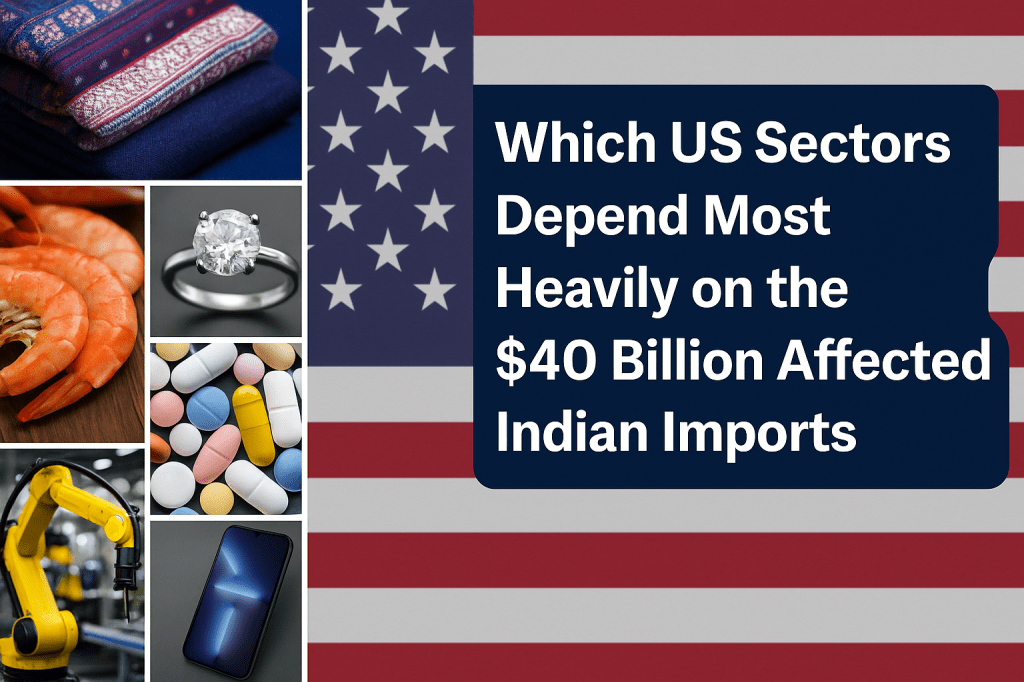
The United States’ recent tariff hikes on roughly $40 billion worth of Indian imports have put multiple high-value sectors at risk, exposing deep interdependencies between the two economies. While the political narrative frames these measures as a push to protect American manufacturing and encourage domestic sourcing, the reality is far more complex—these tariffs could disrupt critical supply chains, raise costs for U.S. consumers, and create ripple effects across multiple industries.
One of the most exposed categories is textiles and apparel, where U.S. retail giants like Walmart, Costco, and The Gap depend heavily on Indian supply chains for garments, home textiles, and shoes. Around 28% of India’s textile exports go to the U.S., and tariffs as high as 63.9% could sharply increase retail prices or force retailers to scramble for alternative suppliers. Given that apparel manufacturing in the U.S. is limited and cost-intensive, the likely result will be higher prices for American households rather than a complete shift to domestic production.
The gems and jewelry sector—especially diamonds and gold ornaments—faces similar vulnerabilities. The U.S. imports over $8.5–12 billion worth of these products annually from India, much of it supporting small and medium-sized jewelers and luxury brands. With a steep 52.1% tariff, jewelers could face tighter margins, delayed supply, and reduced consumer demand, especially in a high-interest-rate environment where luxury spending is already slowing.
Perhaps the most strategically sensitive sector is pharmaceuticals. India supplies close to 40% of the U.S. market for generic drugs, valued at $7.5–8 billion annually. This is not just a trade issue—it’s a public health concern. A tariff shock in this space could drive up drug prices, strain U.S. healthcare budgets, and create shortages for critical medicines. Unlike textiles or jewelry, the pharmaceutical supply chain cannot be easily replaced due to regulatory requirements, specialized manufacturing, and cost competitiveness.
Seafood—particularly shrimp— is another vulnerable segment, with India supplying over $2.24 billion worth annually to U.S. markets. This is crucial for restaurants, grocery chains, and food processors. Any tariff-induced price rise will hit both the hospitality industry and end consumers, especially given limited domestic shrimp farming capacity in the U.S.
Industrial categories like machinery and chemicals also face disruption. India exports roughly $9 billion in machinery and $2.3–2.4 billion in organic chemicals to the U.S., much of it as intermediate goods for American manufacturing. Tariffs here could squeeze margins for downstream industries ranging from automotive assembly to electronics manufacturing.
Luxury and lifestyle goods are not spared—leather and footwear imports from India amount to $1.18 billion annually. Major American brands that rely on Indian craftsmanship and competitive pricing will now face a difficult choice between absorbing costs or passing them on to consumers.
Even in smartphones, a sector dominated by East Asian suppliers, India has emerged as a significant player, exporting over $3 billion worth to the U.S. in early 2025 alone. Tariffs here could not only increase costs but also slow diversification efforts aimed at reducing dependence on Chinese manufacturing.
Interestingly, petroleum products—a major Indian export—are not at the center of these tariff measures, which appear instead to target consumer and industrial goods with strong U.S. market penetration. The focus seems designed to exert maximum pressure on Indian export margins while minimizing disruption to U.S. energy security.
The downstream implications are substantial. These targeted sectors sustain wide networks of distributors, retailers, and manufacturers across the U.S., many of them small and medium enterprises. With tariffs likely to push up costs, the end result could be higher prices, reduced variety, and supply delays for American consumers—an outcome that runs counter to the political promise of “protecting the American shopper.”
From a broader perspective, these tariffs test the resilience of U.S.–India trade ties. The immediate impact will be felt in price adjustments and supply chain shifts, but the long-term risk lies in eroding trust between two economies that have positioned themselves as strategic partners in global trade realignment. If the policy objective is to reduce dependency on Indian imports, it comes at the cost of destabilizing industries that are, in many cases, irreplaceable in the short term.
#USTariffs
#IndianExports
#TextilesAndApparel
#GemsAndJewelry
#Pharmaceuticals
#SeafoodImports
#MachineryAndChemicals
#LeatherAndFootwear
#SmartphoneTrade
#SupplyChainImpact


Leave a comment