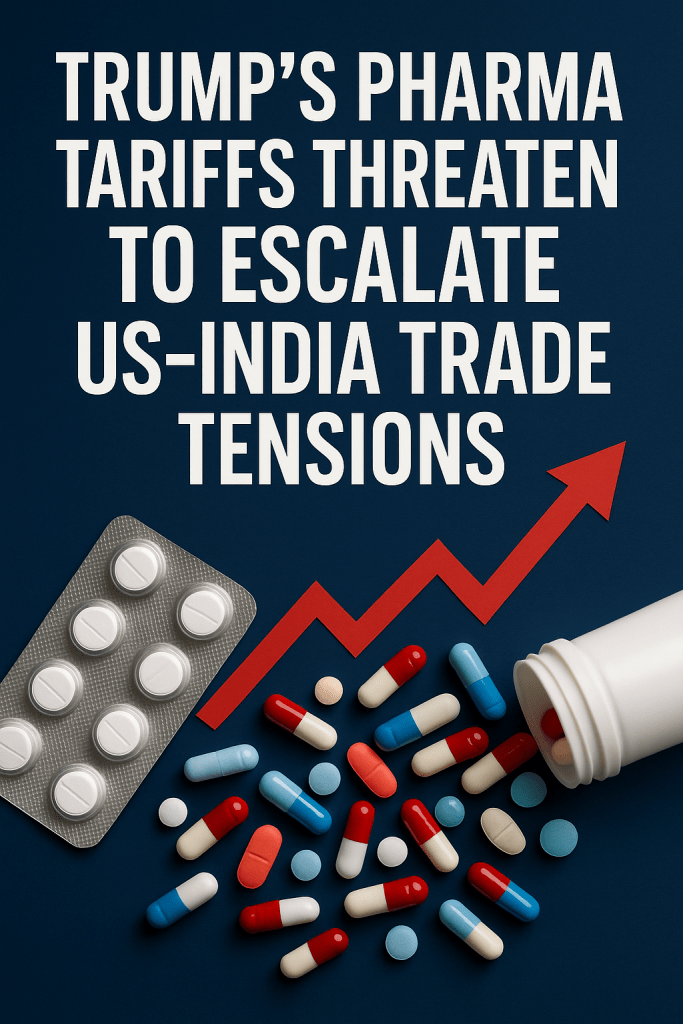
President Donald Trump’s latest tariff announcement marks one of the most aggressive trade policy moves in recent years, setting the stage for a potential economic and diplomatic standoff between the United States and India. The policy introduces phased tariffs on imported pharmaceuticals, starting at a modest level but with the potential to escalate sharply to as high as 250% over the next 12 to 18 months if drug manufacturers fail to relocate production to the U.S. This measure is explicitly aimed at reshoring pharmaceutical manufacturing, a sector Washington views as strategically vital. However, the ripple effects of such a move extend far beyond U.S. borders, with India—one of the largest suppliers of generic and branded drugs to the American market—squarely in the crosshairs.
For India, the stakes are enormous. The country accounts for a significant share of the U.S. generic drug supply, with Indian pharmaceutical exports valued at billions of dollars annually. A steep tariff hike of this magnitude would not only erode the competitiveness of Indian drug makers in the U.S. market but could also lead to severe disruptions in global pharmaceutical supply chains. Analysts warn that the immediate fallout may be felt in the form of higher medicine prices for American consumers, potential shortages of essential drugs, and strained access to affordable generics—particularly for critical treatments like cardiovascular medicines, antibiotics, and cancer drugs. While some generic products are temporarily spared, branded Indian pharmaceuticals face immediate tariff exposure, and the risk of wider coverage remains high.
The policy comes at a time when U.S.-India trade relations are already under strain. Washington has been openly critical of India’s continued oil trade with Russia, prompting threats of additional tariffs beyond the existing 25% baseline on many Indian goods. This creates a broader context of economic tension in which the pharmaceutical dispute is not an isolated event but part of a strategic U.S. push to exert leverage over India’s trade practices and supply chains. In response, Indian policymakers and industry leaders are exploring counter-strategies, including diversifying export markets, relocating parts of their production to tariff-neutral territories, and strengthening domestic demand to absorb potential export shocks.
From a global perspective, this development raises significant concerns. The pharmaceutical industry is heavily interdependent, relying on cross-border sourcing of raw materials, intermediate products, and active pharmaceutical ingredients (APIs). A sharp escalation in tariffs threatens to fragment this network, forcing companies to reorganize supply chains at high cost and potentially delaying drug availability worldwide. Moreover, the prospect of retaliatory trade measures could further destabilize the already fragile global trade environment, pushing both nations into a spiral of economic brinkmanship.
Economically, the move risks undermining India’s export earnings, with potential downstream effects on employment, investment in research and development, and overall GDP growth. For the U.S., while the intended outcome is to boost domestic manufacturing, the short-term reality may involve higher healthcare costs and reduced drug availability—an outcome that could prove politically contentious.
In essence, Trump’s proposed pharmaceutical tariffs represent a decisive escalation in U.S.-India trade tensions, with unpredictable consequences for both economies and the broader global pharmaceutical ecosystem. The coming months will be critical, as negotiations, countermeasures, and possible retaliatory actions determine whether this becomes a temporary flashpoint or a long-term restructuring of the global drug trade.#TrumpTariffs
#PharmaceuticalIndustry
#USIndiaTradeTensions
#GenericDrugs
#BrandedMedicines
#GlobalSupplyChains
#MedicinePrices
#ExportDiversification
#TradePolicy
#EconomicImpact
 "Connecting communities, empowering nations: Unifying the Regional and Global Economy ."
Leave a comment