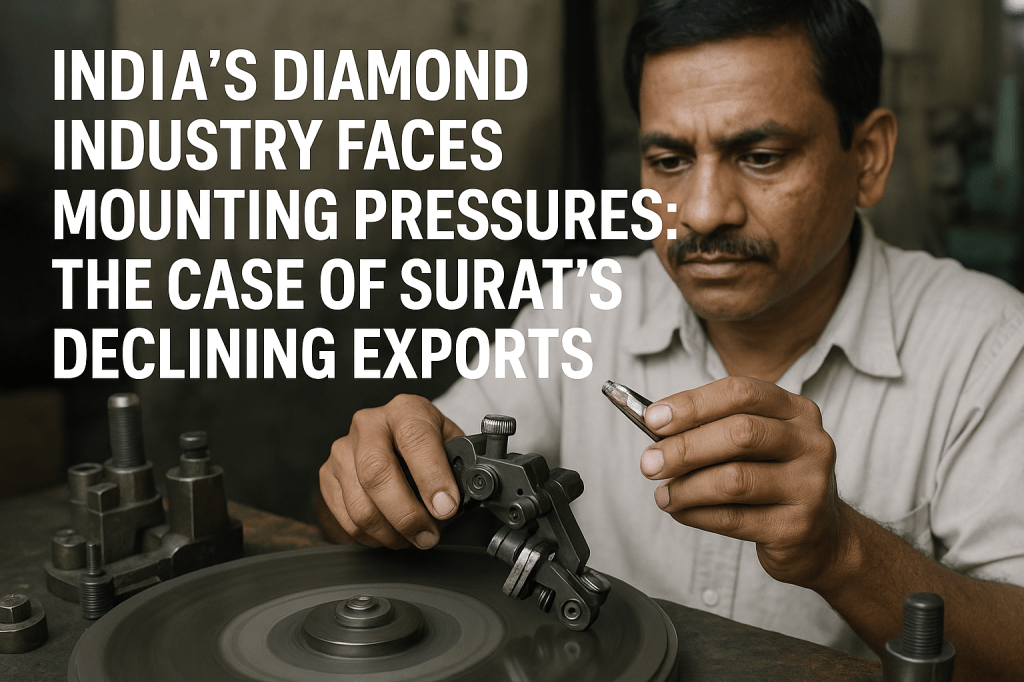
For decades, Surat has been the glittering heart of the global diamond polishing and cutting industry, processing nearly 90% of the world’s diamonds. Known as the “Diamond City of India,” the city’s intricate craftsmanship, cost efficiency, and skilled workforce turned it into a global hub, supplying polished stones to luxury markets in the U.S., Europe, and East Asia. However, in recent years, the sparkle has begun to dim, as India’s diamond exports have witnessed a sharp and sustained decline.
Several factors have converged to create this downturn. The first is the changing dynamics of global demand. Traditionally, demand from Western luxury markets drove the industry’s growth, but economic slowdowns, particularly in Europe, coupled with subdued luxury spending in the U.S., have eroded orders. Moreover, geopolitical uncertainties, including the Russia-Ukraine conflict, have disrupted the supply chain of rough diamonds. With Russia being a key global supplier, sanctions and trade restrictions have complicated procurement channels, making raw materials costlier and less predictable.
Another structural challenge lies in the growing popularity of lab-grown diamonds. These alternatives, chemically identical to mined diamonds but cheaper and increasingly marketed as eco-friendly, have started capturing a significant share of the market. Countries like China have scaled up production rapidly, offering stones at competitive prices. This shift in consumer preference—especially among younger, sustainability-conscious buyers—has put pressure on Surat’s traditional model, which is heavily dependent on natural diamond processing.
Domestic factors have compounded the industry’s woes. Fluctuating currency values have impacted margins, while rising labor costs and inflation in operational expenses have eroded competitiveness. For small and medium-scale polishing units, cash flow issues and tighter credit conditions have made it difficult to absorb these shocks. As a result, some workshops have downsized operations or even shut down, displacing thousands of skilled workers who rely on the industry for livelihood.
Critically, the industry’s dependence on a few concentrated markets has made it vulnerable to external shocks. For example, when the Chinese luxury goods market slowed during the pandemic recovery phase, it exposed how heavily Surat’s export portfolio leaned on a narrow base of buyers. The absence of aggressive market diversification strategies has meant missed opportunities in emerging regions like the Middle East, Southeast Asia, and Latin America, where demand for luxury goods is gradually expanding.
Looking ahead, the survival of Surat’s diamond trade will depend on strategic adaptation. This includes embracing advanced technologies for precision cutting, integrating lab-grown diamond processing into existing operations, and targeting diversified markets. Policymakers could also play a role by offering export incentives, easing access to credit, and facilitating trade agreements that open new channels. Without these interventions, the city risks losing its global edge—a scenario that would have far-reaching economic and social consequences for millions linked to the industry.
Surat’s diamond story has been one of skill, resilience, and global acclaim, but in today’s shifting trade and consumption landscape, past glory alone cannot guarantee future success. The coming years will be decisive in determining whether the city can reinvent its sparkle for a new era of global trade.
#Surat
#DiamondIndustry
#ExportsDecline
#GlobalDemand
#LabGrownDiamonds
#LuxuryMarkets
#TradeDiversification
#EconomicSlowdown
#SupplyChainDisruption
#SkilledWorkforce
 "Connecting communities, empowering nations: Unifying the Regional and Global Economy ."
Leave a comment