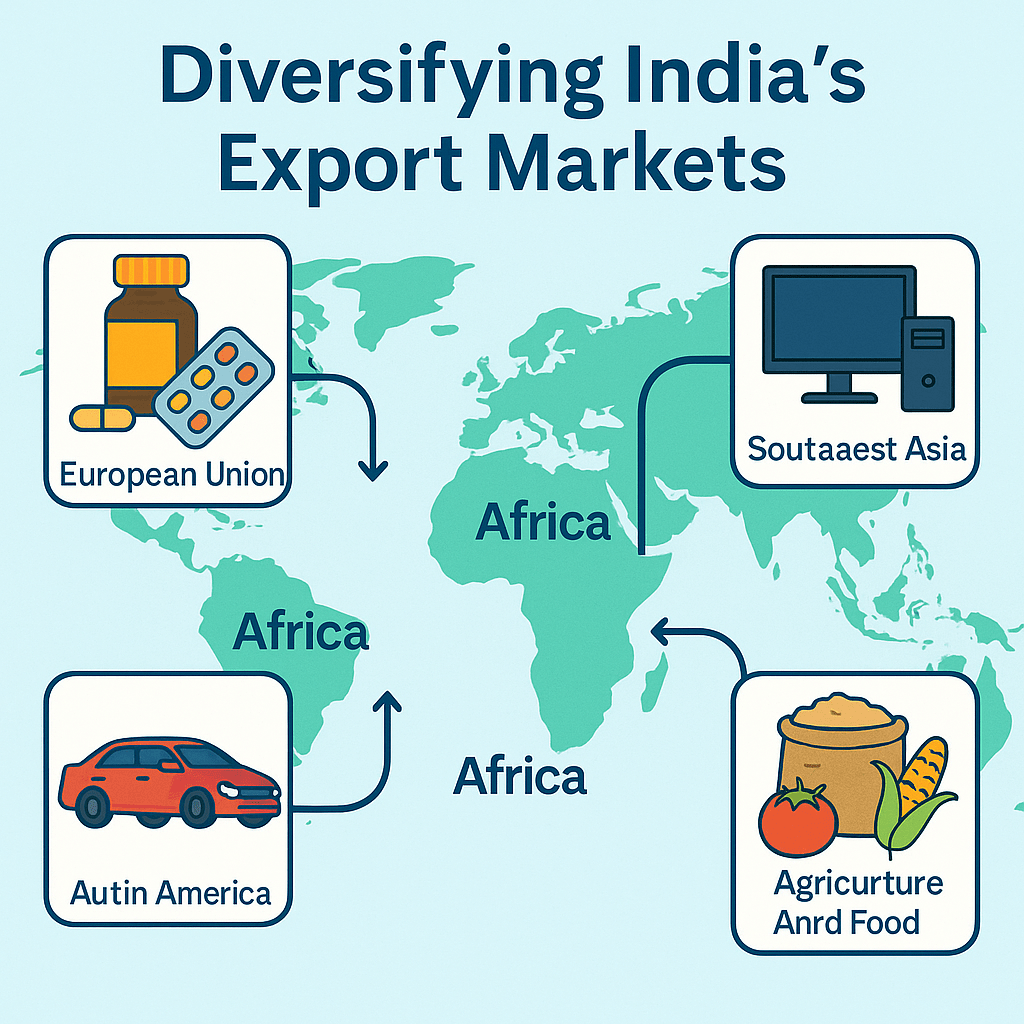
India’s ambition to reduce reliance on any single export destination—especially the U.S.—makes strategic diversification a clear priority. Four high‑potential regions stand out, each offering unique demand profiles, growth dynamics, and scale:
🇪🇺 European Union
Market size & context: The EU is one of India’s biggest export destinations for pharmaceuticals, gems, and textiles. Indian pharma exports alone—worth around $26 billion in FY 2023‑24—already reach regulated markets including the EU .
Key products to target: Pharmaceuticals (generics & vaccines), machinery, chemicals, gems & jewellery, cars and auto parts. Indian auto companies like Hero are preparing to ship vehicles—especially electric scooters—to European markets by mid‑2025 .
Why it matters: EU demand for high‑quality, standards‑compliant goods splits across industrial and consumer categories. India must meet stringent regulatory compliance and carbon/sustainability norms to succeed.
🌏 Southeast Asia (ASEAN region)
Market size & growth trend: Trade with ASEAN grew ~20% in 2023, with major gains in IT services, agriculture, and electronics exports .
Top product segments: Agricultural commodities (spices, tea, coffee), electronics and mobile devices (supported by PLI expansion), pharmaceuticals and processed foods.
Strategic fit: Proximity lowers cost and transit time. Rising urban incomes are expanding demand for Indian consumer goods. India can leverage regional trade frameworks like RCEP.
🌍 Africa
Market size & expansion potential: India–Africa exports stood at around $48 billion in 2023, with strong contributions from pharma and auto components . India aims to double trade with Africa by 2030 via initiatives like “Bharat‑Africa Setu” .
Export opportunities: Pharmaceuticals, low‑cost vehicles (three‑wheelers, two‑wheelers), auto parts (engine and transmission components), agricultural staples (spices, pulses, rice), and electronics. India’s coffee exports (up to $1.8 billion by 2023‑24) also resonate strongly in African demand markets .
Why it’s attractive: African demand for affordable, reliable goods aligns well with Indian strengths in pharma, machinery, autos, and food.
🌎 Latin America
Trade size & forecast: Latin America took ~$50 billion in Indian exports in 2022, with projections to reach ~$100 billion by 2027 . Export growth surged ~16% in 2023, notably for automobiles and pharmaceuticals .
Products in demand: Indian cars, motorcycles, auto parts; pharmaceuticals and generic medicines; processed foods; textiles; agricultural goods like spices, pulses, tea and coffee. In Peru, for instance, India sells iron‑steel towers, pipes, yarns and pharma products .
Growth enablers: Interest in Mercosur PTAs and expanding trade agreements with Chile, Colombia, Peru presents new access opportunities.
📊 Product Map & Market Scale Summary
EU ~$80 b (India‑EU total) + pharma component ≈ $26 b Pharmaceuticals, machinery, autos, gems, chemicals, textiles Premium cit compliance, emissions & sustainability norms
Southeast Asia ASEAN trade rose ~20% in 2023 Electronics, IT/ITES, agriculture (coffee, tea, spices), processed foods Proximity, RCEP, rising middle class
Africa $48 b in 2023, aiming to double by 2030 Pharma, auto parts & vehicles (three‑/two‑wheelers), agri‑goods, coffee Affordable products, existing ties & infrastructure corridors
Latin America $50 b in 2022, $100 b projected by 2027 Automobiles, pharma, textiles, processed foods, spices, pulses, tea Growing trade pacts, demand for new suppliers beyond US/China
Critical Insights & Data‑Backed Reasoning
Pharmaceutical exports are a core strength—it’s a ~$26 b industry in FY 2023‑24, with global leadership in generics & vaccines .
Auto components exports reached ~$23 b in FY 25 with a trade surplus, with Latin America and Africa growing fastest in demand (21% and 17% respectively) .
Textiles, especially from Tirupur’s knitwear cluster, clock ~$4.5 b in exports—targeting a $10 b milestone by 2030 by shifting toward synthetic/man‑made fibres tailored to Africa and Latin America’s athleisure markets .
Agricultural & food goods: India is targeting to double agri exports from ~$48 b in 2023‑24 to $100 b by 2030, capitalizing on global needs for staples like rice, pulses, coffee, tea and spices—Africa remains a major destination for rice and pulses thanks to affordability and volumes .
Electronics, including smartphones and solar PV modules, offer rising potential. Electronics exports (via PLI‑incentivized manufacturing) are expanding rapidly, including exports from India to Africa and West Asia, while solar PV shipments soared to ~$2 b in FY 24, mainly to the U.S. but with scope for other regions .
Strategic Takeaways
Diversifying exports into these multiple regions substantially lowers geopolitical and tariff risk. The EU demands high compliance but offers premium pricing; Southeast Asia and Africa demand affordability and scale; Latin America offers steady high growth and willingness to diversify.
By aligning India’s export mix—pharma, autos & parts, textiles (especially MMF), agri‑food, electronics—with each region’s demand, India can unlock resilient and rising growth levers. Carefully calibrated infrastructure investments, trade agreements, and quality upgrades will be key to execution.#IndiaExports
#GlobalTradeDiversification
#EuropeanUnionMarket
#SoutheastAsiaGrowth
#AfricaTradeOpportunities
#LatinAmericaBusiness
#PharmaceuticalExports
#AutomobileExports
#AgricultureAndFoodExports
#ElectronicsManufacturing
 "Connecting communities, empowering nations: Unifying the Regional and Global Economy ."
Leave a comment