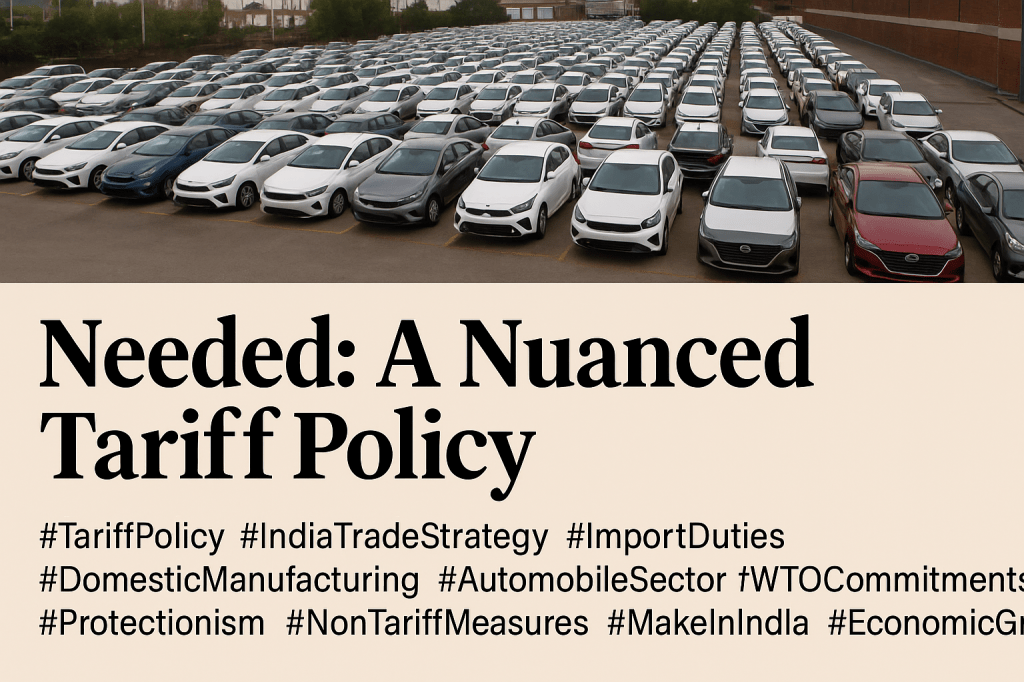
India’s tariff policy has long been the subject of debate among economists, policymakers, and trade negotiators. At the heart of the discussion lies the fact that India’s simple average tariff during the past decade has hovered between 8% and 11%, far higher than the 2%–3% average seen in the United States. While this has led to criticisms—particularly from global trading partners like the U.S.—India’s strategic use of tariffs has played a significant role in shaping certain domestic industries and protecting its economic interests. What remains critical, however, is the need for a calibrated, sector-sensitive approach that balances protection with competitiveness, enabling India to participate meaningfully in the global economy while supporting domestic industry.
The key argument in favor of India’s higher tariffs stems from their role in fostering domestic manufacturing ecosystems. The development of the Indian automobile sector during the 1990s and 2000s is a prime example. Backed by tariffs in the range of 60% to 125% on automobile imports, India managed to create a vibrant and competitive domestic auto industry. Major global players such as Suzuki and Hyundai were drawn to invest and manufacture locally rather than simply export to India. This inward investment, triggered by strategic protection, contributed to job creation, skill development, and technology transfer.
However, the protectionist narrative is not without its pitfalls. High tariffs can increase input costs for domestic producers, hamper integration into global supply chains, and sometimes hurt the very industries they aim to protect. The electronics sector offers a contrasting example. While high tariffs on mobile phones initially aimed to encourage local assembly and value addition, the broader IT hardware sector faced setbacks during India’s WTO commitments between 1997 and 2005. At that time, India removed tariffs on nearly 200 items, including computer components, which decimated local manufacturing. Indian producers, previously holding around 70% of the market share, saw it plummet to around 35-40% within a few years due to uncompetitive pricing against cheaper imports.
This contrast highlights the need for a differentiated approach to tariff policy—one that is neither uniformly high nor low but varies based on sectoral priorities, technological readiness, and strategic interests. For example, moderate tariffs on auto parts and components, combined with local sourcing requirements, can help create a robust supplier base. At the same time, low tariffs on inputs critical for export-driven industries such as textiles or electronics could enhance global competitiveness.
Critics often argue that India’s relatively high average tariffs contribute to inefficiencies and consumer disadvantage. Yet, the case for a uniform reduction in tariffs is not compelling either. A one-size-fits-all approach risks undermining emerging sectors or discouraging FDI in key areas. Moreover, in the absence of strong non-tariff measures (NTMs) such as stringent Sanitary and Phytosanitary (SPS) standards and Technical Barriers to Trade (TBTs), which many developed countries use effectively, a precipitous tariff drop could leave domestic producers exposed without adequate safeguards.
Some have suggested replacing tariffs with calibrated NTMs to protect domestic interests while remaining WTO-compliant. However, NTMs must be framed with transparency and fairness to avoid creating opaque barriers that could be challenged internationally. More importantly, India must invest in institutional capacity to implement and monitor such standards effectively—something that still remains a work in progress.
The ideal tariff policy for India, therefore, lies in its ability to strike a balance—encouraging competitiveness while offering strategic protection, promoting exports without compromising domestic industry, and using tariffs alongside well-designed NTMs where necessary. As India seeks to expand its manufacturing base under initiatives like ‘Make in India’ and position itself as a global supply chain partner, its trade policy must reflect this delicate balancing act. A nuanced tariff regime—sector-specific, dynamic, and development-oriented—will be central to India’s aspirations for inclusive, sustainable, and globally competitive economic growth.
#TariffPolicy
#IndiaTradeStrategy
#ImportDuties
#DomesticManufacturing
#AutomobileSector
#WTOCommitments
#Protectionism
#NonTariffMeasures
#MakeInIndia
#EconomicGrowth
 "Connecting communities, empowering nations: Unifying the Regional and Global Economy ."
Leave a comment