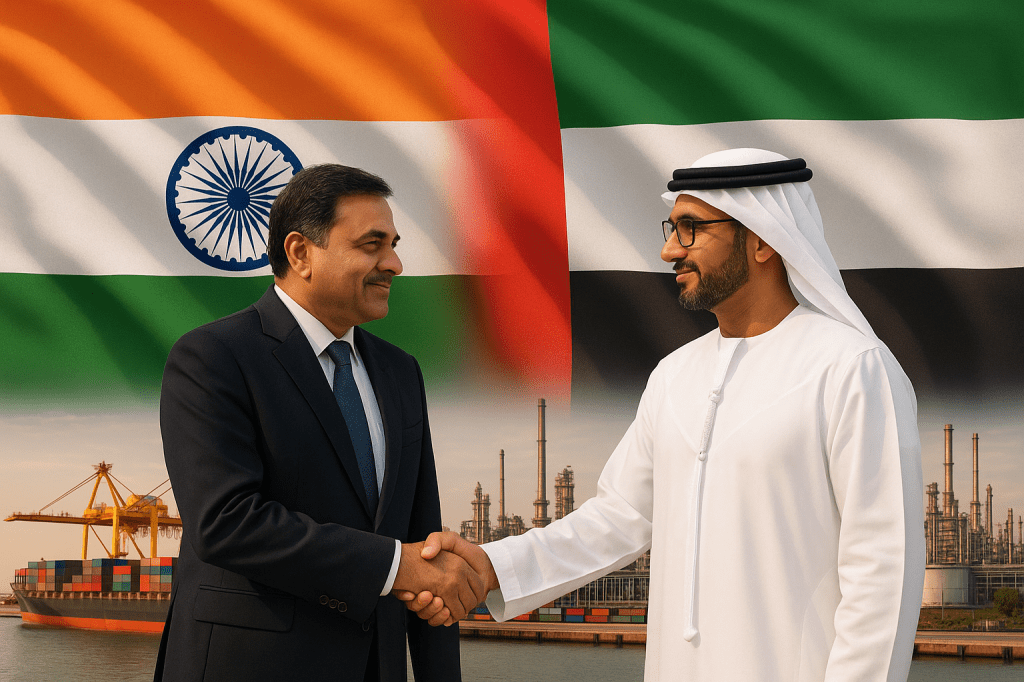
Since the implementation of the India-UAE Comprehensive Economic Partnership Agreement (CEPA) in May 2022, bilateral relations between the two nations have entered a new phase—marked by robust trade growth, accelerated investment flows, and sectoral synergy. The agreement has not only enhanced economic integration but also strategically positioned both economies to act as pivotal trade gateways in Asia, the Middle East, and beyond.
At the heart of this transformation lies the impressive growth in trade volumes. Bilateral trade between India and the UAE surged by 14.76% year-on-year, reaching a remarkable $83.64 billion in 2023–24. Notably, India’s exports to the UAE rose by over 27%, reflecting the immediate trade liberalization impact of CEPA. Even more critical is the over 20% growth in non-oil trade, which crossed $59.72 billion in the same fiscal period. These figures reflect a significant diversification of trade, with key contributions from gems and jewelry, pharmaceuticals, textiles, food processing, and engineering goods—many of which are labor-intensive and gain substantially from CEPA’s zero-duty regime on more than 90% of Indian export lines.
From an export potential perspective, CEPA has unlocked opportunities beyond the immediate UAE market. With improved tariff access, Indian exporters now view the UAE as a strategic transit point to high-demand markets in the Gulf Cooperation Council (GCC), Africa, and even Europe. This gateway function is particularly important for small and medium enterprises (SMEs), which now have cost advantages and simplified regulatory processes to tap into global value chains.
Investment flows, too, have witnessed a paradigm shift. The UAE has emerged as India’s fourth-largest foreign investor, committing $3.35 billion in 2023–24 to Indian sectors such as logistics, renewable energy, fintech, and infrastructure. In parallel, Indian businesses invested around $1.16 billion in the UAE, reflecting deepening bilateral confidence. The CEPA has liberalized investment frameworks, removed barriers, and encouraged joint ventures, particularly in advanced technology sectors like semiconductor design, green hydrogen, artificial intelligence, and defense manufacturing.
Major milestones post-CEPA include the establishment of new logistics corridors, green energy alliances, and fintech partnerships. In addition, over 1 million jobs are expected to be created in India, particularly in export-oriented and MSME-dense sectors, reinforcing CEPA’s role in inclusive growth and employment generation.
However, the journey hasn’t been devoid of challenges. While CEPA provides significant tariff benefits, businesses have had to adapt to new compliance mechanisms, documentation standards, and regulatory alignments. Many small Indian exporters initially struggled with certification norms, unfamiliar customs procedures, and limited awareness of sector-specific opportunities. On the UAE side, concerns about ensuring diversified supply chains and ensuring food security have necessitated regular bilateral consultations.
Nonetheless, both governments have proactively responded. Regular stakeholder meetings, trade facilitation councils, and digital platforms have been introduced to resolve friction points. Additionally, the push for integrated single-window clearance mechanisms and standardized digital trade documentation is steadily easing operational bottlenecks.
In conclusion, the India-UAE CEPA stands out as a model bilateral agreement that transcends mere tariff concessions. It has become a comprehensive framework for economic cooperation, technological exchange, and strategic alignment. For Indian exporters and investors, it opens new market corridors, builds resilience in global supply chains, and fosters long-term partnerships across sectors. With continuous policy support and capacity building for businesses, CEPA’s promise is only beginning to unfold—and its future looks even more promising.
#IndiaUAECEPA #TradeBoost #ExportPotential #BilateralTrade #InvestmentFlows #NonOilTrade #TariffFreeAccess #EconomicPartnership #GreenEnergyInvestments #GlobalSupplyChain
 "Connecting communities, empowering nations: Unifying the Regional and Global Economy ."
Leave a comment