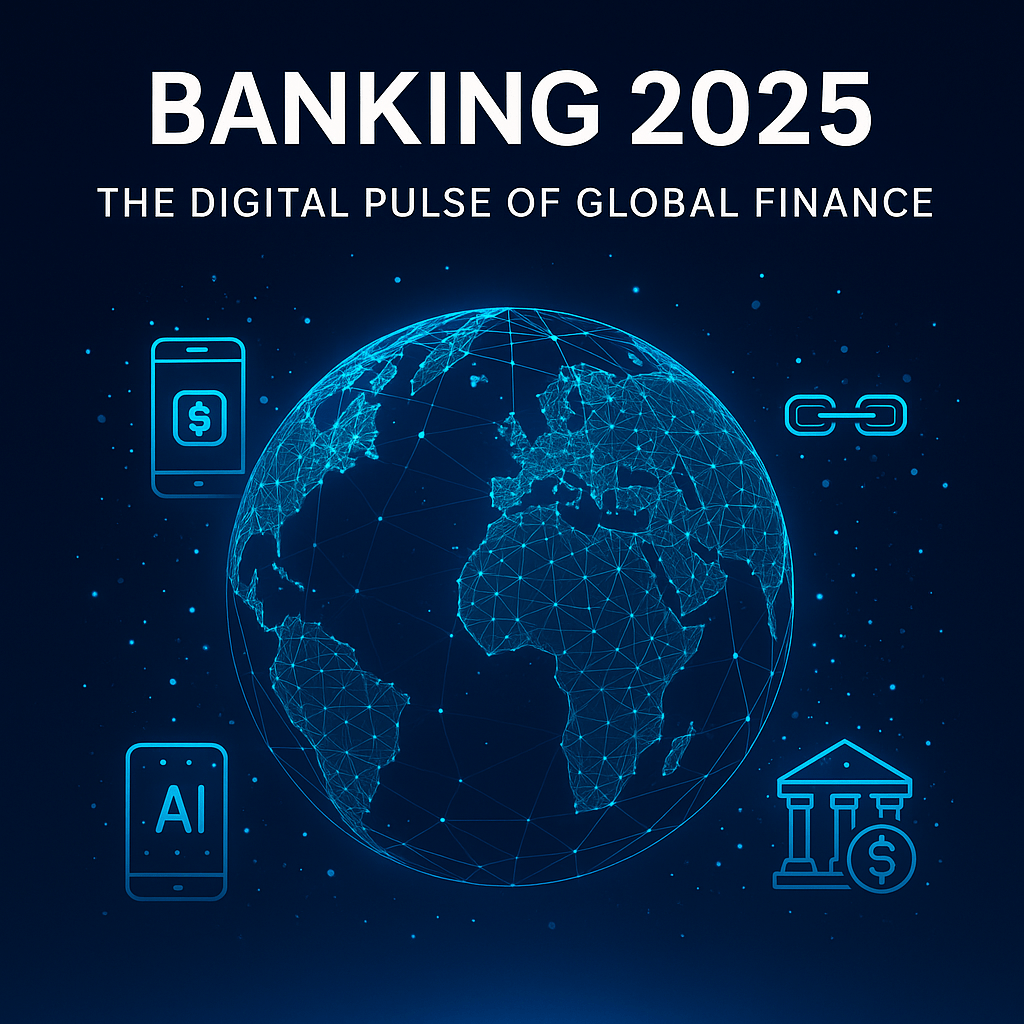
Banking and Financial Services in 2025: A Sector at the Crossroads of Innovation and Inclusion
The global banking and financial services industry in 2025 stands at a crucial inflection point. With a market valuation of $35.85 trillion—and on track to reach $47.34 trillion by 2029—the sector is not just expanding in size but also evolving in structure, driven by technological innovation, emerging financial ecosystems, and shifting customer expectations.
🔹 Market Dynamics and Size
Financial Services Market Size: $35.85 trillion in 2025
Projected Growth: $47.34 trillion by 2029 (CAGR: 7.2%)
Banking Sector Size: $29.8 trillion in 2025
Expected Growth: $52.56 trillion by 2033 (CAGR: 7.35%)
The industry’s expansion is fuelled by strong demand across segments such as lending and payments, insurance, investment management, and foreign exchange. Rapid digitalization and financial democratization are also enabling deeper market penetration, especially in underbanked regions.
🔹 Disruptive Trends Shaping 2025
1. Digital Transformation
From AI-driven customer service to cloud-native banking platforms, financial institutions are embracing technology to improve user experiences and operational efficiency. Blockchain is now a cornerstone of secure digital transactions, reducing friction and fraud risks.
2. Stable Profitability
With an average global Return on Equity (ROE) close to 12%, the banking industry is navigating 2025 with stable profitability. Banks are strategically pivoting toward data-rich services, agile operations, and revenue diversification.
3. Rise of Embedded Finance
Valued at $606 billion in 2025, embedded finance—banking services integrated into non-financial platforms—is redefining how consumers and businesses interact with money. Retailers, tech firms, and mobility apps now offer seamless financial products, bypassing traditional institutions.
4. Financial Inclusion as Growth Strategy
Digital financial services have expanded access across regions like Africa, South Asia, and Latin America. In India alone, the proliferation of mobile banking and UPI systems has transformed grassroots banking. Countries like the U.S., Canada, the U.K., and Germany continue to lead in infrastructure and innovation.
5. Security and Regulatory Compliance
As financial transactions shift online, cyber threats have surged. Regulatory bodies now mandate rigorous data governance, biometric authentication, and real-time risk monitoring to maintain consumer trust and protect systemic stability.
🔹 Industry Structure: A Snapshot
Companies: Over 22,900 active banking and financial firms globally
Employment: 7.6 million professionals
Innovation Drivers: More than 9,200 fintech startups
Investments: Over 12,000 funding rounds in recent years, with average investment size of $79 million per round
The ecosystem is vibrant and collaborative—traditional banks are increasingly partnering with fintechs, tech startups, and cloud service providers to co-create next-gen solutions.
🔹 Critical Insights for the Future
The banking sector is no longer just about money management—it’s about enabling lifestyles, powering small businesses, and driving digital inclusion.
Artificial Intelligence, blockchain, and edge computing are becoming foundational layers, not just add-ons.
ESG goals and green finance are also gaining traction, with sustainable banking initiatives now a key differentiator in investor and consumer decision-making.
The year 2025 represents more than a numeric milestone for the global financial sector—it is a transformation checkpoint. With robust growth, expanding access, rising security protocols, and tech-led innovation, the banking and financial services industry is rewriting its own rules. Institutions that invest in digital resilience, user-centric models, and inclusive strategies will not only survive but thrive in this new era.
#DigitalBanking
#FintechInnovation
#FinancialInclusion
#EmbeddedFinance
#BlockchainSecurity
#AIinFinance
#BankingTransformation
#FinancialServices2025
#GlobalBankingGrowth
#SustainableFinance
 "Connecting communities, empowering nations: Unifying the Regional and Global Economy ."
Leave a comment