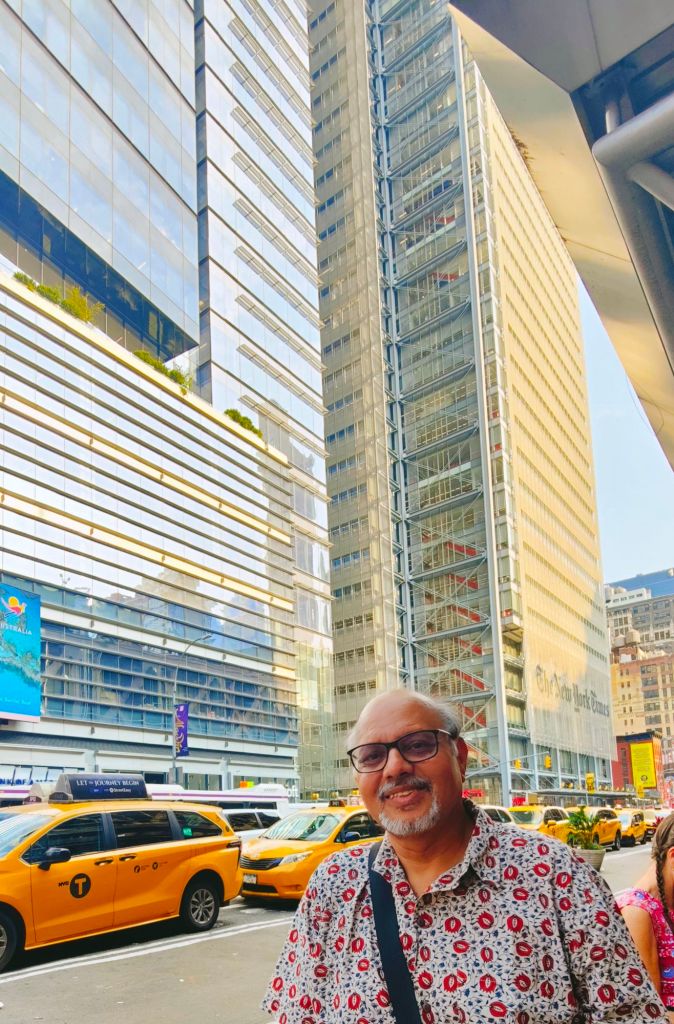
As I explore the financial heartbeat of New York City during my visit from India, I can’t help but reflect on the compelling similarities and stark contrasts between this iconic metropolis and Mumbai—India’s own financial powerhouse. Both cities are the nerve centers of their respective economies, yet their scale, depth, and global influence set them apart in meaningful ways.
Mumbai is undeniably the financial epicenter of India and South Asia. It houses the Reserve Bank of India (RBI), the Securities and Exchange Board of India (SEBI), and two of India’s most important stock exchanges—the Bombay Stock Exchange (BSE), which is Asia’s oldest, and the National Stock Exchange (NSE), the country’s largest in terms of trading volume. New York, by contrast, is the crown jewel of global finance, home to the New York Stock Exchange (NYSE) and NASDAQ, the world’s largest and second-largest stock exchanges by market capitalization. The NYSE alone accounts for over $25 trillion in market value, dwarfing even the combined valuation of BSE and NSE.
Mumbai contributes nearly 6% to India’s GDP and generates over 30% of the country’s direct tax revenue. Its strategic importance as the home of India’s biggest financial institutions, insurance firms, and major conglomerates like Reliance and Tata is unparalleled. Meanwhile, New York contributes close to 10% of the U.S. GDP and serves as the global headquarters for banking giants such as JP Morgan Chase, Goldman Sachs, and Morgan Stanley. The Federal Reserve Bank of New York plays a pivotal role in setting monetary policy and managing global liquidity flows.
The character of their financial districts is also revealing. Mumbai’s financial pulse beats across Nariman Point and the Bandra-Kurla Complex (BKC)—the latter being a rapidly modernizing corporate hub. New York’s financial identity, however, is forever linked with Wall Street and the broader Financial District of Lower Manhattan, which houses the NYSE, Federal Reserve, and numerous investment banks in iconic skyscrapers steeped in history.
Innovation in financial technology is reshaping both cities. Mumbai is witnessing a fintech boom fueled by IndiaStack, UPI, and a thriving startup culture. Homegrown unicorns like Zerodha and Groww exemplify this shift. In contrast, New York leads the U.S. in fintech investment outside Silicon Valley, with firms like Robinhood and Stripe innovating in capital markets, consumer finance, and blockchain applications. The venture capital landscape in NYC is mature and globally connected, supporting an ever-expanding fintech ecosystem.
Yet, each city grapples with its own set of challenges. Mumbai faces issues such as urban congestion, inconsistent infrastructure, and socio-economic inequality, particularly due to a large informal sector. Despite major urban transformation projects—often referred to as the development of “Third and Fourth Mumbai”—gaps in public transportation, housing, and flood resilience persist. New York, on the other hand, must contend with sky-high living and business costs, aging public transit infrastructure, and growing income disparities, particularly in post-pandemic recovery efforts.
From a business perspective, the cost of operations in New York is significantly higher than Mumbai. Office space, salaries, regulatory compliance, and overall cost of living make New York among the most expensive cities in the world. Mumbai, while costly by Indian standards, offers relatively affordable alternatives for global businesses, making it a favored destination for multinational corporations setting up back-offices and fintech labs.
Despite the contrasts, the importance of both cities cannot be overstated. Mumbai is the undisputed financial capital of India, with increasing relevance in global markets, particularly among emerging economies. It plays a central role in capital mobilization for infrastructure, services, and innovation-driven industries. New York, however, remains the benchmark for financial ecosystems worldwide. Its ability to influence global financial regulations, capital allocation, and investment behavior remains unmatched.
In essence, Mumbai and New York are not competitors—they are complementary forces in the evolving geography of global finance. Mumbai’s prominence is growing rapidly, backed by a young workforce, regulatory innovation, and increasing global investor interest. Meanwhile, New York continues to anchor the global financial system with its scale, maturity, and institutional power.
As globalization becomes more multipolar, the world will likely witness deeper financial ties between centers like Mumbai and New York. For now, standing amidst the skyscrapers of Manhattan, I appreciate how these two cities—separated by oceans but united in ambition—are scripting the future of global finance in their own powerful ways.
MumbaiFinance
#NewYorkFinance
#GlobalFinancialCenters
#StockMarkets
#FintechInnovation
#WallStreet
#BandraKurlaComplex
#CapitalMarkets
#FinancialInclusion
#UrbanEconomy
 "Connecting communities, empowering nations: Unifying the Regional and Global Economy ."
Leave a comment