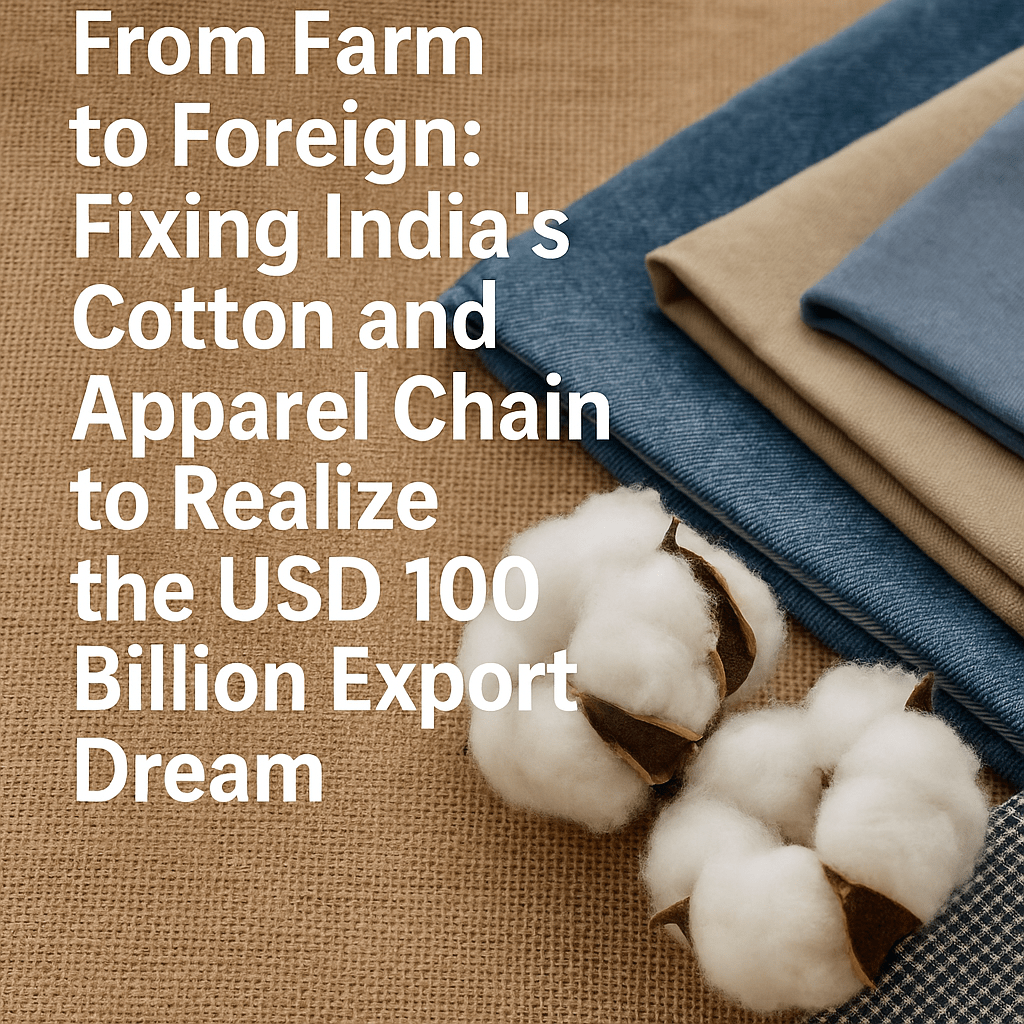
India’s textile and apparel sector is one of the oldest and most diverse industries in the country. Known as the 5Fs—Farm, Fibre, Fabric, Fashion, and Foreign—this sector is a vital pillar of India’s economic architecture. It contributes 2.3% to GDP, employs over 45 million people, and accounts for 12% of total export earnings. Yet, despite such prominence, the sector remains entangled in fragmented production systems, outdated technologies, low farm productivity, and uncompetitive global positioning.
The Productivity Paradox at the Farm Level
The cotton value chain, the backbone of India’s textile sector, witnessed a dramatic transformation with the introduction of genetically modified (GM) Bt cotton in 2002. This led to a 193% increase in cotton output over 12 years. However, productivity gains have stagnated in recent years. India’s average yield of 435 kg/ha is far behind China (1,945 kg/ha) and Brazil (1,689 kg/ha), indicating deep inefficiencies. Policy hurdles—especially delays in GM approvals—continue to restrain adoption of advanced pest-resistant, high-yield varieties.
Manufacturing Bottlenecks: An Incomplete Transition
While India produces large volumes of cotton, challenges in manufacturing persist. Indian spinning mills, for instance, are older than 20 years on average and require urgent modernization. The sector is dominated by micro, small, and medium enterprises (MSMEs), many of which lack the financial muscle to upgrade machinery or adopt energy-efficient processes. Modern blended textiles like polyester staple fibre (PSF) and viscose staple fibre (VSF), essential in global demand, are not competitively priced due to inverted GST structures and quality control issues.
Compounding these issues, India is also heavily reliant on raw material imports from China. In 2013, over 42% of Indian yarn exports were to China, but policy changes like China’s duty-free access to Pakistan and the withdrawal of Indian export incentives led to a sharp fall in India’s global share.
Apparel Sector: Fast Fashion, Slow Exports
India’s garment manufacturing sector, a significant employment generator, remains largely cotton-centric and MSME-led. Despite having one of the lowest labor costs, Indian manufacturers struggle with long delivery timelines, outdated production lines, and lack of design innovation. For instance, an Indian garment export takes 63 days to reach the buyer—far slower than Bangladesh’s 50-day cycle.
India’s global market share in man-made fibre (MMF) production is abysmally low at 1.9%, even though MMF accounts for over 70% of global consumption. Trade barriers and an inverted GST regime further raise the cost of synthetic garments in India by 9–12% over competitors. While Bangladesh and Vietnam enjoy duty-free access to EU markets, India suffers from significant trade disadvantages.
Policy Recommendations: Roadmap to USD 100 Billion
Achieving the ambitious target of USD 100 billion in textile and apparel exports by 2030 is possible—but only with a systemic transformation across the 5F value chain. The report recommends a five-pronged strategy:
1. Integrate the 5F Supply Chain and Fast-track PM MITRA Parks
Vertical integration is critical to reduce lead times and enhance global competitiveness. Establishing Mega Integrated Textile Regions and Apparel (PM MITRA) parks in Gujarat and Tamil Nadu could serve as anchor platforms for value-added exports.
2. Reform MMF Policy and Correct GST Inversion
The inverted duty structure on MMF should be rationalized. Quality control standards must also be revised to make India’s synthetic textile competitive globally.
3. Expand Market Access in Key Destinations
India must urgently pursue bilateral trade agreements with the EU and U.S.—its two largest apparel markets—to regain competitiveness lost to Bangladesh and Vietnam.
4. Boost Cotton Productivity and Close Yield Gaps
Strategic irrigation, high-density planting, and quicker GM crop approvals will help bridge the productivity gap and stabilize raw material supplies for the textile sector.
5. Modernize Manufacturing with Tech and Capital Access
India must provide targeted financial assistance and policy support for MSMEs to adopt Industry 4.0 practices, digital design systems, and sustainable production technologies.
Turning the Loom of Reform
India’s textile dream cannot be realized without bold policy choices and committed execution. The opportunity is vast—emerging destinations like Japan, Brazil, and South Korea offer promising demand. But unless India aligns farm productivity, modernizes machinery, unlocks market access, and streamlines GST and QCO frameworks, the vision of becoming a global textile powerhouse will remain unfinished. With coordinated reforms, however, India can stitch together a globally competitive textile value chain—right from cotton fields to fashion runways.
Source: This blog draws extensively on the research and data published by ICRIER in their report “From Farm to Foreign: Saga of Indian Textile and Apparel Sector.” The original analysis offers a comprehensive evaluation of the cotton-to-garment value chain and India’s policy challenges and opportunities in the textile and apparel sector. Full credit is due to the authors and researchers of this report.
 "Connecting communities, empowering nations: Unifying the Regional and Global Economy ."
Leave a comment