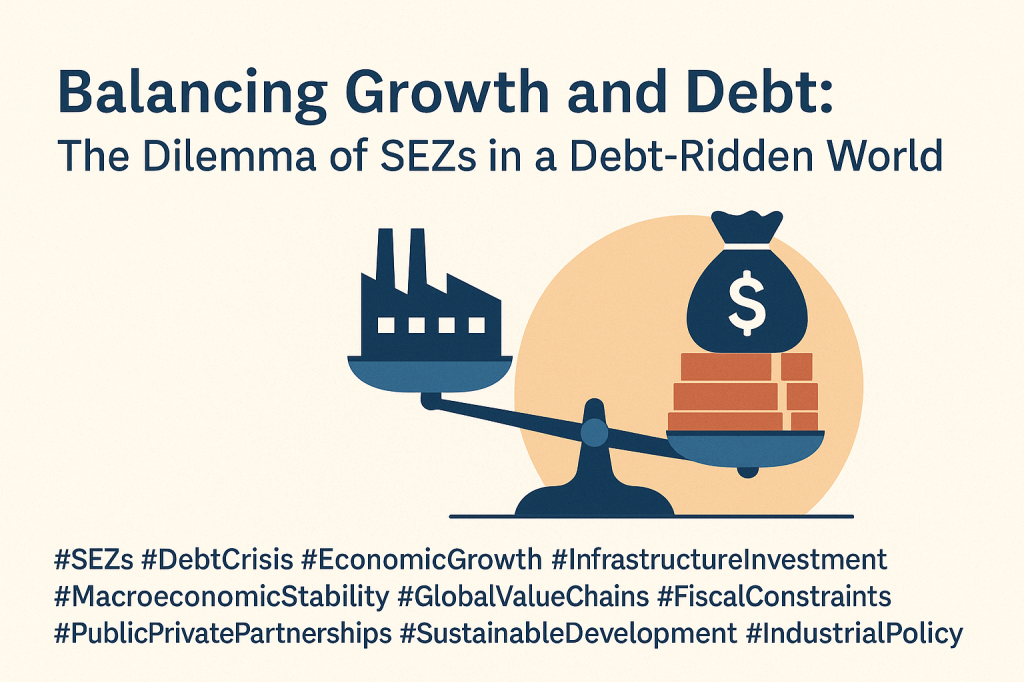
In recent years, the global economy has witnessed mounting debt burdens that are reshaping fiscal strategies across both developing and developed nations. With over a third of the world’s countries at risk of debt distress, governments are being forced to reprioritize spending, often pulling back on long-term development projects—including Special Economic Zones (SEZs).
SEZs have long been heralded as engines of industrial growth, trade facilitation, and employment generation. These zones, strategically designed to attract foreign investment and integrate local economies into global value chains, have played a vital role in transforming economies such as China, Vietnam, and the UAE. According to UNCTAD, countries with effective SEZ strategies have seen export growth increase by up to 40% and FDI inflows grow by 25% over a decade.
However, the irony lies in the paradox that SEZs, which are meant to stimulate economic development and relieve fiscal strain over the long term, require significant upfront investment. Establishing functional SEZs involves robust infrastructure, sound regulatory frameworks, skilled administrative personnel, and continuous policy support. This is precisely where the debt crisis has begun to stifle progress. Many nations, already struggling to meet existing debt obligations, now face an impossible trade-off between macroeconomic stability and forward-looking investments in zones that could revitalize their economies.
The situation is further complicated by global shocks such as the COVID-19 pandemic, supply chain disruptions, and rising interest rates. For instance, in Africa alone, over 20 countries are either in or at high risk of debt distress, as per IMF data. These fiscal constraints have led to postponed or poorly implemented SEZ projects, dampening investor confidence and undermining the zones’ economic potential.
Yet, this is not a call to abandon SEZs. On the contrary, when planned with precision and embedded within national industrial strategies, SEZs can serve as powerful tools for structural transformation. They offer targeted environments to test reforms, incubate export-led industries, and generate employment—especially in regions left out of mainstream economic growth.
To harness their full potential amid financial constraints, countries must adopt a phased and collaborative approach:
Public-private partnerships (PPPs) can spread financial risks and bring in expertise.
Multilateral financing and technical assistance from institutions like the World Bank or Asian Development Bank can bolster capacity building and infrastructure readiness.
Policy coherence and governance reforms can enhance transparency and efficiency, ensuring better returns on SEZ investments.
In conclusion, the global debt crisis is indeed narrowing fiscal options, but it should not extinguish the vision of sustainable industrialization through SEZs. Instead, it calls for smarter, leaner, and more inclusive planning. If managed prudently, SEZs can still carve out a path from economic stagnation toward growth and resilience—proving that even in the face of financial constraints, bold economic imagination remains essential.
#SEZs
#DebtCrisis
#EconomicGrowth
#InfrastructureInvestment
#MacroeconomicStability
#GlobalValueChains
#FiscalConstraints
#PublicPrivatePartnerships
#SustainableDevelopment
#IndustrialPolicy
 "Connecting communities, empowering nations: Unifying the Regional and Global Economy ."
Leave a comment