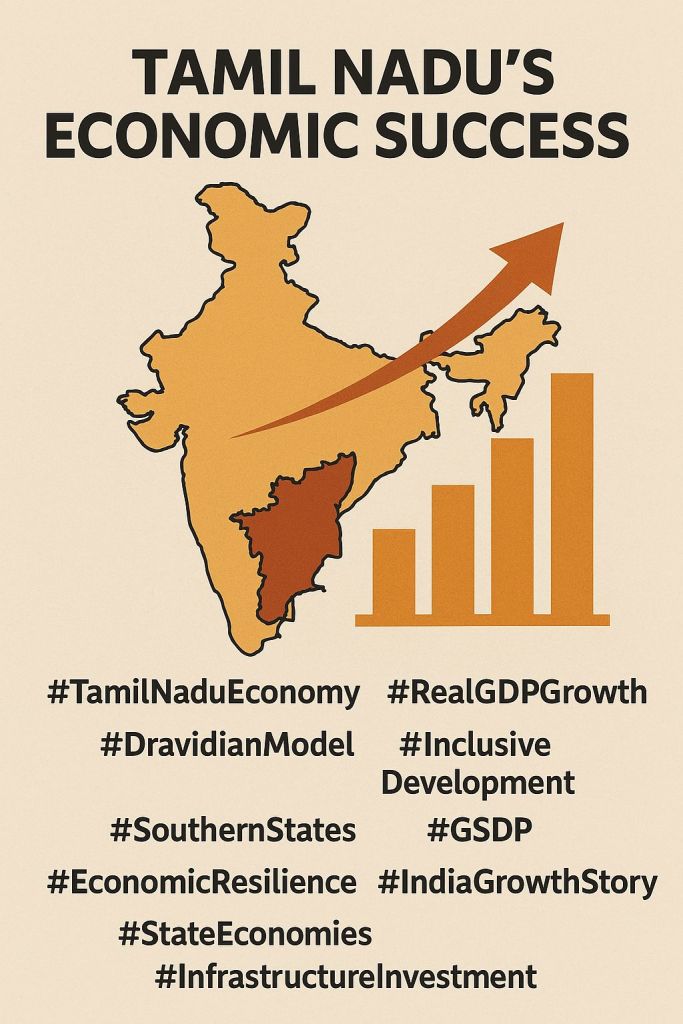
India’s federal structure has long encouraged healthy competition among states—particularly in economic performance. In a compelling display of resilience and vision, the southern state of Tamil Nadu has emerged as the frontrunner in India’s growth narrative for the fiscal year 2024–25. Recording a real economic growth rate of 9.69%, the state not only topped the national charts but also marked its highest growth in a decade—a milestone that speaks volumes about the efficacy of its policy orientation and economic stewardship.
This is more than just a statistical achievement; it’s a validation of a developmental philosophy that has consistently prioritized inclusion, gender equality, and regionally balanced growth. The Chief Minister credited this momentum to the Dravidian model, a framework rooted in equity and social justice, which has now evolved into a powerful growth engine.
What makes Tamil Nadu’s achievement particularly remarkable is its resilience in adversity. During the COVID-19 crisis of 2020–21, when the national economy barely moved at 0.07%, Tamil Nadu still posted positive growth, even as many other states slipped into contraction. Such sustained performance through volatile times indicates robust institutional and fiscal capacity—an often underappreciated factor in regional growth dynamics.
Real vs. Nominal Growth: Why It Matters
Understanding Tamil Nadu’s economic performance requires a closer look at real growth, which strips out the effects of inflation and offers a more accurate picture of actual expansion in economic activity. At 9.69% real GSDP growth, Tamil Nadu has clearly surged ahead, while also registering a nominal growth rate of 14.02%—again the highest in the country.
The state’s Gross State Domestic Product (GSDP) rose from ₹16 lakh crore to ₹17 lakh crore, showcasing growth not only in numbers but also in capacity to generate wealth, jobs, and revenue. These figures, published by the Union Ministry of Statistics and Programme Implementation, lend credibility to Tamil Nadu’s aspirations of becoming a $1 trillion economy in the foreseeable future.
The Southern Growth Corridor
Tamil Nadu is not alone in powering ahead. Fellow southern states such as Andhra Pradesh and Karnataka also posted commendable growth, underlining a trend: the South is emerging as India’s economic heartbeat. Meanwhile, Maharashtra—India’s financial powerhouse—has also shown continued strength.
In the northern belt, Rajasthan and Haryana have registered credible growth, proving that with the right mix of policy reforms, infrastructure investments, and industrial strategies, even landlocked states can climb the economic ladder.
The Silence from the Heartland
In contrast, a puzzling void emerges in the official data. States like Gujarat, Bihar, and Uttar Pradesh—home to large populations and historically crucial to India’s overall development trajectory—were not included in the latest economic performance dashboard. These omissions raise questions: are these states lagging in their data transparency, or is it a signal of underperformance that authorities are hesitant to reveal?
Traditionally, states such as Bihar, Madhya Pradesh, and Uttar Pradesh have faced structural bottlenecks: poor educational outcomes, weak health infrastructure, and limited industrial diversification. However, some of them—particularly Uttar Pradesh—are now making bold claims of transformation.
The Uttar Pradesh government, for instance, has projected a GDP target of ₹32 trillion by 2025, banking on massive investments in infrastructure, manufacturing, and foreign direct investment. This goal, though ambitious, reflects a growing willingness among states to reposition themselves in the global economic matrix.
Will the Claims Hold?
It is one thing to project ambition and quite another to institutionalize performance. The success of Tamil Nadu lies not in loud promises, but in its quiet, consistent execution—across sectors and administrations. If states like Uttar Pradesh and Bihar are to catch up, they must replicate not only the investment strategies but also the governance ethos that prioritizes public services, human capital, and data-driven policymaking.
India’s development story is not a monolith. It is a mosaic—each state a tile with its own shine or shadow. The recent data offers a timely reminder that with the right mix of vision, inclusion, and execution, states can leapfrog challenges and emerge as national leaders.
As we move further into the decade, will the next growth champion rise from the South again, or will the heartland script a new narrative? The answer lies in the choices states make today—in budgets, in reforms, and in their commitment to inclusive, evidence-backed development.
 "Connecting communities, empowering nations: Unifying the Regional and Global Economy ."
Leave a comment