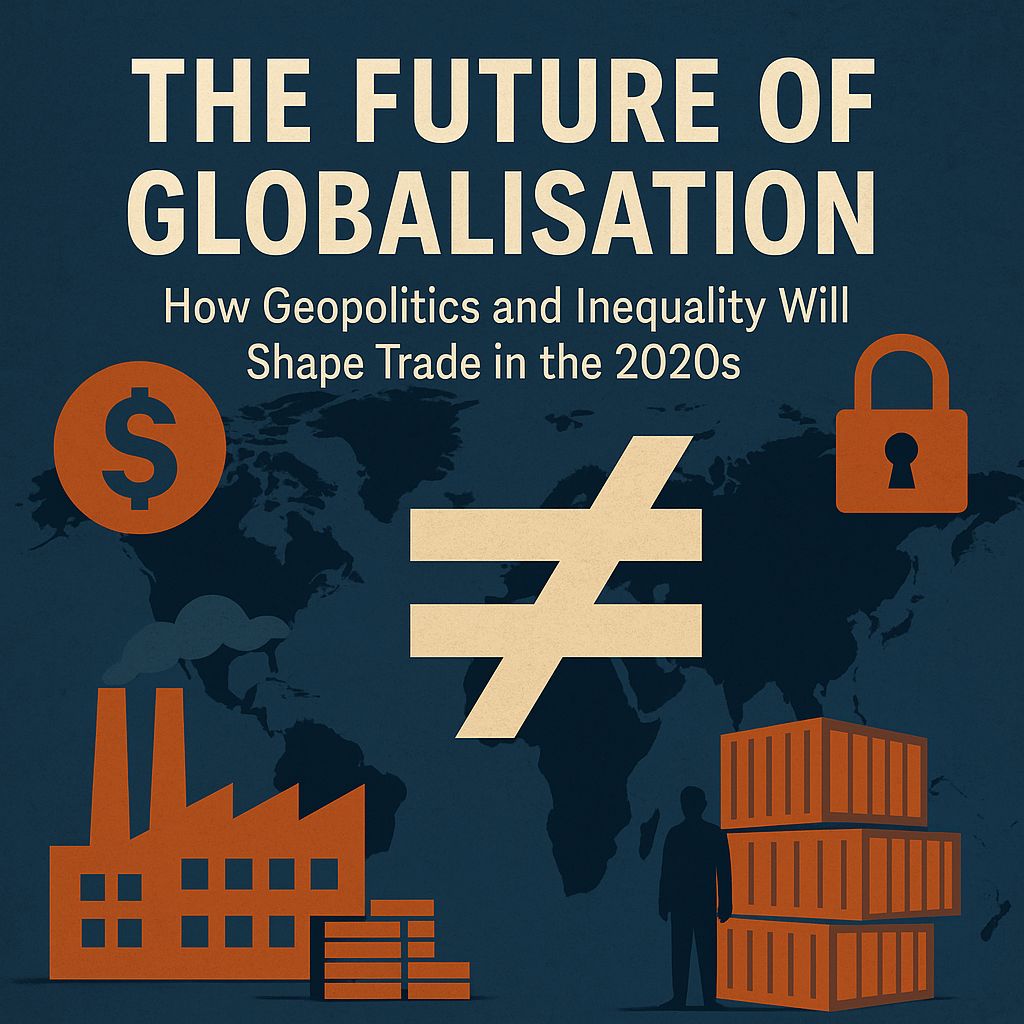
Globalisation, once seen as an unstoppable force driving prosperity and interconnectedness, is now entering a period of recalibration. The 2020s are witnessing a paradigm shift where geopolitical tensions and rising inequality are redefining trade flows, reshaping supply chains, and challenging the very foundations of global economic integration.
The Geopolitical Rebalancing of Trade
The world is increasingly becoming multipolar. The U.S.–China trade war that began in 2018 has evolved into broader strategic rivalry, affecting technology transfer, investments, and global supply chains. Recent data from the Peterson Institute for International Economics shows that between 2018 and 2023, U.S. imports from China declined by 20%, with countries like Vietnam and Mexico gaining market share. This trend suggests a clear shift towards “friend-shoring” and regionalisation.
The Russia–Ukraine conflict further accelerated geopolitical fault lines, particularly in energy trade. Europe, once heavily reliant on Russian gas, has diversified toward LNG imports from the U.S., Qatar, and Norway. According to Eurostat, EU imports of Russian natural gas dropped from 40% of total imports in 2021 to less than 15% in 2023. This reflects a decisive push for geopolitical trade realignment, emphasizing security over cost-efficiency.
Another development is the rise of economic nationalism. Countries are increasingly using tariffs, subsidies, and trade barriers to protect domestic industries. The U.S. Inflation Reduction Act of 2022, offering massive subsidies for domestic green technology production, is already prompting responses from the EU and others, raising concerns about the fragmentation of global trade norms.
Inequality and the Shift in Global Trade Dynamics
While globalisation lifted millions out of poverty, it also widened inequality both within and between countries. According to the World Inequality Report 2022, the top 10% of earners hold 76% of the world’s wealth, while the bottom half hold just 2%. This inequality is fuelling protectionism and populism, with citizens in advanced economies increasingly questioning the benefits of open trade.
Emerging economies, however, are demanding a more equitable share of the global trading system. South-South trade is growing rapidly. The Asian Development Bank reports that trade between developing Asian economies increased from $1.5 trillion in 2010 to over $3.8 trillion in 2022, outpacing North-South trade growth.
The challenge for the 2020s will be balancing efficiency with fairness. The push for ‘inclusive globalisation’ — integrating smaller nations, investing in capacity building, and ensuring fair access to technology — is becoming a policy imperative. The WTO has acknowledged these challenges, but multilateral consensus is increasingly hard to achieve.
Technology and Trade Fragmentation
The digital economy is another key battleground. The world is splitting into tech blocs: one led by the U.S. and allies focusing on open digital standards, and the other dominated by China’s state-led technology model. The decoupling in semiconductors, 5G infrastructure, and AI development signals a future where technology trade will be increasingly politicized.
Cross-border data flows, valued at over $3 trillion annually (McKinsey Global Institute, 2023), are facing regulatory hurdles, with countries introducing data localization laws and digital sovereignty measures. India’s proposed Digital Personal Data Protection Act and similar laws in the EU and China will shape the new contours of digital trade.
Climate Change and Green Trade Alliances
Another factor shaping the future of trade is climate change. Countries are forming green trade alliances, linking carbon border taxes and environmental standards to trade agreements. The European Union’s Carbon Border Adjustment Mechanism (CBAM), set to be fully implemented by 2026, will tax imports based on their carbon intensity. This could alter competitiveness and shift manufacturing towards greener economies. Developing countries may struggle with these requirements unless supported by technology transfer and financial aid.
Conclusion: Towards a More Complex Globalisation
Globalisation is not ending, but it is becoming more complex. Geopolitical considerations, rising inequality, technological fragmentation, and climate imperatives are all influencing how trade will evolve in the 2020s.
For businesses and policymakers, adaptability is key. Companies must diversify supply chains and prepare for regulatory complexities. Nations need to engage in strategic trade diplomacy, balancing national interests with global cooperation. The vision for globalisation in this decade will be less about seamless borders and more about managed interdependence — resilient, secure, and (hopefully) more inclusive.
 "Connecting communities, empowering nations: Unifying the Regional and Global Economy ."
Leave a comment