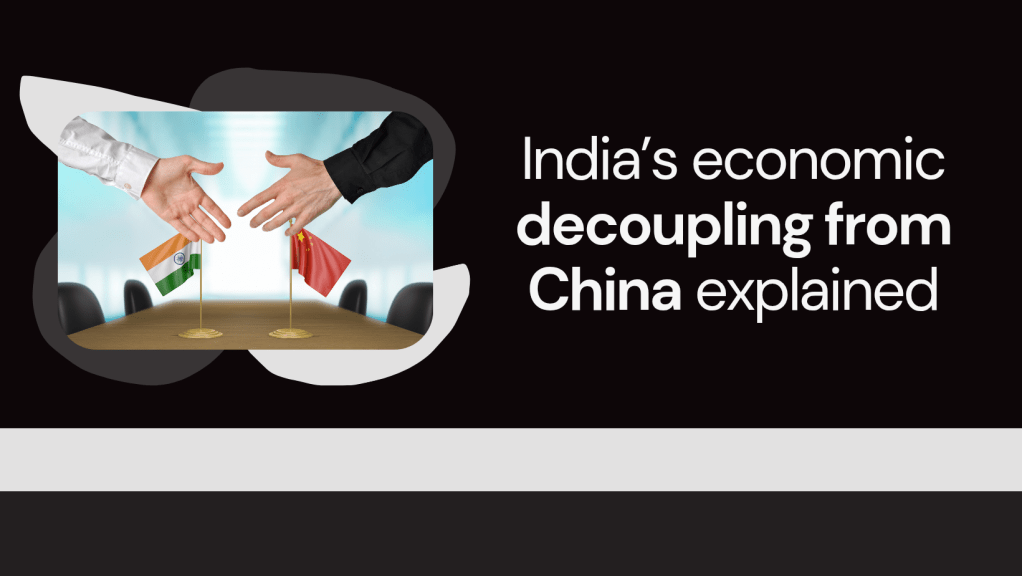
In recent years, India has embarked on an ambitious path to reduce its economic reliance on China. This move, often termed as “economic decoupling,” is driven by a mix of geopolitical tensions, self-reliance goals, and the broader vision of positioning India as a global manufacturing hub. However, the question remains – is India truly capable of severing economic ties with China, or is the process more intricate than it appears?
Strategic Steps Towards Decoupling
The Indian government, under the ‘Atmanirbhar Bharat Abhiyan’ (Self-Reliant India Initiative), has introduced a series of policies aimed at boosting domestic industries and curbing Chinese imports. Key strategies include:
Protectionist Measures – Tariffs and non-tariff barriers have been imposed to limit imports from China, fostering the growth of domestic producers.
Foreign Direct Investment (FDI) Restrictions – Chinese investments face tighter scrutiny, with approvals required for investments from neighboring countries, particularly in sensitive sectors.
Manufacturing Incentives – India is prioritizing sectors like pharmaceuticals, electronics, and renewable energy, aiming to reduce reliance on Chinese supply chains for active pharmaceutical ingredients (APIs) and electronic components.
These efforts reflect India’s intent to strengthen domestic manufacturing and attract global companies seeking alternatives to China.
The Challenges on the Path
Despite these initiatives, India’s decoupling journey faces substantial roadblocks. A complete shift away from Chinese imports is neither swift nor straightforward due to:
Labor and Skill Gaps – India’s workforce, while abundant, often lacks the specialized skills needed to rapidly scale up production in high-tech sectors.
Infrastructure Deficits – Inadequate logistics, power supply, and port facilities hinder India’s ability to compete with China’s efficient and cost-effective manufacturing ecosystem.
Government Support – Although policies promote self-reliance, many industries argue that subsidies and incentives remain insufficient compared to China’s comprehensive state-backed industrial policies.
Dependency on Chinese Goods – Chinese imports dominate crucial segments such as machinery, chemicals, and telecommunications, accounting for billions in trade annually.
Furthermore, experts highlight that India has a limited window – estimated at two to three years – to capitalize on companies relocating from China. Failure to act decisively could result in these firms diverting to other emerging economies in Southeast Asia.
Economic Realities: Decoupling or Diversification?
While reducing dependence on China is desirable, achieving complete decoupling may be more of a long-term aspiration than an immediate reality. China’s position as the world’s manufacturing powerhouse means that India will likely continue importing essential goods even as domestic production grows.
This interdependence suggests that rather than absolute decoupling, India may pursue economic diversification – gradually expanding its industrial base while selectively reducing reliance on Chinese products in critical areas.
Moreover, recent diplomatic interactions indicate that economic pragmatism may coexist with competitive posturing. As global supply chains recalibrate, India and China could explore collaborative ventures in mutually beneficial sectors, striking a delicate balance between rivalry and cooperation.
A Long Road Ahead
India’s economic decoupling from China is not a binary process but a complex and evolving strategy. While the foundations for reducing dependency are being laid, structural challenges and economic realities suggest that a nuanced approach will prevail.
Ultimately, India’s success in this endeavor hinges on sustained investments in infrastructure, innovation, and workforce development, ensuring that the country is not only resilient but also globally competitive.
 "Connecting communities, empowering nations: Unifying the Regional and Global Economy ."
Leave a comment