Introduction:
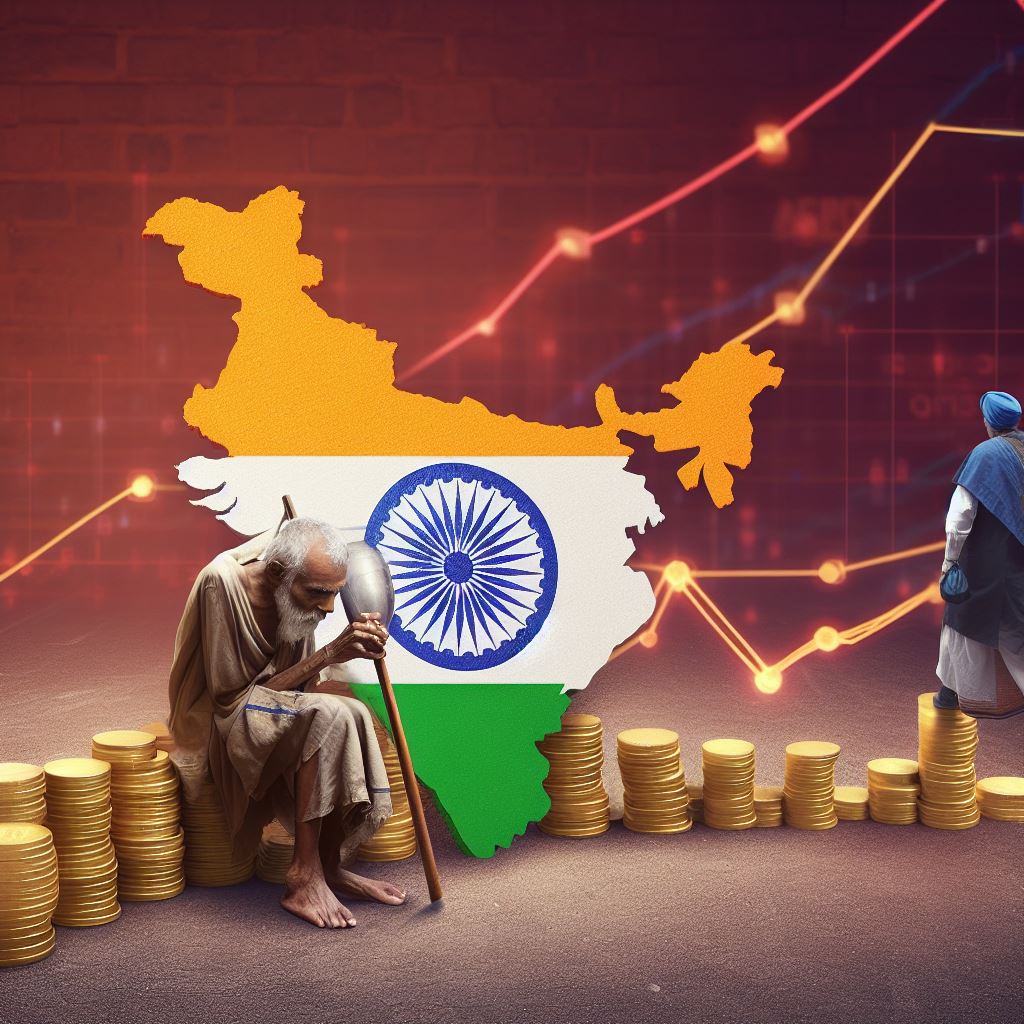
The recent rapid growth of the Indian economy has undeniably contributed to poverty reduction in the country. Several government programs and policies have played a crucial role in improving the lives of millions. However, challenges such as uneven distribution of growth, high levels of inequality, the prevalence of the informal sector, and limited access to basic services remain, underscoring the need for continued efforts and a multi-faceted approach.
Uneven Distribution of Growth:
India’s economic growth has not been equally distributed across the nation. Certain regions, such as urban areas and more industrialized states, have experienced more significant benefits from growth compared to rural regions and less-developed states. This uneven distribution has perpetuated regional disparities, exacerbating poverty levels in some areas.
High Levels of Inequality:
India’s rapid economic growth hasn’t been accompanied by a proportional reduction in income inequality. In fact, the country continues to grapple with one of the highest levels of inequality globally. The gap between the rich and the poor remains substantial, limiting the potential of economic growth to uplift the most vulnerable segments of society.
Informal Sector and Working Conditions:
The informal sector, which employs a significant portion of India’s workforce, is characterized by low wages and poor working conditions. Workers in this sector often lack job security, social protection, and access to benefits such as healthcare. Formalizing the informal sector is crucial to ensure fair treatment, improved wages, and better working conditions for this vulnerable group.
Lack of Access to Basic Services:
Despite progress, a considerable portion of the Indian population still lacks access to basic services such as education, healthcare, and sanitation. Insufficient infrastructure and inadequate government spending in these areas perpetuate the cycle of poverty, limiting opportunities for social mobility and economic advancement for marginalized populations.
Positive Impacts of Government Programs:
India’s government has put in place several poverty alleviation programs to address these challenges. The Mahatma Gandhi National Rural Employment Guarantee Act (MGNREGA) aims to provide higher income and guaranteed employment opportunities to rural households. The Pradhan Mantri Jan Dhan Yojana (PMJDY) promotes financial inclusion, while the Pradhan Mantri Ujjwala Yojana (PMUY) aims to provide access to clean cooking fuel for impoverished households.
However, More Needs to Be Done:
While commendable progress has been made, further action is necessary to reduce poverty and its associated challenges.
Investing in Inclusive Growth:
The government should prioritize investment in sectors that generate employment opportunities and improve incomes for the poor. Agriculture, manufacturing, and services sectors have significant potential for job creation and income enhancement, particularly in rural areas. Initiatives such as skill development programs and support for small and medium-sized enterprises can contribute to inclusive growth.
Reducing Inequality:
Addressing inequality requires a multi-pronged approach. Progressive taxation policies can help redistribute wealth, funding social welfare programs aimed at providing healthcare, education, and basic services for the disadvantaged. Access to quality education should be improved to bridge the skills gap and enhance employability, while affordable and accessible healthcare services should be expanded to ensure no one is left behind.
Formalizing the Informal Sector:
The government needs to take steps to formalize the informal sector, protecting the rights of workers and improving their working conditions. Creating an enabling environment that supports entrepreneurship, provides training programs, and enhances access to credit can incentivize informal sector workers to transition into the formal economy.
India’s recent economic growth has undoubtedly had a positive impact on poverty reduction. Nevertheless, the challenges of uneven distribution of growth, high inequality rates, the widespread informal sector, and limited access to basic services persist. Continued efforts and a multi-faceted approach involving the government, private sector, and civil society are necessary to overcome these challenges and create a more inclusive and equitable society.
References:
- “Impact of Poverty – Indian Economy Notes – Prepp.” Prepp, https://prepp.in/news/e-492-impact-of-poverty-indian-economy-notes.
- “Economic growth: the impact on poverty reduction, inequality, human….” Bing, https://bing.com/search?q=Indian+economy+growth+impact+on+poverty.
- “Impact of LPG reform on reducing poverty in India – INSIGHTSIAS.” INSIGHTSIAS, https://www.insightsonindia.com/indian-economy-3/poverty-and-unemployment/poverty/impact-of-lpg-reform-on-reducing-poverty-in-india/.
- “Press Information Bureau.” Press Information Bureau, https://pib.gov.in/PressReleasePage.aspx?PRID=1693210.
 "Connecting communities, empowering nations: Unifying the Regional and Global Economy ."
Leave a comment