The Next Global Conflict May Not Be About Technology but About Water
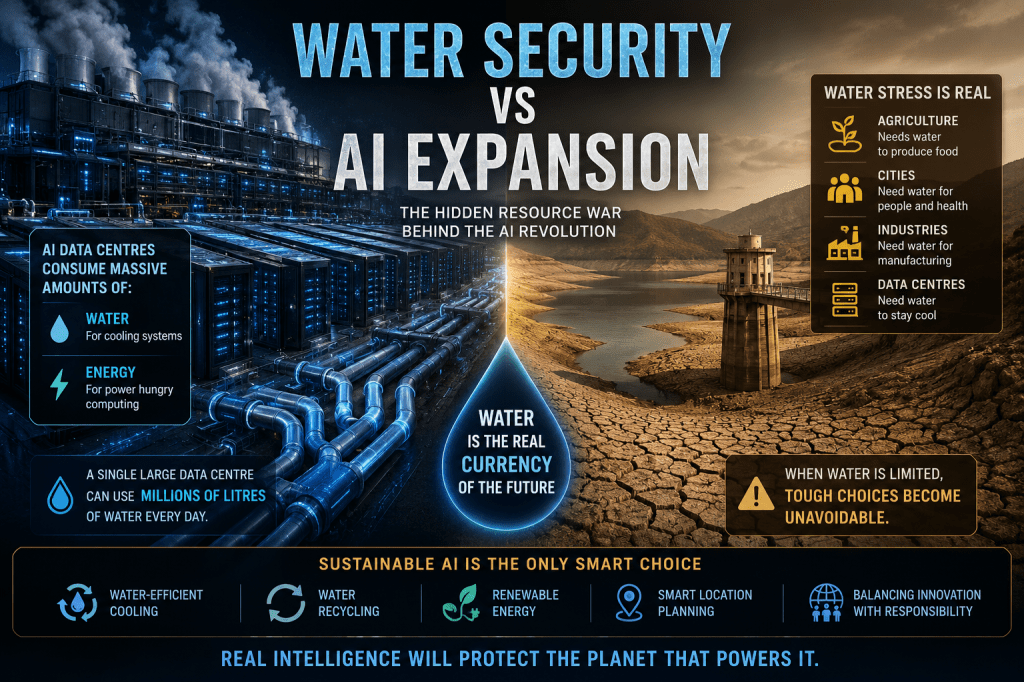
Artificial Intelligence is being celebrated as the engine of the next industrial revolution. Governments are racing to build AI infrastructure, companies are investing billions in massive data centres, and nations are competing to become global AI leaders. Yet behind this technological excitement lies a silent reality that receives far less attention. AI does not run only on algorithms. It runs on electricity, cooling systems, and above all, water. Every powerful AI model requires enormous computing capacity, and these computers generate tremendous heat. Keeping them cool often demands millions of litres of water. The future may therefore witness an uncomfortable question. Can a country become an AI superpower if it cannot guarantee enough water for its own people?
History Shows That Every Civilization Has Been Built Around Water
History repeatedly reminds us that water has always shaped economic power. Ancient civilizations flourished along rivers because water supported agriculture, trade, and growing populations. When water systems weakened, even powerful empires struggled to survive. Industrialization later transformed coal, oil, and electricity into symbols of economic strength, but water quietly remained the foundation that made every factory, every city, and every power plant possible. Today, the digital economy appears different on the surface, but its dependence on water is no less significant. The difference is that this time the competition is no longer between agriculture and industry alone. It is increasingly between human survival and digital infrastructure.
AI Infrastructure Is Creating a New Kind of Water Economy
Most people imagine AI as software living inside the cloud, but the cloud is made up of enormous physical facilities filled with servers that operate continuously. These facilities require reliable cooling systems to prevent overheating. As AI models become larger and more complex, their computing requirements multiply rapidly, increasing both energy and water demand. Every new AI campus, every high-performance computing cluster, and every hyperscale data centre adds pressure to local water resources. The invisible cost of artificial intelligence may therefore be measured not only in electricity bills but also in disappearing groundwater and stressed rivers.
The Hidden Competition Between Cities, Farms and Data Centres
The coming decades may witness a new form of competition that few policymakers are openly discussing. Farmers need water to grow food. Cities need water for households, sanitation, and public health. Industries require water for manufacturing. Now AI infrastructure is emerging as another major consumer. In regions already facing declining groundwater, unpredictable rainfall, and rising temperatures, these demands can easily collide. When difficult choices become unavoidable, governments may face an uncomfortable dilemma. Should scarce water produce food, sustain communities, support manufacturing, or cool artificial intelligence systems? This is not a technological question. It is an economic, environmental, and ethical decision.
India Must Balance Digital Leadership with Resource Security
India has every reason to invest in AI. It has a large digital economy, world-class engineering talent, and ambitious plans to become a global technology leader. However, India is also among the countries facing serious water stress in many regions. Rapid urbanization, changing rainfall patterns, over-extraction of groundwater, and increasing industrial demand are already creating pressure on water resources. If AI infrastructure expands without integrating water planning into industrial policy, digital success could unintentionally deepen local environmental stress. The smartest AI strategy will therefore not simply attract investments but ensure that every investment respects ecological limits.
The Future Will Reward Water-Efficient Intelligence, Not Just Artificial Intelligence
The next generation of innovation will not be judged only by faster processors or larger AI models. It will also be judged by how efficiently technology uses natural resources. Companies investing in advanced cooling technologies, water recycling, liquid cooling, renewable-powered infrastructure, and location planning based on water availability will gain long-term competitive advantages. Sustainability may soon become as important as computing power itself. The countries that recognise this connection early will build resilient digital economies while protecting their natural resources.
Ignoring Water Could Turn AI into an Economic Risk
Many nations are currently competing to host AI infrastructure because of investment, employment, and strategic influence. However, if water shortages intensify, operating costs could rise sharply, environmental regulations may become stricter, and public opposition to water-intensive facilities could grow. Investors may begin evaluating water availability alongside electricity and connectivity before selecting locations. Water scarcity could therefore become one of the biggest constraints on future AI expansion. The race for artificial intelligence may ultimately become a race for sustainable resource management.
The Real Intelligence of the Future
The greatest technological achievement of the twenty-first century will not simply be building smarter machines. It will be building societies wise enough to protect the natural systems that make those machines possible. Artificial intelligence can transform economies, industries, healthcare, education, and governance. But no algorithm can replace a drying river, an exhausted aquifer, or a failed monsoon. The future belongs not to those who build the largest AI models, but to those who understand that every technological revolution ultimately depends on the planet that sustains it. In the decades ahead, water security may become the true measure of digital leadership.
ArtificialIntelligence #WaterSecurity #Sustainability #DataCentres #DigitalEconomy #ClimateChange #FutureOfTechnology #India #Innovation #EconomicDevelopment
 "Connecting communities, empowering nations: Unifying the Regional and Global Economy ."
Leave a comment