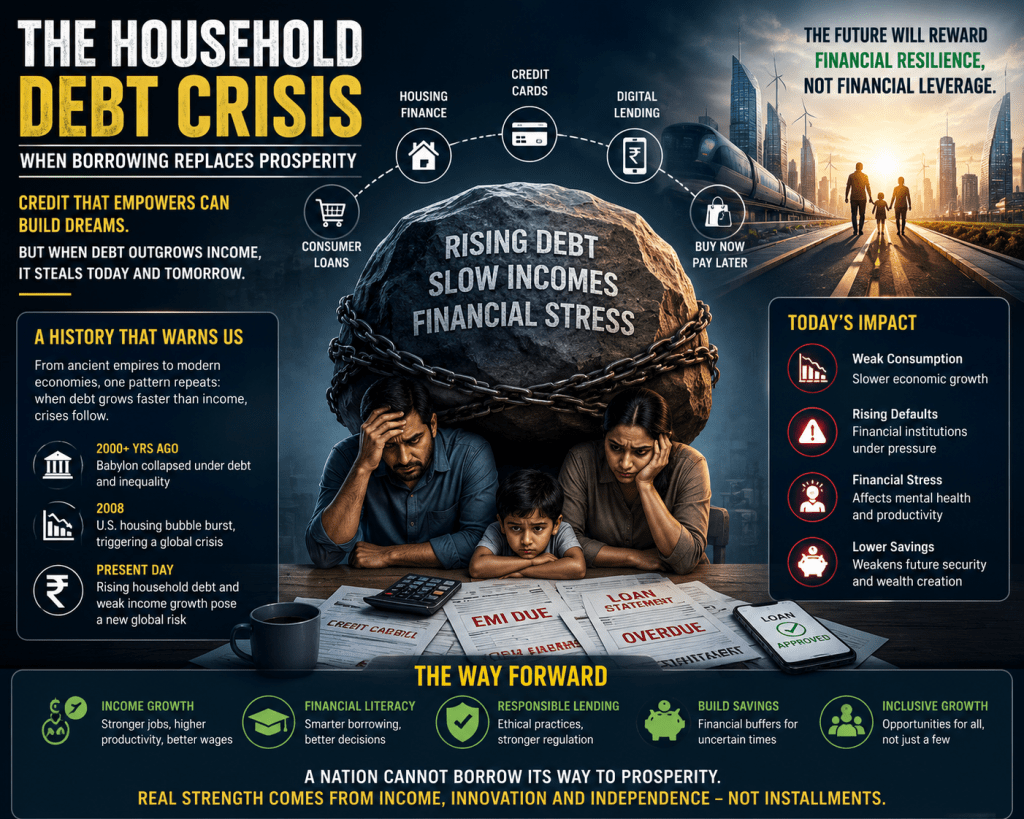
For generations, debt was seen as a bridge to a better future. Families borrowed to educate their children, buy a home, start a business, or overcome temporary financial difficulties. When supported by rising incomes and stable employment, borrowing strengthened economic mobility and helped societies build wealth. But history also teaches a different lesson. Every major financial crisis has carried a common warning: when debt grows faster than income, prosperity gradually turns into financial vulnerability. The Household Debt Crisis is not simply about families owing more money. It is about an economy where credit increasingly replaces genuine purchasing power.
The Illusion of Rising Prosperity
A growing economy naturally creates demand for housing finance, education loans, consumer credit, and business borrowing. These are signs of confidence when household incomes keep pace with repayments. The danger begins when consumption depends less on earnings and more on easy access to credit. In such situations, households may continue spending, giving the impression of a healthy economy, while their financial resilience quietly weakens. The economy appears strong on the surface, but beneath it lies a growing dependence on borrowed money rather than sustainable income growth.
India’s New Credit Economy
India is witnessing a remarkable expansion in consumer finance. Housing loans, vehicle finance, personal loans, credit cards, Buy Now Pay Later services, and app-based digital lending have made credit available to millions who previously had limited access to formal finance. This financial inclusion has supported demand and improved access to opportunities. However, it has also created a new challenge. For many middle-income households, monthly loan repayments now consume an increasing share of family income. A job loss, health emergency, or unexpected rise in living costs can quickly transform manageable debt into financial distress. As digital lending becomes faster and more convenient, financial decisions are often made within minutes, while the consequences may last for years.
The Hidden Cost of Living on Borrowed Money
When families allocate a large portion of their income to debt repayments, they gradually reduce spending on education, healthcare, nutrition, savings, and productive investments. Household consumption, which is one of the strongest engines of economic growth, begins to slow. Lower consumer demand affects businesses, discourages investment, and limits employment creation. The impact extends far beyond individual families. Rising household debt gradually becomes a macroeconomic challenge capable of weakening overall economic momentum.
The New Financial Divide
One of the less discussed consequences of rising household debt is its unequal impact. Wealthier households often use borrowing to acquire appreciating assets such as property or businesses that generate future income. Lower and middle-income families, however, increasingly borrow to finance everyday consumption, education expenses, medical bills, or emergency needs. While one group builds wealth through debt, another merely survives with it. This widening gap risks creating deeper financial inequality and reducing long-term social mobility.
Technology Has Made Credit Easier but Not Always Safer
Financial technology has transformed lending by making it faster, more accessible, and highly personalised. Artificial intelligence can approve loans within minutes, while digital platforms offer instant credit with minimal paperwork. These innovations have expanded financial inclusion, but they have also increased the temptation to borrow frequently without fully understanding repayment obligations. The future challenge is not the availability of credit itself, but ensuring that financial literacy, responsible lending, and consumer protection evolve at the same pace as technology.
The Future Will Reward Financial Resilience, Not Financial Leverage
Over the coming decades, successful economies may not be those with the highest levels of household borrowing, but those where rising incomes consistently outpace debt. Sustainable prosperity will increasingly depend on productive employment, higher wages, affordable housing, accessible healthcare, quality education, responsible financial regulation, and stronger household savings. Families with financial buffers will be better equipped to withstand economic shocks, while economies built on excessive consumer debt may become increasingly vulnerable to slowdowns and financial instability.
The Household Debt Crisis is therefore not simply a banking issue or a personal finance concern. It is a reflection of the broader relationship between economic growth, income distribution, financial innovation, and public policy. A nation cannot borrow its way to lasting prosperity. True economic strength emerges when households build wealth through rising productivity, secure employment, innovation, and savings rather than relying on expanding debt to maintain their standard of living. The real measure of economic progress is not how much people can borrow today, but how confidently they can build tomorrow without depending on loans for everyday survival.
#HouseholdDebt #ConsumerFinance #IndianEconomy #FinancialResilience #MSME #DigitalLending #EconomicGrowth #FinancialLiteracy #MiddleClass #FutureEconomy


Leave a Reply