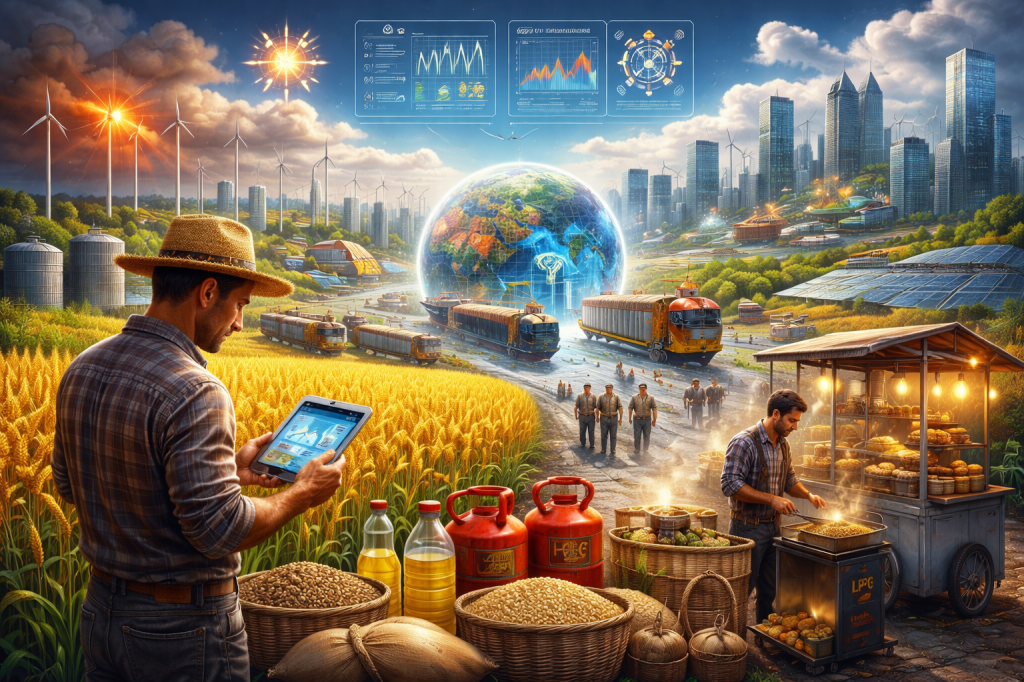
The traditional narrative of agriculture—centered on crop output, monsoon performance, and farm productivity—is undergoing a decisive transformation into a broader and far more complex food-systems story. Historically, agricultural economics was largely about land, labor, and yield, where the Green Revolution marked a turning point by stabilizing food grain production and insulating countries like India from famine-like vulnerabilities. However, in the current decade, the determinants of food security and price stability have expanded beyond the farm gate. Today, weather shocks, energy disruptions, logistics bottlenecks, and procurement inefficiencies are exerting as much influence on food outcomes as agricultural output itself. This shift signals a systemic transition where agriculture is no longer a standalone sector but part of an interconnected web involving energy markets, global trade, and urban consumption patterns.
Weather Volatility and the Fragility of Output Assumptions
The increasing unpredictability of weather patterns has fundamentally altered the reliability of agricultural forecasting. Wheat harvest uncertainty, for instance, is no longer just about acreage or input use but about temperature spikes during critical growth phases. Episodes of unseasonal heat waves in recent years have shown that even marginal deviations in climate conditions can lead to disproportionate output losses, thereby amplifying price volatility. Historically, agriculture adapted to cyclical climate risks, but the emerging reality is one of structural climate uncertainty. This undermines the very basis of procurement planning and buffer stock strategies, forcing policymakers to rethink traditional models that assumed relative climatic stability.
Edible Oils and the Globalization of Food Inflation
The case of edible oil inflation highlights how deeply integrated domestic food systems have become with global commodity markets. India’s heavy reliance on imports for edible oils exposes it to international price fluctuations, currency movements, and geopolitical disruptions. Unlike cereals, where domestic procurement provides some cushion, edible oils remain vulnerable to supply chain shocks originating thousands of miles away. This reflects a broader historical transition—from food self-sufficiency in staples to strategic dependence in key consumption items—raising critical questions about resilience and diversification in agricultural policy. In a globalized food economy, inflation is no longer a domestic phenomenon but a transmitted shock, often beyond immediate policy control.
Energy–Food Nexus: The Hidden Driver
One of the most underappreciated dimensions of the evolving food-systems narrative is the energy–food nexus. The spillover of commercial LPG shortages into food demand patterns and informal food businesses illustrates how energy disruptions can reshape consumption behavior. When commercial fuel becomes scarce or expensive, small food vendors and informal enterprises—critical providers of affordable meals in urban and peri-urban India—are forced to either raise prices or reduce operations. This, in turn, shifts demand back toward household cooking or alternative food sources, indirectly influencing food prices and nutritional outcomes. Historically, energy and agriculture were treated as separate policy domains; today, they are deeply intertwined, with energy costs embedded across the entire food value chain—from irrigation and transportation to processing and retail.
Procurement Frictions and Market Imperfections
Procurement systems, once designed to stabilize prices and ensure food security, are now facing new forms of friction. Delays in procurement, mismatches between minimum support prices and market realities, and logistical inefficiencies can distort supply signals and exacerbate price volatility. The wheat procurement cycle, for example, is increasingly sensitive not just to production levels but to timing, quality variations, and policy responsiveness. Historically, procurement acted as a buffer between farmers and markets; in the current context, it can sometimes become a bottleneck, reflecting the need for more agile, data-driven, and decentralized systems. The challenge lies in balancing state intervention with market efficiency in a rapidly evolving food ecosystem.
Informality, Livelihoods, and Food Access
The interplay between food systems and informal livelihoods adds another layer of complexity. Informal food businesses—street vendors, small eateries, and micro-enterprises—are both consumers and distributors within the food system. Disruptions in energy supply or input costs directly affect their viability, which in turn influences urban food accessibility, especially for lower-income populations. Historically, these informal networks have acted as shock absorbers, providing affordable and flexible food options. However, their vulnerability to systemic disruptions raises concerns about the resilience of food access mechanisms in an increasingly urbanized economy.
Toward Integrated Food-System Governance
Looking ahead, the transition from an agriculture-centric to a food-systems-centric paradigm demands a fundamental rethinking of policy frameworks. The future of food security will depend not only on increasing production but on managing interdependencies across climate, energy, trade, and urban systems. Data-driven forecasting, integrated supply chain management, and diversification of import dependencies will become critical. Moreover, resilience will need to be built at multiple levels—farm, market, and consumer—through investments in climate-smart agriculture, energy-efficient logistics, and robust informal sector support mechanisms.
The deeper challenge is philosophical as much as operational: moving from a siloed view of agriculture to a systems-thinking approach that recognizes the interconnected nature of modern economies. In this emerging paradigm, food is not merely an output of agriculture but the outcome of a complex, dynamic system shaped by forces far beyond the farm. The countries that successfully navigate this transition will not only secure their food futures but also redefine the very meaning of agricultural policy in the 21st century.
#FoodSystems #ClimateVolatility #WheatUncertainty #EdibleOilInflation #EnergyFoodNexus #LPGShortages #ProcurementFriction #SupplyChainShocks #InformalEconomy #FoodSecurity
 "Connecting communities, empowering nations: Unifying the Regional and Global Economy ."
Leave a comment