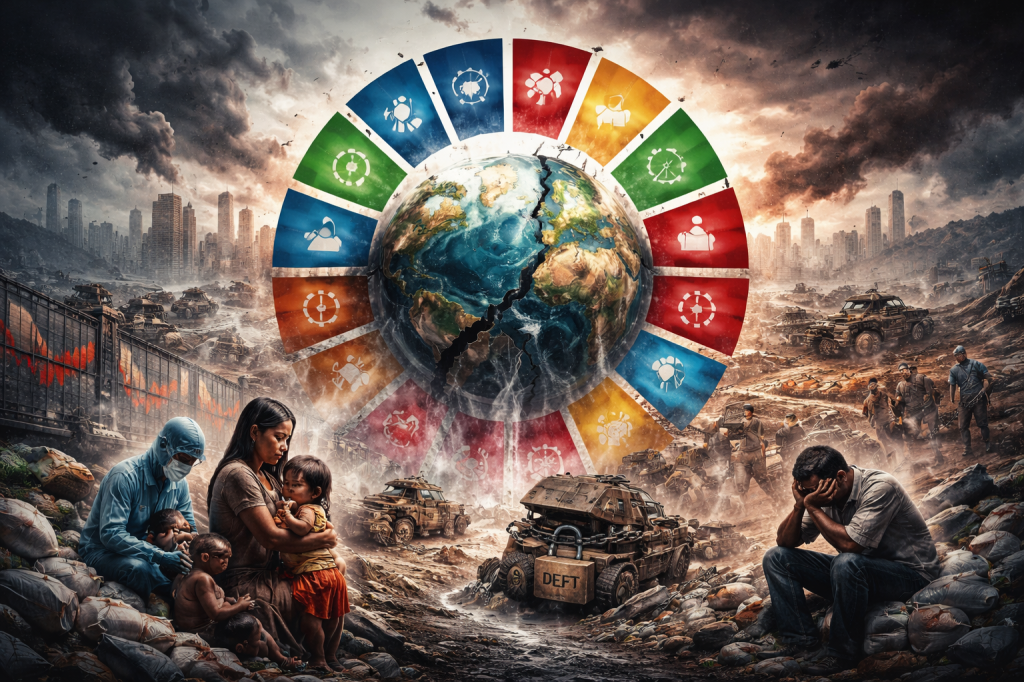
From Idealism to Uncertainty: The Evolution of the SDG Dream
When the global community, led by institutions like the United Nations, adopted the Sustainable Development Goals (SDGs) in 2015, it represented one of the most ambitious collective economic and social commitments in human history. Rooted in the optimism of post-globalization cooperation, SDGs aimed to eliminate poverty, ensure environmental sustainability, and promote inclusive growth by 2030. Historically, such grand development visions—from the Marshall Plan to the Millennium Development Goals—have succeeded when backed by geopolitical alignment and financial depth. However, the current decade is witnessing a fragmentation of that very consensus, turning the SDG vision into what can metaphorically be called a “White Whale”—visible, desirable, but increasingly elusive.
The Financing Faultline: When Aspirations Meet Fiscal Reality
At the core of the SDG crisis lies a widening financing gap. Estimates suggest that developing economies require trillions annually to stay on track, yet capital flows remain constrained. Rising global interest rates, tightening liquidity, and declining development aid have significantly reduced fiscal space. Many low- and middle-income countries are caught in a debt trap, where servicing external obligations consumes resources that could otherwise fund health, education, and infrastructure. The paradox is stark—while global wealth has expanded, its distribution and deployment toward developmental goals have weakened. This signals a structural flaw in global financial architecture, where risk perception overrides developmental necessity.
Debt Stress and the New Dependency Cycle
Debt stress is not merely an economic issue—it is reshaping sovereignty and policy autonomy. A growing number of countries are allocating over 30–40% of their revenues toward debt servicing, limiting their capacity to invest in long-term development. Historically, debt crises have led to structural adjustment programs, often imposing austerity measures that undermine social spending. Today, a similar pattern is emerging, but with more complex creditors, including private funds and non-traditional bilateral lenders. This creates a fragmented and opaque debt ecosystem, making resolution mechanisms slower and less effective. The risk is the emergence of a new dependency cycle, where development goals become secondary to financial survival.
Geopolitical Fragmentation: Development in a Divided World
The SDG agenda was built on the assumption of a cooperative global order. However, rising geopolitical tensions—trade wars, regional conflicts, and strategic decoupling—are disrupting supply chains, inflating costs, and diverting attention from development priorities. Major economies are increasingly focusing inward, prioritizing national resilience over global cooperation. This shift is evident in the reallocation of budgets toward defense and industrial policy rather than development assistance. In such a fragmented world, collective action problems intensify, making global goals like climate action and poverty eradication significantly harder to achieve.
Climate, Inequality, and the Compounding Crisis
Adding to the complexity is the intersection of climate change and inequality. Climate shocks are disproportionately affecting developing economies, eroding years of developmental gains. At the same time, inequality within and between nations is widening, reducing the effectiveness of growth as a tool for poverty reduction. The SDGs were designed as an integrated framework, but current realities are pushing countries into trade-offs—between growth and sustainability, between fiscal prudence and social welfare. This fragmentation of priorities weakens the holistic approach that the SDGs demand.
The Illusion of Progress: Data vs Ground Reality
While official reports often highlight incremental progress in select indicators, the broader picture reveals stagnation or regression in many goals. The pandemic alone reversed years of gains in poverty reduction and education. Moreover, data asymmetry and reporting inconsistencies create an illusion of progress, masking deeper structural issues. The risk is that the SDG narrative becomes more about compliance and reporting rather than genuine transformation.
A Futuristic Turning Point: Reinventing Development Paradigms
Looking ahead, the failure or success of the SDGs will depend on a fundamental rethinking of development paradigms. Traditional models based on aid, multilateral lending, and incremental reforms are proving insufficient. The future may require a shift toward decentralized, technology-driven, and locally anchored development models. Digital public infrastructure, green financing mechanisms, and innovative public-private partnerships could redefine how development is financed and implemented. However, these solutions require governance frameworks that are currently lagging behind technological advancements.
Beyond the White Whale—From Ambition to Adaptation
The Development Agenda 2030 is not just at risk—it is at a crossroads. The “White Whale” metaphor captures the growing gap between ambition and reality. Yet, history shows that crises often catalyze transformation. The challenge lies in moving from a universal but rigid framework to a more adaptive, context-specific approach. Without this shift, the SDGs may remain an aspirational benchmark rather than a transformative milestone. The real question is not whether we can achieve the SDGs as originally envisioned, but whether we are willing to redefine development itself in a rapidly changing world.
#SDGsCrisis #DevelopmentFinance #GlobalDebt #Geopolitics #ClimateInequality #FutureOfDevelopment #EconomicTransformation #PolicyShift #GlobalSouth #SustainableFuture
 "Connecting communities, empowering nations: Unifying the Regional and Global Economy ."
Leave a comment