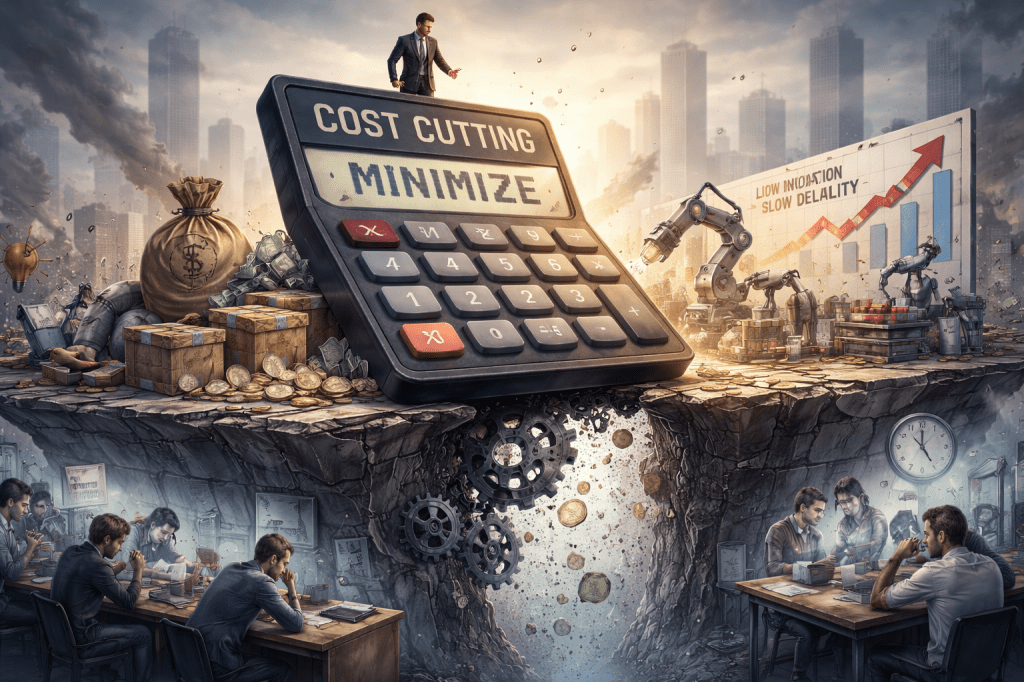
There was a time, particularly during the early industrial era and later under the influence of Taylorism and mass production systems, when cost minimization was seen as the ultimate expression of managerial efficiency. Firms that could produce cheaper were believed to dominate markets, and economies that could compress costs were expected to scale faster. This logic worked in relatively stable, supply-constrained environments where demand was predictable and competition was limited. However, as markets evolved—from Fordist standardization to post-globalization complexity—the narrow obsession with cost began revealing its structural weaknesses. The very models that once powered industrial expansion are now increasingly becoming liabilities in a world defined by volatility, innovation cycles, and shifting consumer expectations.
Cost vs Value: The Missing Equation in Economic Thinking
At its core, cost minimization assumes that reducing inputs without proportionately reducing output will enhance efficiency. But this assumption breaks down in real-world systems where inputs are not neutral—they shape quality, innovation, and brand perception. Cutting costs in production may simultaneously erode product reliability; reducing workforce expenses may weaken institutional knowledge; minimizing R&D may hollow out future competitiveness. The deeper flaw lies in ignoring the revenue side of the equation. Businesses do not succeed merely by spending less—they succeed by creating value that customers are willing to pay for. When cost becomes the central metric, value becomes incidental, and over time, this imbalance distorts the firm’s strategic direction.
The Dynamics of Markets: Why Static Models Collapse
Cost minimization models are inherently static, while markets are deeply dynamic. Prices fluctuate, consumer preferences evolve, supply chains face disruptions, and technological shifts constantly redefine cost structures themselves. A strategy built purely on cost efficiency often lacks the flexibility to respond to these changes. For instance, a firm optimized for lowest-cost production may struggle to pivot when demand shifts toward customization or sustainability. Similarly, global supply chain disruptions—whether due to geopolitical tensions or pandemics—expose the fragility of hyper-optimized, cost-driven systems. What appears efficient in a stable equilibrium becomes highly vulnerable under stress.
The Strategic Deadlock: Stuck Between Cost and Differentiation
Modern competitive strategy has long recognized that cost leadership without differentiation creates a dangerous middle ground. Firms attempting to compete solely on price often find themselves in a race to the bottom, where margins shrink and competitors easily replicate advantages. Without a distinctive value proposition, cost-based strategies lack defensibility. Over time, such firms face an erosion of brand identity, reduced customer loyalty, and heightened exposure to new entrants. In contrast, organizations that balance cost efficiency with innovation, design, or service quality are better positioned to sustain competitive advantage. The failure, therefore, is not in controlling costs—but in making cost control the strategy rather than a component of it.
Organizational Consequences: The Hidden Costs of Cutting Costs
One of the most underappreciated consequences of aggressive cost minimization is its impact on organizational health. Continuous cost-cutting often translates into workforce reductions, reduced investments in training, and increased pressure on employees. This creates a culture of short-termism, where survival replaces creativity and compliance replaces initiative. Over time, productivity may decline, not because of inefficiency, but because the system has stripped itself of resilience and motivation. Innovation—by its very nature uncertain and resource-intensive—is often the first casualty in such environments. The irony is stark: in trying to eliminate “waste,” organizations often eliminate their capacity to evolve.
Lessons from Failure: When Efficiency Backfires
Corporate history offers multiple instances where cost-centric strategies led to long-term setbacks. Firms that outsourced excessively to reduce costs later faced quality issues, supply disruptions, and reputational damage. Others that aggressively trimmed operational expenses found themselves unable to invest when new opportunities emerged. Even in technology sectors, repeated cost-reduction programs have often failed to deliver sustainable gains because they did not address structural inefficiencies or redesign business models. Instead, they created temporary improvements while leaving deeper issues unresolved. The pattern is consistent—cost cutting without strategic clarity leads to cyclical instability rather than lasting efficiency.
The Future of Strategy: From Cost Minimization to Value Optimization
Looking ahead, the next phase of economic and business thinking will likely move from cost minimization to value optimization. This shift recognizes that the objective is not to minimize cost per se, but to maximize the ratio of value created to resources used. In an era shaped by artificial intelligence, digital ecosystems, and sustainability imperatives, firms must integrate cost efficiency with innovation, adaptability, and stakeholder value. Resilient supply chains may not always be the cheapest, but they are more reliable. Sustainable production may involve higher upfront costs, but it secures long-term market access. Data-driven personalization may increase operational complexity, but it enhances customer engagement and revenue potential.
Redefining Efficiency in a Complex World
The failure of pure cost minimization models is not a rejection of efficiency—it is a redefinition of it. Efficiency in today’s world is multidimensional, encompassing not just cost, but also adaptability, innovation, and value creation. Firms and economies that continue to chase the lowest cost without understanding these broader dimensions risk becoming efficient at the wrong things. The future belongs to those who can manage trade-offs intelligently, invest in capabilities that generate long-term value, and recognize that the true measure of success is not how little you spend, but how effectively you create and sustain value in an uncertain world.
#CostMinimizationTrap #ValueCreation #StrategicFailure #DynamicMarkets #InnovationLoss #CompetitiveAdvantage #OperationalResilience #BusinessStrategy #LongTermValue #EconomicEfficiency
 "Connecting communities, empowering nations: Unifying the Regional and Global Economy ."
Leave a comment